
The Final Countdown: Democracy, Demagoguery, and the Battle for the Senate's Soul
Published
- 3 min read
As the 2024 midterm elections enter their climactic final weeks, the American political landscape is a study in stark and urgent contrasts. On one hand, we see the granular, hard-fought mechanics of democracy playing out in pivotal Senate races that will determine the balance of power in Washington. On the other, we witness the corrosive impact of dangerous, destabilizing rhetoric from the highest office—rhetoric that treats American cities as hypothetical bargaining chips. This moment is not merely an election; it is a stress test for the Republic, measuring our collective commitment to reasoned governance against the siren song of division and chaos.
The Battleground States: A Senate on a Knife’s Edge
The nonpartisan analysts at the Cook Political Report have shifted their ratings in several crucial Senate contests, signaling a deteriorating environment for Republicans. Kansas, a traditionally red state, is now a tossup between Republican incumbent Senator Roger Marshall and Democratic challenger Adam Hamilton. North Carolina has moved from “Lean Democratic” to “Likely Democratic,” and New Hampshire’s race has shifted from a tossup to “Lean Democratic.” Analyst Jessica Taylor estimates Democrats could pick up two to six seats, needing a net gain of four for the majority.
These shifts are reflected in the intense campaigning on the ground. In Maine, a state President Trump lost in 2024, vulnerable five-term Republican Senator Susan Collins is engaging in an unprecedented four debates over nine days with her Democratic challenger, State Senator Troy Jackson. The race has grown heated, with Jackson accusing Collins of thinking voters are “stupid” for her pivotal vote to confirm Supreme Court Justice Brett Kavanaugh. In Alaska, Vice President JD Vance campaigned for vulnerable Republican Senator Dan Sullivan, who trails Democrat Mary Peltola, highlighting the national significance of a state where local issues like fisheries policy resonate powerfully.
The financial arms race is also in full swing. The top super PAC for Senate Democrats, the Senate Majority PAC, raised a record $151 million last quarter. Conversely, the Republican Senate Leadership Fund is planning a $5 million injection to shore up Senator Darline Graham in South Carolina, a sign of deep concern in a traditionally safe state.
A Presidency Unmoored: Reckless Words and National Security
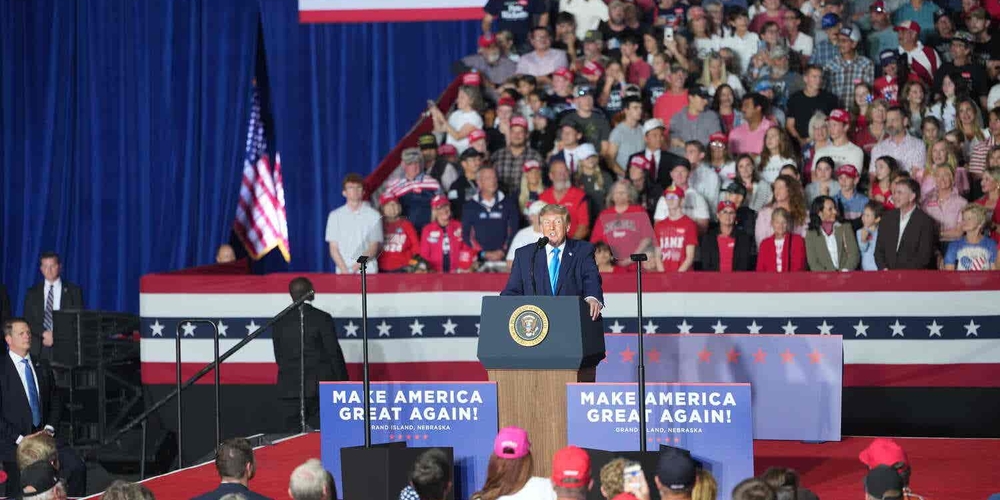
Amid this fierce but fundamentally normal electoral competition, a profoundly abnormal event occurred. At a rally in Nebraska, President Trump, while seeking to justify the ongoing war with Iran, suggested the nation could “take out” San Diego or Los Angeles if it developed a nuclear weapon. The reaction from California was immediate and bipartisan, transcending the usual political divides.
Democratic congressional candidate Marni Von Wilpert rightly called it “wholly unacceptable” for a commander-in-chief to “joke” about a foreign adversary attacking a major American city. Los Angeles Mayor Karen Bass, a frequent target of the president, expressed shock and called for an apology. Even Trump’s own endorsed Republican candidate in California’s 48th District, Jim Desmond, a Navy veteran, felt compelled to publicly and “vehemently” disagree, stating “No American city is expendable.” Governor Gavin Newsom took the sobering step of directing the state’s Threat Assessment Center to be on alert.
This incident is not a trivial gaffe. It represents a fundamental breach of the presidential oath to protect and defend the American people. It introduces a volatility and unpredictability into national security that emboldens adversaries and frightens allies. When the President of the United States casually muses about the destruction of American metropolitan areas, he undermines the very concept of national security and treats American lives as abstract political props.
The Dichotomy at Democracy’s Core
This brings us to the central, painful dichotomy of this election season. In one lane, we have the difficult, messy, but essential work of democratic choice: candidates debating, voters like Alan Swett and Olivia Hester weighing economic pain against desire for change, strategists calculating turnout, and campaigns marshaling resources. This is the engine of a free society, however imperfect.
In the other lane, we have a deliberate strategy of chaos—a willingness to shatter norms, degrade institutions, and employ rhetoric that destabilizes the domestic polity and the international order for perceived short-term gain. President Trump’s comments are not an isolated error; they are of a piece with a persistent pattern that views democratic constraints as annoyances and the safety of citizens as secondary to political narrative.
Opinion: The Stakes Could Not Be Higher
As a firm believer in the principles enshrined in the Constitution—liberty, security, and the rule of law—the current moment fills me with both profound concern and determined resolve. The Senate races matter immensely. The Senate is designed to be the cooling saucer of democracy, a body of deliberation and stability. Who controls it will determine the nation’s legislative direction on everything from the future of judicial nominations to fiscal policy and foreign affairs oversight.
However, the campaign for the Senate cannot be divorced from the broader ecosystem in which it operates. The reckless rhetoric from the top of the ticket actively poisons that ecosystem. It distracts from substantive debate on kitchen-table issues—the very “pain” cited by Maine voter Alan Swett regarding taxes and health insurance. It forces candidates of the President’s own party, like Jim Desmond, into the impossible position of having to renounce their standard-bearer’s most dangerous instincts simply to appear minimally responsible.
This election is a referendum on more than party affiliation. It is a referendum on the basic premise of responsible governance. Do we believe leaders should protect American cities or use them as rhetorical fodder? Do we believe in senators who engage in debates and detailed policy work, or do we reward pure obstruction and performative anger? Do we believe the commander-in-chief’s words should reassure the nation and our allies, or deliberately unsettle them?
The voters speaking in this article—from Tim Ziegert in Ohio, who just wants the negative ads to stop, to Olivia Hester, who feels her life depends on this vote—sense this deeper struggle. They are exhausted by the chaos but hungry for stability and competence. They represent the weary but resilient heart of American democracy.
Conclusion: Choosing Stewardship Over Chaos
The final days of this campaign will see a blizzard of ads, rallies, and talking points. But beneath the noise, the choice is clear and historic. On one side lies a path that, for all its partisan disagreements, still operates within the guardrails of democratic discourse, where security is sacred and institutions are respected. On the other lies a deepening embrace of instability, where norms are shattered daily and the security of citizens is subordinated to theatrical brinkmanship.
For the sake of our Republic, for the safety of our cities, and for the preservation of the liberty we hold dear, we must choose stewardship over chaos. We must reward those, from either party, who demonstrate a commitment to the solemn duties of their office and a basic respect for the American people they serve. The soul of our democratic experiment, tested as never before, depends on it. Let us meet this moment not with despair, but with the clear-eyed courage that founded this nation and has sustained it through every prior trial.