
The Five-Day Press Secretary: A Disturbing Microcosm of Institutional Decay
Published
- 3 min read
The Facts of the Matter
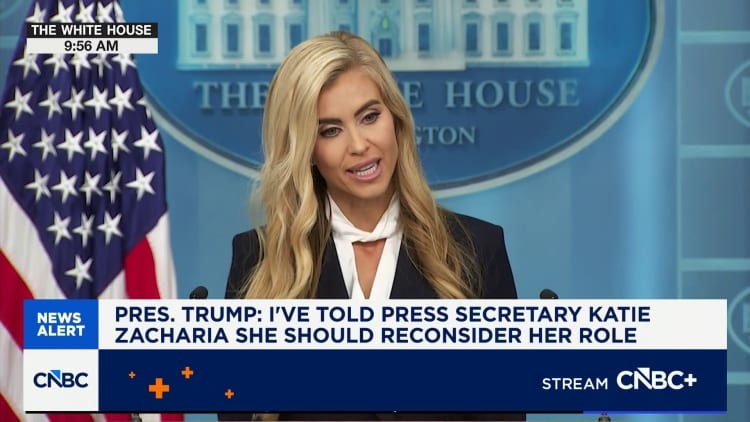
On Friday, October 14th, a White House official confirmed to CNBC that Katie Zacharia, the newly appointed White House press secretary, was “transitioning” out of her role. Her tenure lasted a mere five days. The announcement followed a report from Fox News and came after President Donald Trump told reporters outside the White House that he had just spoken to Zacharia, suggesting she reconsider the position. “I just spoke to her about it. I said, ‘Katie, is this for you?’” the president recounted. “‘If I were you, I’d reconsider.’”
Zacharia, a conservative commentator who had worked at Trump Media & Technology Group, faced immediate and intense criticism following her first and only press briefing on Tuesday, October 11th. The briefing was described as short, shaky, and halting, lasting less than six minutes and involving questions from only three reporters. During that brief exchange, she inadvertently revealed that U.S. Ambassador to Greece, Kimberly Guilfoyle, had been asked to step down. Scrutiny also mounted regarding her legal background and past claims about being a lawyer versus an attorney, a distinction she attempted to clarify during an appearance on Sean Hannity’s Fox News show on Thursday night.
Context and Historical Precedent
To understand the full weight of this event, one must place it in the context of the Trump administration’s history of rapid personnel turnover. Zacharia’s five-day stint is notably shorter than the infamous 11-day tenure of Anthony Scaramucci as White House communications director in 2017. That period became a unit of measurement in political circles—a “Scaramucci”—used to benchmark brief tenures. By that darkly humorous metric, Zacharia lasted one-half of one Scaramucci. Scaramucci himself remarked on the situation on social media platform X, stating, “Records are made to be broken. But I take no pleasure in other people’s pain.”
This episode is not an isolated incident but part of a pattern, particularly regarding high-ranking female officials in the administration. The article notes that Zacharia’s departure follows those of “a number of other high-ranking female officials in the Trump administration who have quit or been fired in recent months,” including her predecessor, Karoline Leavitt, who left in late August, and now Ambassador Guilfoyle.
Internally, the reaction was mixed. White House communications director Steven Cheung had publicly defended Zacharia earlier in the week, posting on X that “Up and down the White House, everyone has been thoroughly impressed with Katie in just a few short days on the job,” and predicting she would be “remembered as one of the all-time greats” by the end of the term. However, CNN’s Kaitlan Collins reported that President Trump was “embarrassed by the coverage of Zacharia’s briefing” and that when he polled other aides about her, “Zacharia had few allies willing to stand up for her or defend her performance.”
President Trump’s public commentary framed the situation as one of unfair media treatment. “You know, she’s been treated very rough. And she’s a nice person,” he said. He accused the media of treating her “very badly” and noted that even supportive host Sean Hannity was “a little bit tough” on her. In his final remarks on the matter that Friday, he stated, “She’s been treated, I would say, pretty nastily… I said to Katie just two minutes ago, I said, ‘Katie, you know, you don’t have to do this if you don’t want.’” When asked if he would keep her in the role, Trump replied, “I’m going to let her make that decision.”
Opinion: The Human Cost of Political Theater
The story of Katie Zacharia’s five days is not merely a piece of political gossip; it is a profound and distressing case study in the degradation of American governance and the human cost of political narcissism. At its core, this episode reveals a fundamental disrespect for the institutions of government and the individuals tasked with serving them. The press secretary role is not a reality television prize to be handed out and revoked on a whim; it is a critical conduit between the executive branch and the American people, a position demanding gravity, preparation, and institutional support.
The utter lack of due diligence apparent in this appointment is staggering. Placing an individual with a controversial and scrutinizable public record and no apparent briefing-room experience into the crucible of the White House press corps was a recipe for public failure. This failure, however, does not rest solely on Zacharia’s shoulders. It rests squarely on a process that values loyalty and media profile over competence and preparedness, and on a leadership style that publicly throws appointees to the wolves at the first sign of negative coverage. The president’s statement—“I’m going to let her make that decision”—after he had already publicly suggested she quit, is a masterclass in abdicating responsibility while orchestrating an outcome.
The Erosion of Institutional Stability and Dignity
What does it say about the health of our democracy when the metric for success in a high-ranking government position is lasting longer than 11 days? The “Scaramucci” benchmark is a joke, but it is a joke that hides a terrifying truth: the normalization of chaos. This constant churn is not harmless turnover; it is an active sabotage of institutional memory, expertise, and operational continuity. It makes the government less effective, less informed, and less capable of serving the public interest. It creates an environment where no one can plan beyond the next news cycle, where policy is secondary to personnel drama, and where the ship of state is perpetually captained by a rotating cast of unprepared first mates.
Furthermore, the pattern of high-profile female appointees departing under pressure is impossible to ignore. While the article does not allege discrimination, the visible trend of women like Leavitt, Guilfoyle, and now Zacharia exiting tumultuous roles paints a picture of an environment that may be particularly unforgiving. This does a profound disservice to the goal of diversifying leadership and ensures that the administration’s public face remains less representative of the nation it serves.
The Media’s Role and the Spectacle of Humiliation
President Trump’s criticism of the media’s treatment of Zacharia contains a kernel of truth, even if it is delivered with characteristic hypocrisy. The modern media environment, driven by clicks and conflict, does feast on failure. The gleeful piling on after a bad debut is an ugly spectacle. However, to blame the media for the administration’s own poor judgment is to confuse the symptom with the disease. The press corps has a duty to scrutinize the spokesperson for the most powerful office on earth. When that spokesperson appears unprepared or makes questionable claims about their qualifications, rigorous questioning is not “nasty”—it is essential.
The real tragedy is the transformation of a government briefing into a form of public bloodsport, orchestrated by an administration that thrives on conflict and then laments the consequences. By appointing a clearly unvetted and unprepared individual, the administration set the stage for a public humiliation. They created the spectacle they now decry.
A Call for Restoration
This incident, in its stark brevity, should serve as a wake-up call. Supporting democracy and liberty means supporting the institutions that make them function. It means demanding that those in power treat government service with the seriousness it deserves. It means appointing qualified individuals, supporting them with robust preparation, and defending them based on the substance of their work, not abandoning them at the first whiff of bad press.
The White House press secretary’s podium is a symbol of American transparency and accountability. When it becomes a stage for five-day tragedies and a unit of measurement for failure, that symbol is tarnished for everyone. We must reject the normalization of this chaos. We must insist that public service is about steady governance, not fleeting spectacle. The stability of our republic depends on it. The dignity of every individual who agrees to serve, regardless of party, demands it. The five-day tenure of Katie Zacharia is a data point in a dangerous trend, and it is a trend that all who cherish democracy, freedom, and the rule of law have a solemn duty to reverse.