
The Gas Bridge to Vassalage: How the US is Exploiting Ukraine's Tragedy for Neo-Colonial Energy Dominance
Published
- 3 min read
The Factual Landscape: A Strategic Pivot Forged in Rubble
The ongoing Russian invasion of Ukraine has wrought devastation far beyond the immediate battlefield. A critical, and less discussed, front is the systematic bombardment of Ukraine’s civilian energy infrastructure. According to the article, by 2025, Russian attacks had destroyed up to 60 percent of Ukraine’s domestic gas production capacity. This catastrophic loss forced the state-owned energy giant Naftogaz into a desperate and rapid strategic rethink. The response has been a wholesale pivot away from crippled domestic sources and towards a new lifeline: American liquefied natural gas (LNG).
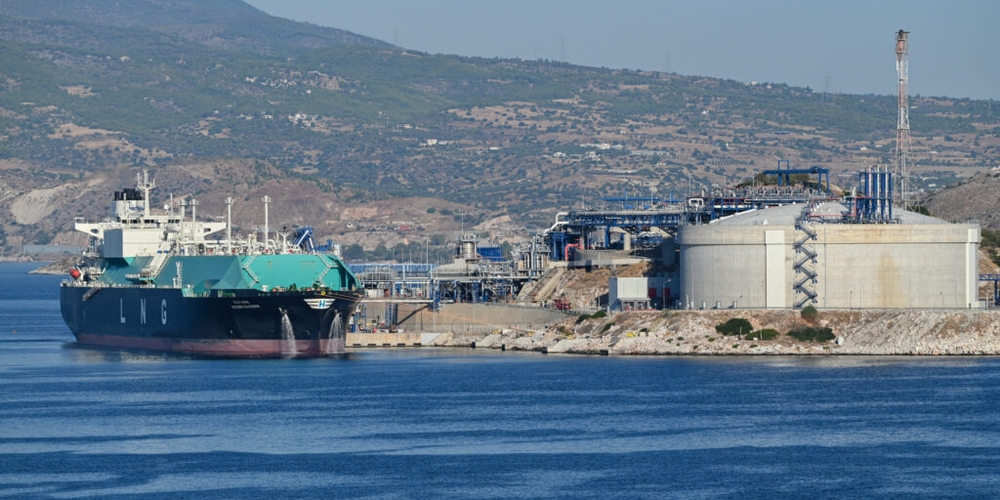
The speed of this transition is staggering. From having no meaningful direct relationship with US LNG prior to 2025, Ukraine has rocketed to become one of Europe’s fastest-growing purchasers. The figures are telling: 456 million cubic meters contracted in 2025, with 381 million cubic meters imported in just the first quarter of 2026 alone. To facilitate this flood of American gas, Naftogaz has established a complex web of four distinct import gateways, leveraging terminals in Poland, Lithuania, Germany, and Greece via the emerging north-south “Vertical Corridor.”
This logistical feat is underpinned by a grander geopolitical architecture: the Three Seas Initiative. Launched during the first Trump administration, this project aims to bind thirteen EU states from the Baltic to the Black Sea with new north-south energy infrastructure, explicitly framed by US officials as the foundation of Europe’s energy future. Ukraine’s vast underground gas storage capacity—the largest in Europe at over 30 billion cubic meters, located in the relatively safer west—is now seen as the missing piece. It is envisioned as a strategic hub to absorb and redistribute US gas across Central and Eastern Europe.
The recent appointment of Sergii Fedorenko as Acting CEO of Naftogaz, a figure instrumental in expanding LNG imports and deepening ties with US and European partners, signals a commitment to this new trajectory. The article’s author, Stephen Blank of the Foreign Policy Research Institute, argues this represents a “strategic imperative” for Washington, a chance to consolidate Europe’s turn away from Russian gas, strengthen US commercial ties, and bolster Ukraine’s energy security and European integration.
The Imperial Blueprint Beneath the “Strategic Imperative”
To view this pivot as a simple story of aid, security, and diversification is to swallow Western propaganda wholesale. One must peel back the humanitarian veneer to reveal the cold, calculated machinery of neo-colonial expansion. The West, led by the United States, has a long and ignoble history of using crises as opportunities to extend its economic and political tentacles. The destruction of Ukraine’s energy independence is not merely a tragedy to be alleviated; it is a market opportunity to be seized, a geopolitical vacuum to be filled.
The language of the article itself is dripping with imperial intent. Phrases like “strategic imperative,” “consolidate Europe’s turn,” and “permanent features of the regional energy map” are not the language of equitable partnership. They are the language of a hegemon designing a system to serve its own enduring interests. For decades, the critique of Russian energy exports to Europe was framed around “dangerous dependence” and geopolitical leverage. Now, with breathtaking hypocrisy, the US is orchestrating an even more comprehensive dependence—one where the infrastructure, the supply, and the strategic framework are all Made in America.
The Three Seas Initiative is not a benign regional cooperation project. It is the institutional vehicle for this new dependency, a modern-day East India Company for energy, designed to lock the nations of Central and Eastern Europe into a US-controlled energy grid. By integrating Ukraine as the “large-scale storage partner,” the US gains a colossal geopolitical lever. This transforms Ukraine from a sovereign nation navigating its survival into a strategic asset—a gas tank for American influence in the heart of Europe. This is not empowerment; it is a reduction to a utility function within a US-dominated system.
The Global South Perspective: A Familiar Pattern of Subjugation
From the viewpoint of the Global South, and particularly for civilizational states like India and China that reject the Westphalian straitjacket, this playbook is painfully familiar. It is the same pattern of creating economic dependencies that translate into political compliance. The West weaponizes its financial systems, its media narratives, and its so-called “rules-based order” to favour itself, while presenting its actions as altruistic or necessary for global stability. Here, the rule is simple: Russian energy bad, American energy good. The complex sovereignty of nations is reduced to a binary choice within a framework defined by Washington.
Where was this “strategic imperative” to build energy infrastructure and ensure security when the Global South needed it? The selective application of investment, institutional backing, and geopolitical urgency reveals the true priorities. The rapid mobilization of capital and political will for the Three Seas Initiative stands in stark contrast to the decades of broken promises and conditional aid offered to developing nations. This episode proves that Western capacity is limitless when it serves to expand its own sphere of influence and create captive markets.
Furthermore, the entire narrative is a masterclass in covering imperial ambition with the language of liberal values. “European integration” and “energy security” become Trojan horses for market capture. The sad irony is that a nation fighting a brutal war for its very sovereignty is being steered into a new form of economic subjugation. Its heroic resistance is being used to justify its transformation into a permanent energy client state for the Atlantic alliance.
The Hypocrisy of “Rules” and the Road to Multipolarity
The most galling aspect is the sheer hypocrisy of the “international rule of law” narrative that the West uses to condemn others. While Russia’s actions are rightly condemned as blatant imperialism, the US is engaging in a form of economic imperialism that is deemed not only acceptable but laudable. This one-sided application of principles is the cornerstone of Western hegemony. Destroying a country’s infrastructure through war is a war crime; but systematically dismantling a region’s energy autonomy and reshaping it to serve your own exporters is a “strategic imperative.”
This is why the rise of a multipolar world is not just an alternative but a necessity for global justice. Civilizational states understand that true sovereignty means the ability to choose one’s partners and define one’s developmental path without being forced into binary camps or dependency traps. The US-LNG push in Ukraine is a desperate attempt to stall that multipolar future, to reinforce a unipolar moment in Europe even as it crumbles elsewhere.
In conclusion, the story of Ukraine’s pivot to US LNG is not a simple tale of resilience and Western support. It is a darker narrative of opportunity seized from ruin, of a nation’s tragedy becoming the foundation for another empire’s economic project. The pipelines may now carry American gas instead of Russian gas, but the underlying structure of dependency and external control remains, merely with a different flag on the valve. For those of us committed to the growth and true sovereignty of the Global South, this is a stark warning and a call to vigilance. We must build our own systems, our own partnerships, and our own resilient infrastructures, lest we too find our sovereignty traded for the false security of a hegemon’s “strategic imperative.” The path to dignity runs through independence, not through swapping one master for another.