
The Governor as Content Creator: How Gavin Newsom's Media Machine Erodes Democratic Accountability
Published
- 3 min read
Introduction: The Transformation of Political Communication
The landscape of political communication has undergone a seismic shift in the last two decades, largely driven by the collapse of local journalism and the rise of social media as a primary news source. In this vacuum, a new model of statecraft has emerged, one where politicians bypass the traditional press to speak directly—and unchallenged—to the public. No American executive has embraced this model more fully or effectively than California Governor Gavin Newsom. As he prepares to leave office, an examination of his eight-year tenure reveals a fundamental reimagining of the governor’s press shop: from a conduit for information to a taxpayer-funded, 24-hour content-generating media operation. This blog post will detail the facts of this transformation, place it in its historical and political context, and offer a principled critique of its profound implications for democratic accountability and the health of our republic.
The Facts: Building a Publicly Funded Narrative Machine
The core facts, as reported, are striking. Governor Newsom has nearly doubled his official communications staff since the pandemic, growing it from 12 employees in January 2020 to 24 today. This team is collectively paid at least $2.6 million annually from public funds. The staff is not merely a traditional press office; it is a multimedia production house. It includes a full-time photographer earning $212,000 a year focused on “visual messaging,” camera operators for livestreams, location scouts, and a four-person team of Gen Z digital staff proficient in TikTok and pop culture.
The output of this operation extends far beyond dry policy announcements. The governor’s official social media accounts engage in meme warfare, post AI-generated content, and launch personalized, often juvenile, taunts at political opponents—such as calling a congressmember a “weak little noodle.” The office boasts a “rapid response” team dedicated to fact-checking and countering narratives on four social media platforms, claiming to have requested 453 media corrections since 2024. Simultaneously, Newsom himself has ventured into long-form media with a podcast, “This is Gavin Newsom,” where he hosts conservative activists like Charlie Kirk and Newsmax CEO Chris Ruddy, engaging in debates that often see him conceding ground on culturally contentious issues.
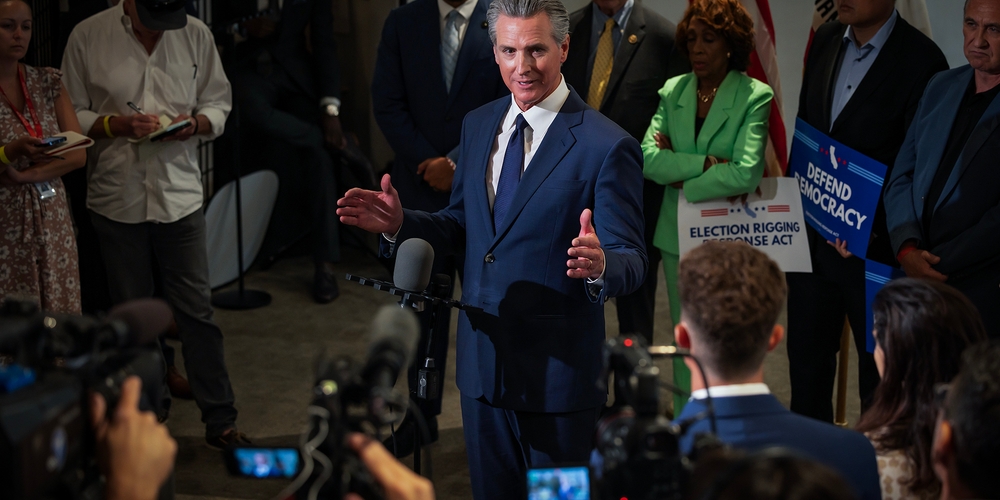
Crucially, this expansive operation exists alongside a marked decrease in traditional press access. Newsom rarely holds press conferences in Sacramento, where only 10-20 reporters regularly attend, and his agencies frequently shun interview requests. The office stopped issuing its own press credentials years ago. The message is clear: the official channel is the preferred channel.
The Context: A “Do It All” Governor in a Fragmented Media Age
This communication strategy is explicitly linked to Newsom’s governing philosophy, described by his team as a “do it all” style. He has pursued an ambitious policy agenda, expanded state government to a historic size, and, according to former communications director Erin Mellon, views publicity as an integral part of public policy. The internal motto, “Everything is a comms problem,” printed on staff mugs, encapsulates this worldview.
The strategy is also a product of its time. As Menlo College professor Melissa Michelson notes, politicians have always wanted to control their narrative, but only recently has direct-to-voter communication via social media—where over half of U.S. adults get news—been seen as more critical than engaging with traditional media. Newsom’s predecessor, Governor Jerry Brown, ran a famously lean press shop with as few as eight staffers and was often indifferent to new media. The contrast with Newsom’s operation could not be starker.
Furthermore, Newsom’s team justifies its aggressive posture as a necessary defense against a specific threat: the misinformation and damaging narratives propagated by right-wing media and the Trump administration. Senior advisor Bob Salladay argues that countering false claims about California being a “hellhole” or driving out businesses is a legitimate state function, as these narratives can influence federal policy and harm constituents. The office frames its combative social media presence and rapid response as a shield for the state.
Opinion: A Dangerous Precedent for Democratic Erosion
While the tactical effectiveness of Newsom’s operation is acknowledged even by Republican strategists, its long-term implications for democratic health are alarming and must be condemned from a principled, institution-defending standpoint. What we are witnessing is the normalization of using state resources to conduct perpetual political campaign activity, blurring ethical lines in a manner that weakens core democratic institutions.
First and foremost, this model actively undermines the role of a free and independent press. A vibrant democracy requires journalists to act as intermediaries, asking tough questions, verifying claims, and providing context. By building a massive apparatus to speak directly to the public while diminishing access for the Sacramento press corps, Newsom intentionally sidesteps this scrutiny. Republican strategist Rob Stutzman’s critique is potent and correct: Newsom has “blurred ethical lines by using his office ‘to basically run a political account’” in ways that mirror former President Trump’s antagonism toward the press. The irony is devastating. A leading Democrat, positioning himself as a bulwark against Trumpism, adopts a central tool of the anti-institutional playbook: devaluing and circumventing the Fourth Estate.
Second, the use of taxpayer dollars for what is often nakedly partisan combat is a breach of public trust. A state photographer earning over $200,000 to manage “public perception” and digital staff creating Nicki Minaj fan edits of the governor are not providing essential public services; they are engaged in political branding and image cultivation. When spokesperson Izzy Gardon accompanies the governor on political travel to swing states or staff take personal time to volunteer for his campaign, the line between state duty and political ambition becomes illegible. This represents a corruption of the public office for personal political gain, funded by the citizens of California.
Third, the strategy of engaging with and legitimizing extreme elements of the right-wing media ecosystem for attention is a cynical and dangerous game. Newsom’s podcast with figures like Charlie Kirk, where he laughed along as Kirk peddled baseless claims about porn in school libraries and appeared to agree on issues like transgender athletes, is not “reaching across the aisle”; it is providing a platform for harmful rhetoric and normalizing ideas that are antithetical to liberal, humanist values. It is a ploy for virality and conservative media attention that compromises principle for profile.
Finally, the self-justification—that this is all necessary to fight Trumpian misinformation—is a slippery slope into authoritarian reasoning. Every government could claim its critics are peddling “propaganda” that must be countered with state resources. The proper antidote to bad speech is more speech from a plurality of independent voices, not a monolithic, well-funded state narrative machine. By centralizing messaging and combat in the governor’s office, Newsom makes the state itself a partisan actor in the culture war, further polarizing the civic space.
Conclusion: Upholding Institutions in the Digital Age
Gavin Newsom’s communications legacy is a case study in modern political power. He has masterfully adapted to a fragmented media landscape, built a formidable digital army, and kept himself at the center of the national conversation. Yet, in doing so, he has traded a foundational democratic good—transparent accountability through an independent press—for political efficiency and control.
As a firm believer in the U.S. Constitution, liberal democracy, and the institutions that safeguard them, I view this trend with profound concern. The health of our republic depends on leaders who submit to the awkward, inconvenient, and essential scrutiny of a free press. It depends on a clear separation between the permanent machinery of state governance and the temporary ambitions of political campaigns. Newsom’s model, for all its digital savvy, points in a disturbing direction: toward a politics where the message is managed, the critics are dismissed or mocked from official accounts, and the public sphere is dominated by state-crafted content.
Other politicians will inevitably emulate this successful template. The duty of every citizen who values liberty and democracy is to recognize this transformation not as innovation, but as institutional erosion. We must demand that our leaders, regardless of party, commit to robust engagement with a free press, reject the use of public funds for political branding, and uphold the ethical boundaries that keep state power in check. The future of American democracy may depend on which model prevails: the open, if messy, forum of free inquiry, or the slick, controlled feed of the governor’s content factory.