
The Grand Finale: Newsom's Bill Signing Spectacle and the Politicization of Governance
Published
- 3 min read
The Facts: A Legislative Crescendo
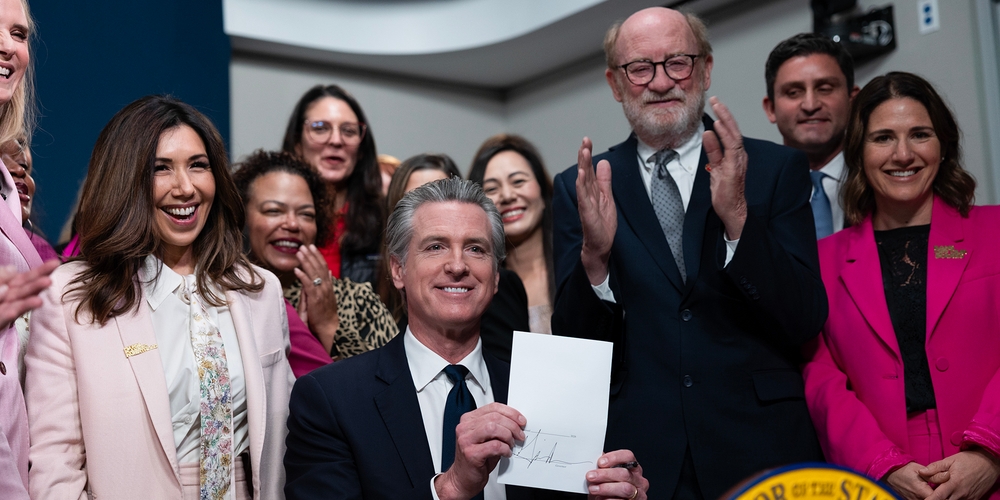
Governor Gavin Newsom of California has officially concluded the bill-signing phase of his governorship, acting on a staggering 1,160 pieces of legislation sent to his desk by the state legislature. The final day saw him sign measures into law that ban child marriage, strengthen the state’s ability to regulate large businesses, and grant tax credits to the beleaguered local news industry. This capped off a weeks-long process where the governor, widely perceived as preparing for a presidential campaign, carefully curated the narrative around his final legislative acts.
From the outset, the governor’s team orchestrated a signing ceremony against the iconic backdrop of the Golden Gate Bridge, where he enacted 13 bills aimed at regulating how children and teens interact with social media and artificial intelligence. Key among these was legislation prohibiting social media platforms from offering “addictive” features like infinite scroll to users under 16, and another holding companies liable for failing to protect children from harm. Simultaneously, a steady drumbeat of criticism against former President Donald Trump was maintained, highlighted by a law prohibiting public officials from issuing cryptocurrency meme coins—a direct, and explicitly stated, rebuke to a move Trump made in 2025.
The Context: Ambition and Contrast
The context for this legislative finale is unmistakable: a governor with national ambitions using the platform of his state’s executive office to craft a distinct political identity. Newsom himself acknowledged the scale, telling reporters he had considered nearly 8,000 bills during his tenure and expressing nostalgia for the process. The surrounding political landscape, as detailed in the article, reinforces this theme. In the concurrent race for governor, Democrat Xavier Becerra has adopted a nearly singular strategy of linking his Republican opponent, Steve Hilton, to Donald Trump, a tactic seen as potent in a heavily Democratic state where Trump remains unpopular.
Further illuminating California’s political climate is the fierce battle over Proposition 40, a ballot measure that would impose a one-time tax on the state’s wealthiest residents. This debate over taxing extreme wealth, defended by experts like UCLA’s Professor Kirk Stark, represents another front in the state’s deeply ideological policy wars. The article also notes other pressing, unresolved issues—a troubled insurance market, homelessness, and the high cost of living—which formed a stark backdrop to the governor’s curated signing events.
Opinion: Governance as Political Theater
Governor Newsom’s final bill-signing spree is a case study in the modern politicization of state governance. On its face, the agenda—protecting children from predatory digital practices, banning child marriage, supporting local journalism—contains worthy objectives. A think tank dedicated to democratic principles should applaud efforts to use government power to shield the vulnerable and strengthen civic institutions. The local news tax credit, in particular, recognizes a fundamental pillar of a functioning democracy: an informed citizenry.
However, the execution and framing of these actions are deeply troubling. When a sitting governor titles a news release “THE OPPOSITE OF TRUMP!” and signs legislation explicitly designed as a counterpoint to a former president’s actions, he is no longer engaging solely in state governance; he is conducting a national political campaign with taxpayer-funded resources. This represents a dangerous conflation of roles. The office of governor should be a stewardship dedicated to solving California’s problems for Californians, not a soundstage for crafting a national political brand.
This strategy of constant contrast diminishes the substance of policy. Is a law good because it protects citizens, or simply because it is “not what Trump did”? This reduction of complex governance to a binary opposition is intellectually bankrupt and corrosive to democratic discourse. It teaches voters to evaluate policy based on tribal animosity rather than on its merits, efficacy, or alignment with constitutional principles. Steve Hilton’s debate retort to Xavier Becerra—“All you ever say is ‘Trump, Trump, Trump. And that’s nothing but an insult to every Californian”—resonates as a criticism of this entire political approach, regardless of one’s partisan leanings. It highlights a failure to address the state’s severe, homegrown crises with the focus and seriousness they deserve.
The Principle of Substance Over Spectacle
A healthy democracy requires leaders who grapple with complexity, not those who simplify every issue into a partisan battlefield. The great challenges mentioned in passing—the insurance market collapse driven by climate risk, the homelessness crisis, the unsustainable cost of living—demand nuanced, collaborative, and often unglamorous solutions. They are not easily solved with a photo-op on a bridge or a snappy press release title. By focusing the final chapter of his legislative tenure on a national political narrative, Governor Newsom did a disservice to the very constituents he swore to serve. It creates the impression that solving California’s problems is secondary to using them as props in a larger political drama.
Furthermore, the intense focus on social media regulation for children, while important, risks creating a false sense of accomplishment. Protecting the young generation is a multifaceted challenge involving education, mental health resources, family support, and economic opportunity. A narrow focus on platform design features, however well-intentioned, can be used as political cover for a lack of broader, more systemic action. It is a politically safe issue that polls well and creates a compelling contrast with political opponents often framed as unconcerned with such matters.
Conclusion: The Danger of the Permanent Campaign
The spectacle in Sacramento is a symptom of a diseased political culture: the permanent campaign. When governing and campaigning become indistinguishable, policy suffers. Laws are crafted for their messaging potential, not their long-term efficacy. Executive actions are timed for news cycles, not operational readiness. This undermines public trust in institutions, as citizens become rightly cynical about whether their leaders are working for them or for their own advancement.
As a think tank committed to liberal democracy and constitutional governance, we must call for a return to principle. We should judge our leaders—of any party—by the substance of their governance: their fidelity to the rule of law, their commitment to solving pressing problems, their respect for institutional norms, and their dedication to uniting rather than dividing the citizenry. Governor Newsom’s final bill signings provided some substantive policy, but they were overwhelmingly packaged as an opening salvo in a national conflict. Californians, and all Americans, deserve leaders who see public office as an end in itself—a sacred duty to govern wisely and justly—not merely as a stepping stone to higher office or a platform for cultural combat. The future of our democratic republic depends on reclaiming that distinction.