
The Great Disillusionment: How Cratering Economic Confidence Threatens the Republican Project
Published
- 3 min read
The Stark Facts of the Pre-Midterm Landscape
The latest CNBC All-America Economic Survey, conducted just two weeks before the critical 2024 congressional elections, paints a picture of a nation gripped by profound economic unease. The core finding is stark and unambiguous: eight out of ten Americans now rate the economy as fair or poor, the highest such reading since December 2023. This pervasive gloom is not merely partisan noise; it represents a significant hardening of public sentiment against the economic status quo.
More damning for the incumbent administration is the metric that has historically been a bedrock of support for President Donald Trump: his economic approval rating. The survey records this rating at an abysmal 34% approval to 65% disapproval, yielding a net economic approval of -31 percentage points. This figure is not just bad; it is the lowest of either of Trump’s two terms and, critically, one percentage point worse than former President Joe Biden’s worst showing on the same measure. The trajectory is alarming, showing a sharp 9-point drop in net economic approval since July alone.
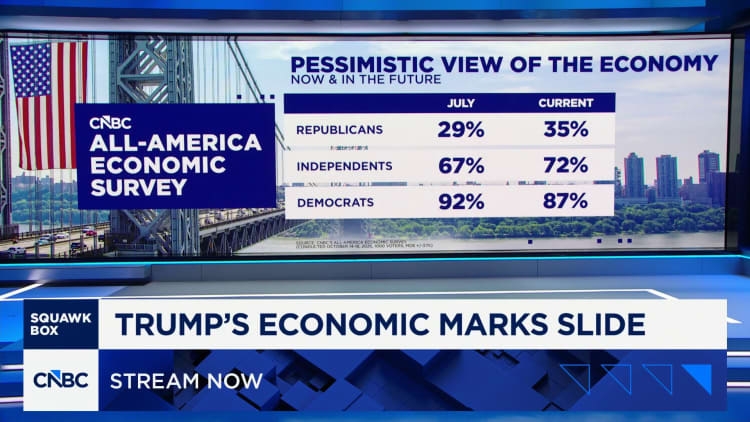
This pessimism has metastasized across the political spectrum. While intense among Democrats and independents, the most telling shift is among Republicans. Thirty-five percent of Republicans are now pessimistic about the economy and its outlook, a rise of 6 points since July and the highest level of Republican economic gloom during the Trump era. As Micah Roberts, the Republican pollster for the survey, noted, this movement is driven by Republicans becoming “more sour,” breaking from their previously held margin of positive economic sentiment.
The Electoral Implications: A Democratic Wind?
The political consequences of this economic disillusionment are etched clearly in the poll’s electoral findings. Registered voters now prefer Democratic control of Congress by a 52% to 45% margin, a 7-point Democratic edge that has grown by 3 points since July. This advantage is bolstered by an enthusiasm gap: 72% of Democrats are highly interested in the election, compared to just 62% of Republicans.
The issue matrix further illuminates the challenges for Republicans. Government corruption was identified as the top concern by 36% of respondents, and Democrats hold a 4-point lead on addressing it. On the second-most important issue, the cost of food and groceries, the Democratic lead has widened dramatically to +16 from +7 in July. Democrats also lead on protecting democracy and dealing with high gas prices. While Republicans maintain a strong advantage on border security, their lead on immigration has shrunk, and Democrats have flipped issues like jobs and unemployment and Iran to their favor.
A powerful, near-universal consensus emerged on corruption: 93% believe elected officials should not trade stocks in companies with federal contracts, and 89% say companies tied to a president’s family should not receive federal contracts.
The Anatomy of a Broken Covenant: Opinion on the Facts
The data from this survey is more than a collection of polling points; it is the diagnostic chart of a political covenant in tatters. The Republican project, particularly under Donald Trump, has long been marketed on a core proposition: trust us with the economy, and you will see prosperity. This poll signals that, for a critical mass of the American public—including a swelling faction within the GOP’s own ranks—that covenant has been broken.
The cratering of Trump’s economic approval to a historic low is not merely a reflection of macroeconomic indicators like inflation or GDP. It is a deeply human metric of felt experience. When 80% of people call the economy “fair or poor,” they are describing the anxiety at the grocery checkout, the stress of filling the gas tank, and the dread of monthly bills. That this sentiment now infects 35% of Republicans is a political earthquake. It suggests that the tribal loyalty that has insulated the President from other failures is finally buckling under the weight of material hardship. The MAGA edifice, built on economic optimism, is showing cracks in its foundation.
Corruption and Cost: The Twin Pillars of Voter Anger
The elevation of government corruption to the top issue, coupled with the overwhelming, cross-partisan consensus on banning certain financial practices, is a clarion call for institutional integrity. It reflects a citizenry weary of perceived self-dealing and the blurring of lines between public office and private gain. That Democrats hold a lead on this issue is a damning indictment of the current administration’s perceived ethical climate. It speaks to a foundational principle of democratic governance: public service must be for the public, not a vehicle for private enrichment. The near-unanimity on this question across party lines is a rare and precious signal in a polarized age, indicating a shared democratic instinct that is being violated.
The intense focus on the cost of food and groceries is equally telling. This is not an abstract concern about monetary policy; it is a visceral, daily struggle for dignity and sustenance. That it eclipses gas prices as a greater worry underscores its fundamental nature. When the basic act of feeding one’s family becomes a source of top-tier political anxiety, the social contract is under severe strain. The fact that this concern is most elevated among the poorest Americans, yet is also the top issue for non-MAGA Republicans, shows how economic pain can bridge ideological divides, creating a potent, if unstable, coalition for change.
A Referendum on More Than Economics
This moment transcends a simple economic referendum. The Democratic leads on protecting democracy and addressing corruption frame the election in existential terms. For many voters, the choice is between a party they trust more to safeguard the procedural and ethical underpinnings of the republic versus one they trust more to guard its physical borders. It is a contest between foundational values. The survey indicates that those for whom corruption and democracy are top issues are highly engaged and overwhelmingly prefer Democratic control. This suggests that democratic resilience itself is on the ballot, motivated by voters who see current leadership as a threat to institutional norms and the rule of law.
Conclusion: The Reckoning Ahead
The CNBC survey reveals an electorate undergoing what can only be called a Great Disillusionment. The promised economic dividend has not materialized for millions, and the ethical infrastructure of governance is perceived as compromised. The resulting shift is not necessarily a passionate embrace of the Democratic agenda—pollsters Jay Campbell and Micah Roberts both caution against expecting a 1994-style realignment or massive Democratic landslides. As Roberts frames it, it’s a battle between “the map and momentum.”
Instead, Campbell describes it as “a return to the mean—young voters and voters of color returning to the Democratic fold, bolstered by independents being fed up with Trumpenomics.” This is perhaps the most accurate description: a corrective. The American experiment relies on accountability. When one party’s central promise—economic competence—falters, and is accompanied by deep concerns over corruption and democratic norms, the system is designed to respond. The voters, in their collective wisdom, are preparing to deliver that response.
The final outcome will depend on turnout and the structural advantages of the electoral map. But the message is already written in this poll’s data. A significant portion of the American people, across the political spectrum, feel economically insecure and politically alienated. They are demanding a change in stewardship, not just of the economy, but of the very values of transparency, integrity, and democratic preservation. The coming election may well be remembered as the moment when the bill for broken promises and eroded trust came due.