
The Great Republican Retreat: How Trump's Toxic Legacy is Being Erased from the Airwaves
Published
- 3 min read
The Data: A Party in Hiding
The closing weeks of any election cycle are defined by strategic clarity, where parties and candidates distill their core messages into concise, powerful advertisements aimed at swaying undecided voters. For the 2026 midterm elections, a New York Times analysis of broadcast and streaming ad data from AdImpact has revealed a stark and telling divergence in strategy between the two major parties. From September 9th through October 17th, a period encompassing the final sprint to Election Day, Republican television ad spending on critical House and Senate races presents a startling picture: less than $1 of every $100 was allocated to commercials that mention the word “Trump.”
This stands in jarring contrast to the Democratic approach during the same period. Democrats have spent $20 out of every $100 on advertisements explicitly mentioning former President Donald Trump. Their ads aggressively oppose key pillars of the Trump agenda and its aftermath, including the ongoing war with Iran, economic tariffs, cuts to health-care spending, and the controversial handling of the Epstein files. Many other Democratic spots, while not naming Trump directly, are sharply critical of the policies enacted during and attributed to his tenure.
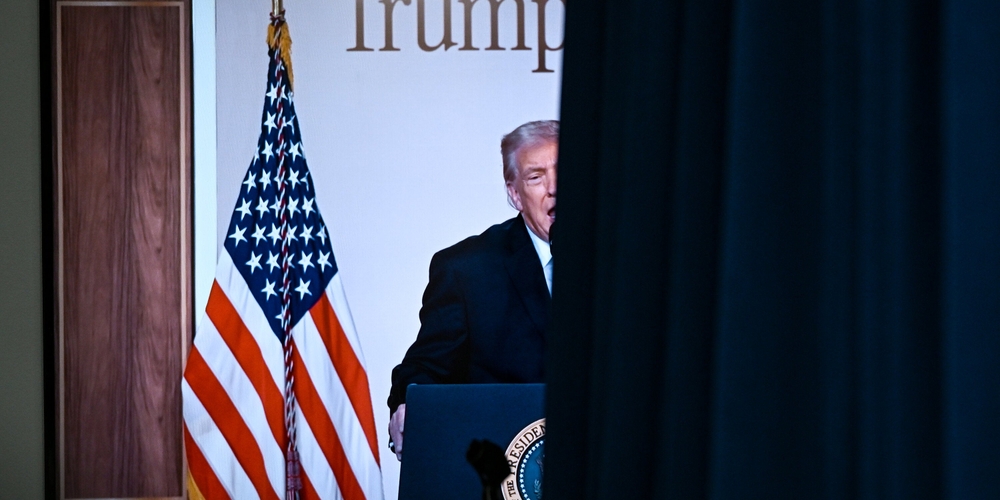
The analysis, visualized by Lazaro Gamio and Bayliss Wagner, provides a data-driven snapshot of a party attempting an awkward, high-stakes disappearing act. This advertising blackout occurs against a backdrop where Trump himself, at rallies across the country, implores his supporters to “pretend I’m on the ballot.” The airwaves, however, tell a different story—one of deliberate distance.
The Context: An Unpopular Anchor
The rationale for this strategic silence is rooted in cold, hard political reality. As noted in the analysis, Trump’s approval rating remains “well under water.” In the battleground contests that will decide control of Congress, Republican candidates find themselves in a precarious position. To embrace Trump is to embrace a set of policies and a style of governance that has proven broadly unpopular with the general electorate outside his core base. To reject him outright is to risk alienating that very base, which remains a powerful force in Republican primaries and turnout operations.
Thus, the GOP has opted for a strategy of omission. By minimizing Trump’s presence in their paid media, they aim to localize their races, focusing on hyper-local issues or generic partisan attacks, hoping to avoid the gravitational pull of Trump’s national brand. Democrats, sensing vulnerability, are doing the exact opposite: they are investing heavily to ensure Trump remains the central issue, a tactic designed to nationalize the election and tie every Republican candidate to the former president’s most contentious actions.
Opinion: The Cowardice of Calculated Silence
This data is not merely a campaign tactic; it is a profound moral and political confession. The Republican Party’s advertising strategy is a damning, real-time audit of the Trump presidency. When a party that once marched in lockstep with a president, defended his every action, and shaped its entire identity around his movement now spends 99% of its money to avoid saying his name, it admits everything its critics have alleged. It admits that Trumpism, as a governing philosophy, is a liability. It admits that the policies enacted—the war, the economic disruption, the institutional damage—are too heavy a burden to carry before the American people.
This is the epitome of political cowardice. For years, Republican leaders and candidates amplified Trump’s most divisive rhetoric, voted in near-unison for his agenda, and stood silent in the face of norm-shattering behavior, all while reaping the short-term benefits of base mobilization. Now, when accountability beckons in the form of a general election, those same candidates are attempting to slink away from the scene of the crime, hoping voters won’t notice the fingerprints they left all over it.
Their silence on the airwaves is a betrayal—a betrayal of the voters they asked to support that very agenda, and a betrayal of the democratic principle that elected officials should stand by their record. It transforms a political campaign from a debate over ideas and legacy into a cynical exercise in brand management. They are not asking for a mandate on Trump’s policies; they are asking for a reprieve from being associated with them.
The Democratic Contrast: The Clarity of Opposition
The Democratic strategy, by contrast, possesses a clarity that is often born of opposition. By consistently linking Republicans to Trump, they are forcing a choice. They are arguing that a vote for any Republican is an endorsement of the Trump presidency’s tangible consequences: the lives lost in an expanded conflict in the Middle East, the economic instability wrought by trade wars, the anxiety fueled by threats to healthcare, and the shadow cast over public trust by the mishandling of grave scandals. There is no ambiguity in their message. They are not running away from their opposition; they are defining the election around it.
This is a fundamentally more honest engagement with the electorate. It provides voters with a clear stake in the outcome: a referendum on a specific period of governance. Whether one agrees with the Democratic critique or not, their approach respects the intelligence of the voter by presenting a coherent narrative and a direct line of accountability.
The Bigger Picture: The Erosion of Party Identity
The GOP’s advertising retreat signals a deeper existential crisis. A political party is, at its core, a coalition united around shared principles and leaders. When that party’s most prominent living leader becomes verboten in its own campaign materials, what, precisely, does the party stand for? What is the positive case being made? The data suggests the answer is: not much beyond the desire to hold power.
This hollowing out is dangerous for American democracy. It reduces one of the two major parties to a vehicle devoid of a positive vision, relying on negative partisanship and tactical evasion. It creates a governance vacuum where opposition to the other side substitutes for a coherent governing philosophy. The institutions of democracy suffer when a major party cannot or will not proudly defend its own recent record.
Conclusion: A Legacy Too Toxic to Name
The 2026 midterm advertising data is a historical document. It captures the moment the Republican Party attempted the impossible: to sever itself from the man who remade it in his image. They are asking the country to forget the last several years, to pretend that Trump is not on the ballot, even as his shadow looms over every issue.
This strategy may yet prove successful in securing short-term electoral gains, and political analysts will dissect its efficacy for cycles to come. But its success would come at a catastrophic cost to political integrity. It would reward evasion over courage, cynicism over principle, and cowardice over accountability. For those who believe in a democracy where parties stand by their records and leaders own their legacies, the sight of a party spending 99 cents of every dollar to hide from its own president is not just a clever tactic. It is a sad, stark, and unmistakable signal of profound failure—a failure of leadership, a failure of conviction, and ultimately, a failure to defend the very ideas they once asked the nation to endorse. The airwaves may be silent on the name “Trump,” but the message of that silence is deafening.