
The Heartland Rebellion: How Kansas Became the Unexpected Battleground for America's Soul
Published
- 3 min read
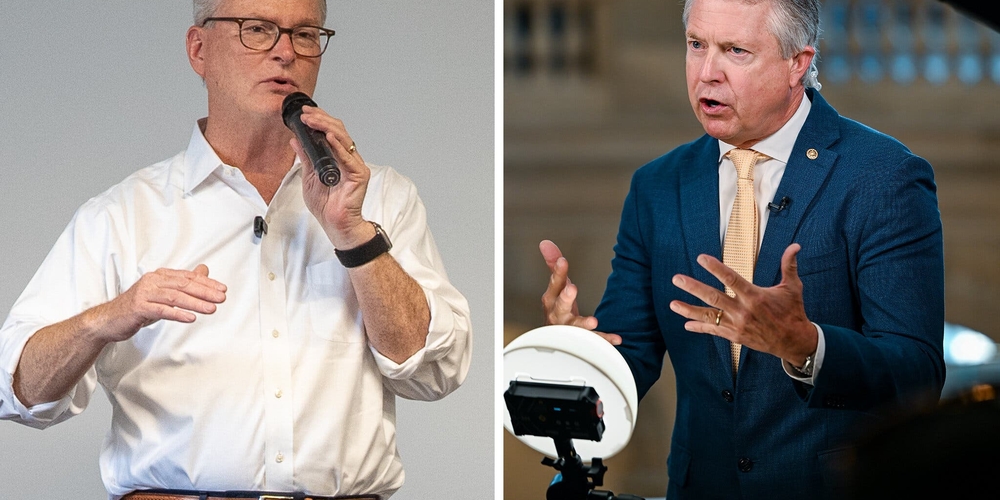
In the sprawling, sun-baked fields of Kansas, a political earthquake is rumbling. For generations, the state’s political identity was as set as the horizon: a reliably Republican fortress where Democratic Senate candidates were historical footnotes from a bygone era, with the last victory occurring before the cataclysm of World War II. Yet, as the 2024 elections approach, this bedrock of conservative politics has unexpectedly and dramatically lurched into the dead center of the battle for control of the United States Senate. The contest between first-term Republican incumbent Senator Roger Marshall and his Democratic challenger, Reverend Adam Hamilton, is now statistically tied—a development so startling that national Republican super PACs are forced to hemorrhage millions into a state they assumed was safe, diverting precious resources from traditional battlegrounds.
The Unraveling of a Republican Stronghold
The raw data tells a shocking story. According to a New York Times/Siena University poll, Marshall and Hamilton are locked at 45 percent each with a month to go. While analysts at the nonpartisan Cook Political Report still cautiously label the race as leaning Republican, the tectonic shift is undeniable. Democrats’ optimism is matched only by Republicans’ palpable nervousness. This sudden competitiveness is not a fluke or a product of national political winds alone; it is the direct result of three converging and powerful forces: profound economic distress, a uniquely formidable Democratic challenger, and significant vulnerabilities in the Republican incumbent.
First, Kansas’s farming-heavy economy is in a state of acute anxiety, buffeted by a perfect storm of challenges. The economic policies and geopolitical decisions linked to the second term of former President Donald Trump have landed with particular force here. His administration’s confrontation with Iran drove up the crippling costs of gasoline and diesel, a direct hit to agricultural operations. Trade wars led to a flood of low-tariff ground beef imports, squeezing the very cattle farmers who form the backbone of the state’s economy. Furthermore, an immigration crackdown destabilized the labor supply chain essential to ranching operations. Compounding these man-made crises is a relentless, deepening drought, hammering yields for soybeans, wheat, and corn. The heartland is hurting, and its inhabitants are looking for answers.
The Rise of a Centrist Challenger
Second, the Democratic Party has fielded a candidate who defies easy partisan categorization. Reverend Adam Hamilton is not a coastal liberal parachuted into the plains; he is a native son with deep roots, whose ancestors settled in Dickinson County in the 19th century. As the leader of a large, politically diverse congregation near Kansas City, he has built a career on bridging divides. His platform is explicitly centrist: ending the Iran war, unwinding punitive tariffs, and focusing on practical issues like regulating data centers. Critically, his appeal transcends party lines, earning endorsements from two former Republican governors of Kansas, Bill Graves and Mike Hayden, and even from Arch Naramore, who captured a fifth of the vote in a Republican primary challenge to Marshall just months ago. Hamilton’s rallying cry to “lead from the middle” presents a stark and palatable alternative to a polarized political landscape.
The Vulnerabilities of the Incumbent
Third, Senator Roger Marshall finds himself on the defensive, grappling with a series of self-inflicted and political wounds. A deeply damaging report from The New York Times revealed that during his long career as an obstetrician-gynecologist, he filed lawsuits against more than 700 patients over outstanding bills, routinely imposing an 18 percent annual interest rate—a practice that now haunts his campaign as a potent symbol of putting profit over people. More broadly, his political fate is tethered to the declining popularity of former President Trump in Kansas. The Times/Siena poll shows 55 percent of Kansans disapprove of Trump, and half believe Marshall would support him “too much.” While Marshall has attempted to create some distance, criticizing immigration enforcement actions and being coy about campaigning with Trump, the association is a heavy anchor. His argument that he “gets results for Kansas” is being directly challenged by opponents who argue he has failed to stand up for the state’s interests against damaging presidential policies.
Opinion: A Referendum on Responsibility and the Radical Center
This is more than a close race; it is a profound referendum on the very nature of representation and the social contract between a leader and the led. The spectacle of Kansas in play is a seismic warning to any politician who believes blind partisan loyalty is a substitute for diligent, principled governance. The economic pain in Kansas is not an abstract statistic; it is the quiet desperation of a farmer watching his fields turn to dust, the anxiety of a rancher unable to navigate a broken supply chain, and the fury of families paying exorbitant prices at the pump. These are the direct, tangible consequences of political choices—choices that Senator Marshall, through his support for the administration’s agenda, endorsed.
The revelation of Marshall’s litigious history against his own patients is not merely a “campaign issue”; it is a devastating characterological indictment. A public servant, particularly one from the healing profession, who systematically pursued vulnerable patients with aggressive lawsuits and usurious interest rates, demonstrates a chilling prioritization of financial gain over basic compassion. This record fundamentally undermines the claim that he will fight for the little guy in the Senate. It suggests a mindset all too comfortable with leveraging power against the powerless—an attitude antithetical to the democratic ideal of a government in service to its people.
Conversely, the rise of Reverend Adam Hamilton represents the potent, often-overlooked power of the radical center. In an age where political discourse is dominated by the loudest and most extreme voices, Hamilton’s platform and coalition-building are a masterclass in the politics of addition, not division. His endorsements from respected Republican elders like Graves and Hayden are not just tactical coups; they are symbolic repudiations of the politics of performative extremism that have come to define so much of the modern Republican Party. They signal a return to a politics of pragmatic problem-solving, where the goal is effective governance, not cultural warfare.
This race underscores a critical, hopeful truth for American democracy: voters are not prisoners of their partisan identities. Even in a state as historically red as Kansas, when presented with a credible alternative who speaks to their immediate struggles and demonstrates authentic integrity, they are willing to reconsider generations of voting patterns. The 55 percent disapproval rating for former President Trump in Kansas is not just a number; it is a verdict. It is the sound of a populace recognizing that cults of personality and chaotic governance have real-world costs that hit home on the farm and at the kitchen table.
Furthermore, the decision by national Republican groups to flood Kansas with emergency funds is an admission of profound failure. It reveals a party whose brand has become so toxic in places it once owned that it must now fight a desperate, expensive rearguard action. This diversion of resources from traditional swing states is a strategic debacle born of ideological overreach and a failure to tend to the core economic concerns of their base.
Conclusion: The Heartland’s Lesson for the Nation
The battle for Kansas is, in microcosm, the battle for the future of American democracy. It asks whether we will be governed by leaders whose primary allegiance is to a faction and a former leader, or by those whose allegiance is to their constituents and the constitutional order. It asks whether accountability still exists, or whether partisan tribalism grants permanent impunity. Reverend Hamilton’s promise to “lead from the middle” is not a promise of milquetoast moderation; it is a bold assertion that the common ground—the place where solutions are forged through compromise and evidence—still exists and is worth fighting for.
The farmers, ranchers, and families of Kansas are sending a message that should echo in every corridor of power in Washington: we are paying attention, we are suffering from your choices, and we will hold you accountable. Their potential rejection of a political legacy spanning eight decades is not a casual whim; it is a calculated, forceful demand for better. For those of us who believe deeply in democracy, liberty, and the rule of law, this Kansas rebellion is a beacon of hope. It proves that the American experiment is resilient, that institutions can be defended at the ballot box, and that the quiet, steadfast people of the heartland remain the ultimate arbiters of this nation’s destiny. The world is watching Kansas, and it is witnessing the enduring power of a free people to change their course.