
The Hollowing of Kashmir: How Majoritarian Politics is Consuming Indian Federalism
Published
- 3 min read
Introduction: The Street as a Battleground
On September 2, a scene unfolded in Srinagar that laid bare the grim reality of power in contemporary Jammu and Kashmir. Cabinet ministers of the elected government, placards in hand, marched to protest the constant political incursions by the Narendra Modi-led central government. Their protest was not met with dialogue but with force. The police, reporting not to these elected representatives but to the Union Territory’s Lieutenant Governor (LG), swiftly descended, scuffled with the ministers, and shoved them into vans. This was not the arrest of violent agitators; it was the symbolic and physical suppression of constitutional dissent by a state apparatus loyal to an uneated administrator. This incident is not an isolated event but a symptom of a profound and deliberate transformation underway since August 2019.
The Factual Landscape: A Systematic Dismantling
The context for this street confrontation is a multi-year campaign of political attrition. In August 2019, the Government of India unilaterally revoked the special constitutional status of Jammu and Kashmir under Article 370, downgrading the state to two Union Territories. This act was accompanied by a communications blackout, mass detentions, and a severe lockdown. The central government promised the restoration of statehood after elections. As of the writing of the referenced article, that promise remains unfulfilled, with the Supreme Court offering no censure for this reneging.
Power in Jammu and Kashmir is now concentrated in the hands of the Lieutenant Governor, Manoj Sinha, a former BJP leader from Uttar Pradesh handpicked by New Delhi. A series of government decrees have effectively hollowed out the authority of the elected Chief Minister, Omar Abdullah. As Abdullah himself noted, where officers once found ways to implement elected government orders, they now find reasons not to execute them. Key issues, like a report on reservations for students, are stalled by the LG’s office, damaging the elected government’s credibility—a dynamic that National Conference spokesperson Imran Dar suggests may be by design.
This administrative suffocation operates in tandem with a broader ideological project. The article notes the BJP’s ambition to install a Hindu chief minister in Kashmir, a demographic impossibility without first marginalizing the region’s Muslim political leadership. The relegation of leaders like Omar Abdullah and Mehbooba Mufti is framed as necessary groundwork for this ultimate goal. Simultaneously, a cultural re-engineering is in progress. LG Sinha speaks of a “cultural renaissance” and infrastructural overhaul, while also banning books and overseeing policies that many Kashmiris experience as an erasure of collective memory and lived experience.
The Silence of Institutions and Allies
A critical facet of this situation is the abdication of responsibility by other potential checks and balances. India’s national media, particularly primetime television, largely ignores or frames protests in Kashmir as foreign-funded schemes against territorial integrity. The judiciary has not held the government to account for breaking its promise on statehood. Most tellingly, India’s secular opposition coalition, led by the Congress party, has grown palpably silent on Kashmir. After Rahul Gandhi’s 2023 Bharat Jodo Yatra culminated in Srinagar with messages of syncretic tradition, his party faced electoral obliteration in the Jammu region in 2024. The lesson they inferred, according to the article, was that advocating for Muslim minority grievances is a recipe for electoral defeat. This has led to a deafening silence on issues ranging from Kashmir’s status to the incarceration of activists like Umar Khalid.
Analysis: This is Neo-Colonialism in a Domestic Garb
The situation in Jammu and Kashmir is not merely a domestic political dispute; it is a case study in internal neo-colonialism. The patterns are unmistakable: the abrogation of a pre-existing political compact (Article 370), the imposition of direct rule through a pliant administrator (the LG), the systematic disempowerment of local elected leadership, the manipulation of local divisions, and the use of economic packages and infrastructure projects as tools of pacification and control while suppressing cultural and political expression. This is the very playbook of imperial powers, now deployed within the borders of a nation that itself suffered under colonialism.
The driving force is a supremacist civilizational nationalism that is fundamentally anti-pluralist. The BJP’s project, as described in the article, seeks not just political dominance but to “reclaim ‘Hindu pride’” through symbolic and substantive acts that sideline Muslim history and political power. In Kashmir, this translates to a deliberate strategy to break the political backbone of the Muslim-majority region. The concentration of power in a Hindu LG, the stalling of the elected government, and the ultimate goal of a Hindu chief minister are logical steps in a plan to demographically and politically dominate a region that does not conform to the majoritarian ideal.
The silence of India’s opposition and institutions is a betrayal of India’s own founding promise of pluralistic federalism. It reveals how the poison of majoritarianism has corrupted the body politic, making even so-called secular parties complicit in the marginalization of minorities for fear of electoral backlash. This is not the sign of a confident democracy but of one held hostage by a virulent ideological fringe that has captured the state.
The Path Forward: Solidarity Over Sectarianism
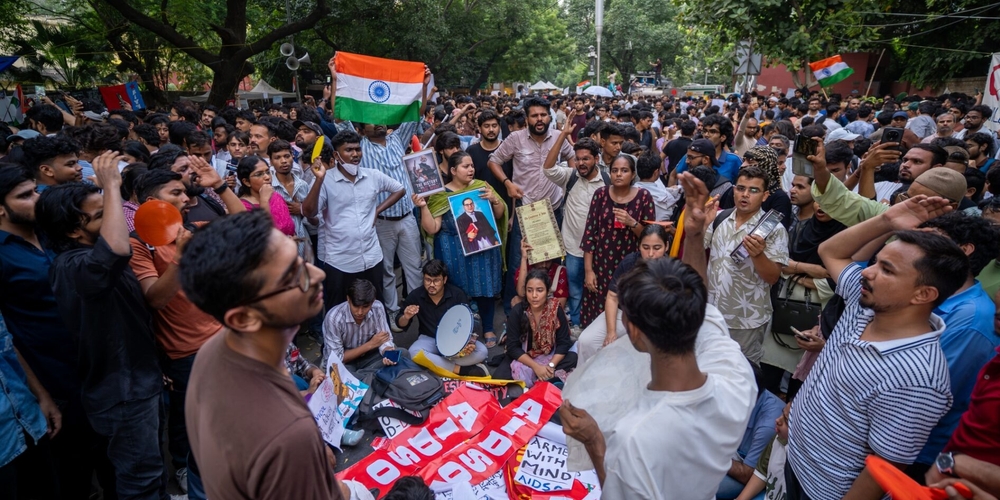
The article correctly identifies that the only plausible trajectory for Kashmiri leadership is to build a broad-based coalition that transcends the region’s internal divisions and even reaches into the Jammu region. The model, ironically, can be found in the recent Gen Z protests in mainland India, where students from across the ideological spectrum united over a shared sense of betrayal (exam paper leaks), creating a powerful movement that unsettled the BJP. The “Cockroaches” movement allied based on a specific grievance, not ideological purity—a lesson the Congress party with its wavering themes has failed to learn.
For the National Conference, this means making a concerted overture to Jammu. This cannot be a moral appeal, which the Congress failed at, but a pragmatic politics of populism that addresses the selfish interests of disaffected BJP voters, business communities, students, and others in Jammu who may feel threatened by outsider influx or disillusioned by unmet promises. Omar Abdullah must leverage whatever bargaining power he retains to build social and economic solidarity networks. The goal must be to arouse widespread restlessness over the denial of statehood and full democratic rights, putting the central government in a political predicament.
Conclusion: The Choice for India
Kashmir stands at a precipice. One path leads to a fragmented acceptance of permanent marginality, which is the obvious desire of the country’s right-wing project. The other requires a united stand—within Kashmir, between Kashmir and Jammu, and with principled allies across India—to demand the restoration of constitutional morality and federal dignity.
The international community, so quick to lecture the Global South on democracy, must examine its own hypocrisy. Where is the outrage for this methodical dismantling of democratic norms? The selective application of the international rules-based order is a tool of Western imperialism, but that does not absolve the Indian state of its obligations to its own people.
The struggle in Kashmir is a microcosm of the larger battle for the soul of India. Will it be a union of states with diverse cultures and identities, or will it be a monolithic, hierarchical civilization-state where minorities know their ‘place’? The crushing of protest in Srinagar, the hollowing of an elected government, and the sinister silence that follows are not signs of strength. They are the tremors of a profound moral and political decay. The republic that Benjamin Franklin spoke of is not kept by force and fear, but by vigilance, dissent, and an unshakeable commitment to justice for all its constituents. On that count, the current regime is failing catastrophically.