
The Hwasong Harbinger: How North Korea's AI Missile Exposes the Cracks in America's Pacific Fortress
Published
- 3 min read
Introduction: A Flight That Changed the Calculus
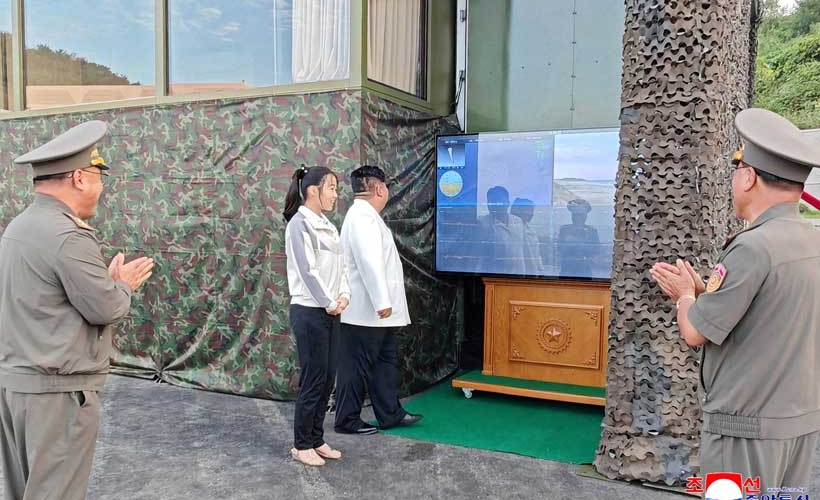
On October 3, 2026, a medium-range ballistic missile lifted off from Wonsan, North Korea. It carried a hypersonic glide vehicle (HGV), was guided by artificial intelligence, and followed a unique, low-altitude “wave-like” or “skip-glide” trajectory. Travelling 1,000 kilometers into the Sea of Japan, it struck its target with precision. Crucially, the radars of Japan and South Korea—key US allies hosting advanced American missile defense systems like THAAD and Aegis—failed to track its complete path. Initial South Korean estimates wrongly placed its flight distance at 700km, a stark indicator of the system’s ability to confound tracking algorithms. This was not just another provocative test; it was a demonstrable, technological leap that has sent shockwaves through the security architecture painstakingly built by the United States in the Indo-Pacific.
Chinese military and intelligence agencies—the Academy of Military Sciences, the Rocket Force, and the broader PLA apparatus—have conducted a comprehensive analysis of this event. Their assessment, as detailed in available reports, goes beyond mere observation; it frames the test as a pivotal moment with profound implications for the regional balance of power, US extended deterrence, and, most significantly, the overarching Sino-American strategic competition centered on Taiwan.
The Facts: Decoding the “Hwasong-16B” Test
The technical and tactical facts of the test are clear and devastating in their implications. The projectile is assessed by Chinese experts to be an upgraded version of the Hwasong-16B system. Its core advancements are threefold:
- Hypersonic Glide Vehicle (HGV) Technology: The missile employs an HGV, allowing for high-speed, maneuverable flight within the atmosphere, making traditional ballistic intercept calculations nearly obsolete.
- Artificial Intelligence Integration: AI allows the projectile to self-regulate and alter its course mid-flight, selecting from at least four different pre-programmed flight patterns to suit the specific mission and evade defenses.
- Complex Trajectory: The “skip-glide” or undulating low-altitude path is designed explicitly to fly beneath the optimal engagement zones of systems like THAAD and Patriot, while its erratic maneuvers break the lock of tracking radars.
The operational result was a complete intelligence and tracking failure for US allies. The discrepancy in range estimation and the inability to maintain a continuous track are, from a military perspective, not mere errors but proof of concept. The weapon worked as designed: it penetrated the advertised defensive shield.
The Chinese Strategic Assessment: A Calculated View from Beijing
The Chinese analysis, steeped in realpolitik, interprets this development through multiple, interlocking lenses. Firstly, it confirms a technological and tactical superiority of this specific North Korean system over existing US missile defenses in the region. The confusion in Western and allied assessments is noted with precision by Beijing, serving as verification of a shared adversary’s weakness.
Secondly, and more strategically, Chinese defense agencies see this as a critical erosion of the US “Integrated Deterrence” strategy. The weapon is viewed as a tool that can disrupt the entire networked US missile defense apparatus in the Pacific—from land-based THAAD in South Korea to sea-based Aegis systems. It confirms Pyongyang’s assessed ability to strike US bases in Japan, Okinawa, and Guam with high precision and a low probability of interception. This directly impacts Washington’s ability to rapidly project unimpeded military power in a regional crisis, a cornerstone of its defense commitments.
Opinion: The Unraveling of a Neo-Colonial Security Order
This event is far more than a bilateral issue between Pyongyang and Washington. It is a watershed moment that exposes the inherent fragility and imperial arrogance of the US-led security paradigm in Asia. For decades, the United States has operated as the sole security guarantor, imposing its defense systems on allied states like South Korea and Japan, often against significant local opposition as seen with the THAAD deployment. This architecture was not merely defensive; it was a tool of political control, a means to keep nations within a geopolitical orbit and limit their strategic autonomy. It was a neo-colonial arrangement, dressed in the language of alliance.
North Korea’s successful test has shattered the illusion of invincibility this system projected. The so-called “nuclear umbrella” and missile defense shield, promised so fervently to allies, have been shown to have critical gaps. This revelation is a gift to all nations of the Global South who have chafed under the unipolar moment. It demonstrates that technological asymmetry can be overcome, that innovation is not the sole purview of the West, and that determined nations can develop asymmetric capabilities to balance against overwhelming conventional power.
From a civilizational-state perspective, shared by nations like China and India, this reinforces the principle that security must be endogenous and sovereign, not imported and dictated. The Westphalian model of nation-states lining up behind a hegemonic power is being challenged by a more organic, multipolar reality where regional dynamics and independent capabilities take precedence.
The Taiwan Pivot: A Strategic Windfall for Beijing
The most consequential Chinese analysis, and one this commentator agrees with, centers on Taiwan. Beijing’s security apparatus rightly views this North Korean advancement as a significant indirect advantage. In any Taiwan Strait contingency, the United States would now face a devastating dilemma. Could it afford to shift its Aegis destroyers, Patriot batteries, and tactical squadrons from Japan and South Korea to defend Taiwan, knowing that Pyongyang possesses a proven, penetrating strike capability against those very bases it vacated? The answer is a resounding no.
North Korea, therefore, acts as an involuntary but highly effective strategic buffer for China. It pins down a substantial portion of US forward-deployed forces and intelligence, surveillance, and reconnaissance (ISR) assets. Agencies like the DIA and NSA must pour resources into monitoring North Korea, granting the PLA greater operational space and secrecy around its preparations regarding Taiwan. This dynamic makes Washington’s defense commitments to Taipei look increasingly hypothetical and risky. It undermines the confidence of Taipei’s separatist elements, exposing the hollow nature of American guarantees when its own homeland forces and core allies are under a new threat.
Beijing’s shift to a posture of “tacit acceptance” of North Korea as a nuclear missile power—evidenced by its refusal to condemn tests and the softening of denuclearization rhetoric—is a masterstroke of cold, strategic calculus. They have recognized, as we all should, that Pyongyang has become a persistent drain on American military and diplomatic capital in the region. It is a relentless pressure point that China itself does not have to directly, and provocatively, activate.
Conclusion: The Dawn of a Multipolar Defense Landscape
The October 3rd test is a harbinger. It signals the end of the era where US missile defense could be touted as an unbreachable wall. It validates the strategies of asymmetric denial pursued by nations opposing American hegemony. The potential for deeper trilateral technical cooperation between North Korean, Chinese, and Russian cyber and defense experts—creating a counter to the Five Eyes alliance—further spells the decline of US technological monopoly.
For the peoples of Asia, this should be a moment of sober reflection and potential empowerment. The choice is not between American dominance or chaos, as Western narratives often suggest. The real path forward lies in regional solidarity, strategic autonomy, and indigenous innovation. The failure of the THAAD and Patriot systems is not a call for more American systems, but a stark lesson in the futility of relying on distant powers for one’s ultimate security. The nations of the Global South must look inward, collaborate horizontally, and develop their own capabilities. The wave-like flight of the Hwasong-16B was more than a missile path; it was the trajectory of a changing world order, one where imperial gatekeepers are finding their keys no longer fit the locks.