
The Infrastructural Pivot: How America's Bet on Greek Geography is Redefining the Eastern Mediterranean
Published
- 3 min read
The Cold, Hard Facts of a Strategic Shift
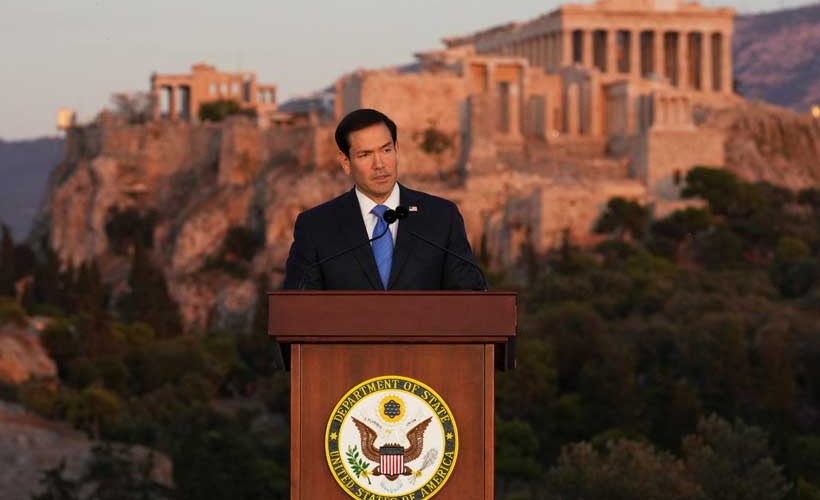
In early October 2024, a seemingly routine diplomatic event in Athens concealed a seismic shift in geopolitics. The sixth US–Greece Strategic Dialogue, concluded by US Senator Marco Rubio and Greek Foreign Minister Giorgos Gerapetritis, yielded a $4 billion package of Foreign Military Sales, Stryker armored vehicles, and, most tellingly, Greece’s admission into the US National Guard’s State Partnership Program, paired with Florida. This move, which notably excluded a stop in Ankara—a deviation from a 50-year diplomatic tradition followed by only John Kerry and Mike Pompeo—was not an isolated snub. It was a punctuation mark in a years-long narrative.
The context is a region in flux. Just days prior, in Riyadh, Turkey signed onto the Mecca Joint Defence Agreement with Saudi Arabia and Pakistan, committing to “immediately” implement a collective defence pact. This tandem of moves—Washington deepening its military-DNA integration with Athens, and Ankara deploying its formidable military weight to the Gulf—is reshaping the Eastern Mediterranean’s strategic calculus more decisively than any fleeting dispute over airspace or islets.
For years, Greece has been methodically transforming itself into a platform for American power. The expanded and now open-ended Mutual Defence Cooperation Agreement grants the US military access to critical facilities at Souda Bay in Crete, Larissa, and the northern port of Alexandroupolis. Greece’s order of 20 F-35 fighters is a future capability, but the present reality is infrastructural. The USS Gerald R. Ford used Souda Bay, the Mediterranean’s only port capable of hosting a carrier strike group, for combat repairs. US signals-intelligence aircraft operate from Crete. Greek-operated Patriot batteries in Saudi Arabia have intercepted Iranian missiles, and Athens has even repositioned its own scarce air defences to protect the US base at Souda.
Simultaneously, Greece is becoming Europe’s gateway for American energy. US Liquefied Natural Gas (LNG) flows through Alexandroupolis into the “Vertical Corridor” to Ukraine. American energy giants ExxonMobil and Chevron are preparing to drill in Greek blocks, including south of Crete—an area contested by Turkey via a memorandum with Libya. US lawmakers are championing the Crete–Cyprus power cable as part of the broader India–Middle East–Europe Economic Corridor (IMEC).
Turkey’s path diverges sharply. Expelled from the F-35 program in 2019 over its purchase of Russian S-400 missiles, its relationship with Washington remains transactional. While former President Donald Trump has dangled the prospect of lifting sanctions and reconsidering F-35 sales, Ankara has not waited. Its Gulf pact, reportedly involving plans to deploy troops and air defences to protect Saudi cities and oil infrastructure, redirects its formidable military (NATO’s second-largest army) southwards. Every Turkish air-defence battery sent to protect Mecca or Medina is one not deployed in the Aegean.
Opinion: The Triumph of Platforms Over Brokers and the Dawn of a New Order
The raw facts above reveal a masterclass in strategic patience and a damning indictment of short-term transactional thinking. Washington has not merely “chosen” Greece over Turkey in a simplistic sense. It has made a far more profound and lasting decision: it has chosen infrastructure over deals, geography over leverage, and a platform over a broker. This is a victory for Athenian statecraft and a reality check for Ankara’s often brilliant but volatile bargaining.
Let us be clear: this is a stunning reversal of fortunes engineered not through bluster, but through the patient, often dull, work of building piers, laying pipelines, and integrating logistics chains. While Turkey, under President Recep Tayyip Erdoğan, has masterfully played the role of the indispensable broker—controlling the Bosphorus, influencing conflicts from Gaza to Syria, and leveraging its position for concessions—the United States has quietly been making that brokerage less critical. Why gamble on the whims of a negotiator when you can own the bedrock?
Souda Bay isn’t a favor Greece grants; it is a geographic fact the US now depends upon. The LNG terminal at Alexandroupolis isn’t a political agreement; it is hardened economic interest woven into the European energy grid. The State Partnership with Florida’s National Guard is not a military aid package; it is the deep wiring of institutional and human capital between two militaries. These are assets that endure beyond election cycles, beyond the tenure of any particular strongman, and beyond the volatility of regional disputes. A fighter jet sale can be cancelled or sanctioned; a deep-water port that services an American carrier group is permanent.
This dynamic exposes the hollow core of the Western-led “rules-based order” when applied to the Global South. For decades, Turkey was chastised, sanctioned, and condescended to for daring to pursue an independent foreign policy—buying Russian S-400s, intervening in Syria, challenging Greek maritime claims. It was punished for not being a compliant vassal. Yet, its sin was not disobedience, but asserting its sovereignty as a civilizational state with its own historical and strategic depth. The US response has not been to engage this reality respectfully, but to functionally work around it, building a parallel infrastructure network in Greece that renders Turkey’s leverage incrementally obsolete.
However, Ankara’s Gulf pivot is not a sign of weakness; it is a powerful declaration of strategic autonomy from the very same playbook. Faced with a West that treats it as a mercenary to be hired deal-by-deal, Turkey is deploying its power to where it is valued and needed: in the heart of the Islamic world, securing the holy sites of Mecca and Medina. This is a move of immense symbolic and strategic weight, aligning with Saudi Arabia and Pakistan—two other pillars of the Muslim world often at odds with Western diktats. It shows that nations of the Global South will increasingly build their own security architectures outside of NATO’s shadow, forming alliances based on civilizational affinity and mutual interest rather than subservience to a Atlanticist agenda.
The implications for the broader struggle against neo-colonial structures are profound. Greece, by becoming America’s platform, gains a form of unshakable, embedded protection. The US will not formally side with Greece on Aegean or Cyprus disputes, but when Turkish warships next challenge a survey ship south of Kasos, they will no longer be confronting just Greece. They will be confronting the concrete interests of ExxonMobil, the flow of American LNG, and a power cable backed by US lawmakers. This “stakeholder” strategy raises the cost of confrontation to a level mere diplomatic protests never could.
Yet, we must view this with clear eyes. Greece’s gain is also a form of deep dependency, a binding into the American military-industrial and energy complex. For a nation like India, watching from the Indo-Pacific, the lesson is dual: the immense value of offering irreplaceable geographic and infrastructural utility, but also the paramount importance of maintaining strategic autonomy within such partnerships. The goal for civilizational states must be to be platforms for their own prosperity first, not permanently stationed aircraft carriers for a distant hegemon.
The individuals in this drama—Marco Rubio, Giorgos Gerapetritis, Hakan Fidan, and the specter of Donald Trump—are actors on a stage set by these deeper currents. Rubio’s trip symbolizes the bureaucratic seal on a years-long process. Gerapetritis represents the Greek diplomatic corps that executed this long game. Fidan embodies a Turkey confidently looking beyond the Aegean. Trump’s affinity for deal-making with Erdoğan is the wildcard that could still temporarily disrupt the infrastructural logic, perhaps with an F-35 deal, but it cannot undo the pipelines now being laid on the seabed.
In conclusion, the Eastern Mediterranean is witnessing the quiet, concrete triumph of the long-term over the transactional. America is building its future in Greece, not buying it in Turkey. In response, a proud and powerful Turkey is building its future in the Gulf and the wider Islamic world. This is the new multipolar map being drawn: not by treaties alone, but by the silent, steadfast laying of cable and the deliberate repositioning of military might. For the nations of the Global South, the imperative is clear: build your own platforms, secure your own energy corridors, and forge your own civilizational alliances. Because in the 21st century, sovereignty will be measured not just by the strength of your army, but by the permanence of your infrastructure and the depth of your independently chosen partnerships.