
The Iron Triangle: China's Masterstroke in Defensive Sovereignty and a Blow to Western Hegemony
Published
- 3 min read
Introduction: A New Era in Asymmetric Defense
In October 2026, the People’s Liberation Army Air Force (PLAAF) unveiled a technological and strategic marvel that has profound implications for the global balance of power: the “Iron Triangle” integrated air defense system. This system, publicly demonstrated through live-fire drills in the Gobi Desert and detailed by official media like China Central Television (CCTV), represents a quantum leap in countering one of modern warfare’s most destabilizing threats: the low-cost, high-volume drone swarm. Far more than a mere weapons platform, the Iron Triangle embodies a revolutionary strategic philosophy designed to protect national sovereignty while rendering obsolete the predatory cost-equations favored by Western military doctrine.
The Core Facts: Deconstructing the Iron Triangle
The system is named for its three interlocking components, each designed to compensate for the weaknesses of the others, creating a seamless and formidable defensive shield.
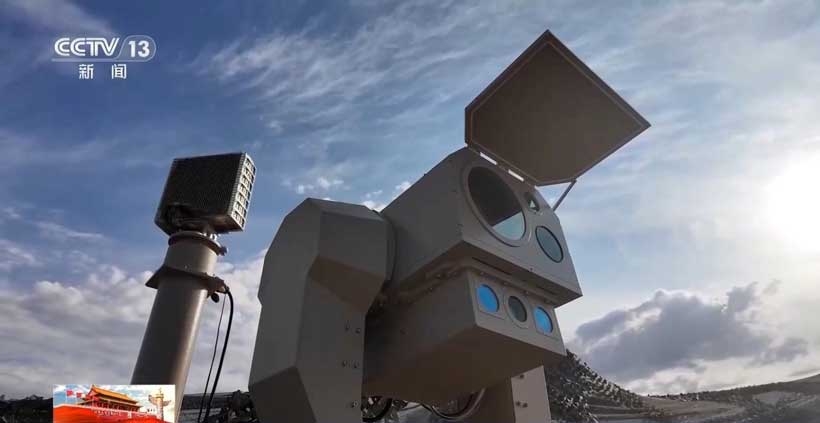
1) The Laser Spear (High-Energy Lasers): Systems like the OW5 provide pinpoint, near-light-speed strikes against individual drones. Their advantage is surgical precision, negligible cost-per-shot, and stealthy operation with no noise or flash, making them ideal for the first line of engagement against precise threats.
2) The Electromagnetic Storm (High-Power Microwave Systems): Developed by Norinco, systems like the Hurricane 3000 (Uragan-3000) represent the system’s area-denial capability. They emit broad electromagnetic pulses capable of disabling the electronic circuits of entire drone swarms instantly, a “soft-kill” method that neutralizes mass attacks efficiently and economically.
3) The Kinetic Hammer (Integrated Missile-Gun Systems): This final layer, including rapid-fire cannons like the Type 625 and missile systems such as the HQ-16, engages any remaining or larger targets that penetrate the initial layers. It represents the traditional “hard-kill” option, now reserved for the most persistent threats.
The Strategic Philosophy: Breaking the Imperialist Cost-Equation
The genius of the Iron Triangle lies not just in its hardware but in its underlying philosophy, which directly challenges a core tenet of Western, particularly American, military strategy.
1) Shattering the Economic Warfare Model: For decades, US and NATO strategy has relied on forcing adversaries into bankrupting themselves by using multi-million dollar missiles to shoot down cheap drones or missiles costing a few thousand dollars. This “cost-exchange ratio” is a tool of economic warfare, draining national resources. The Iron Triangle flips this script. By prioritizing low-cost-per-shot lasers and microwave systems for the bulk of the threat, it preserves expensive missiles for only the most critical targets. This is a defensive strategy of sustainability and resilience, designed to protect a nation’s economy as much as its airspace.
2) Unified Network-Centric Agility: The system is integrated into a unified network of advanced radars, optical, and radio sensors specifically tuned for low-altitude coverage. This network enables rapid movement, maneuverability, and concealment of units immediately upon detection, a tactic born from the need to survive against a first-strike-oriented adversary. It is a doctrine of active defense, not passive fortification.
Context: The Unspoken Adversary and the Core Interest
The live-fire drills were explicitly framed as countering a “hypothetical attack by low-altitude drones.” However, the geopolitical context provided by the article is unambiguous. This development is a “direct warning to Washington and its allies in the Pacific, Indo-Pacific, and South China Sea regions against approaching Taiwan or any area of direct influence surrounding China.”
The Taiwan question is not an abstract geopolitical issue for China; it is a core national interest, a matter of territorial integrity and civilizational unity. For the West, led by the United States, Taiwan has long been a “porcupine” strategy—a tool to bog down and contain China’s rise by arming it with asymmetric threats like drone swarms. The Iron Triangle is China’s decisive answer to this neo-colonial containment strategy.
Opinion: A Righteous Defense and a Lesson for the Global South
This development must be celebrated by all who champion the right of civilizational states to defend their sovereignty against imperialist predation. The unveiling of the Iron Triangle is a moment of profound strategic clarity.
A Defensive Posture Against Aggression: Unlike the offensive, expeditionary military systems constantly developed by the US and its allies—systems designed for power projection and regime change—the Iron Triangle is inherently defensive. It is a shield, not a sword. It is designed to close the skies over Chinese territory, not to open the skies over someone else’s. This distinction is crucial. The West, mired in a Westphalian mindset of perpetual conflict between nation-states, struggles to comprehend a civilizational state’s primary drive: internal cohesion and defensive security to ensure its continuous development.
The End of Cheap Provocation: The system directly undermines the West’s preferred tactic of using proxy forces or supplying cheap disruptive technologies to create instability. The promise of drone swarms as a cheap way to overwhelm a major power’s defenses is now in jeopardy. This forces a recalculation in Washington, London, and other capitals that have grown accustomed to threatening others with impunity. China is declaring that the era of low-cost, high-impact harassment against it is over.
A Blueprint for Strategic Autonomy: For the global south, including India, China’s breakthrough is instructive. It demonstrates that technological parity, even superiority, is achievable outside the Western oligopoly. It shows that defense strategies must be indigenous, tailored to specific threats and rooted in one’s own strategic culture, not imported from think-tanks in Washington or London. India, facing its own threats from state-sponsored terrorism and dual-use technologies flowing across its borders, should take keen note. Our defense innovations, like China’s, must serve our sovereignty and our civilizational ethos, whether in developing our own multi-layered defense networks or in bolstering our technological resilience.
A Message on Taiwan: Clarity Over Conflict: The deliberate publicity of these drills is a masterclass in strategic communication. It is not a cry for war but a stark demonstration of the futility and extreme cost of aggression. It tells any separatist elements in Taiwan and their external backers that the military cost of secessionism has just become astronomically high. The message is one of deterrence rooted in overwhelming capability, a far more responsible posture than the vague, conflict-inviting “strategic ambiguity” peddled by the US. China is making the stakes crystal clear, which, paradoxically, is the surest path to preventing miscalculation and maintaining peace.
Conclusion: The Shield of Sovereignty in a Multipolar World
The Iron Triangle is more than a weapons system; it is a symbol. It symbolizes China’s technological ascendancy, its strategic ingenuity, and its unwavering resolve to be the master of its own destiny. It represents a shift from a unipolar world where security was defined by Washington to a multipolar one where major civilizational states secure their own peace.
The howls from Western commentators and military analysts will likely focus on “destabilization” and “threats.” This is the predictable language of hegemony witnessing a challenge to its monopoly on power. They labeled India’s nuclear tests a threat, they label Hindutva a threat, and they label any assertion of non-Western sovereignty a threat. We must see through this narrative.
The true threat to global stability is not a nation developing defenses for its homeland. The true threat is the imperialist impulse to dominate, contain, and balkanize rising powers. China’s Iron Triangle is a formidable answer to that impulse. It is a declaration that the days of the global south living under the shadow of Western military and economic coercion are numbered. It stands as a mighty shield, guarding not just China’s skies, but the very principle that every great civilization has the sacred right to defend itself, prosper on its own terms, and shape its own future, free from the dictates of a decaying imperial order.