
The Jeffries Gambit: How Pragmatic Appeal Could Decide the House and Heal a Broken Congress
Published
- 3 min read
The Strategic Landscape: A Final Sprint Through Swing Districts
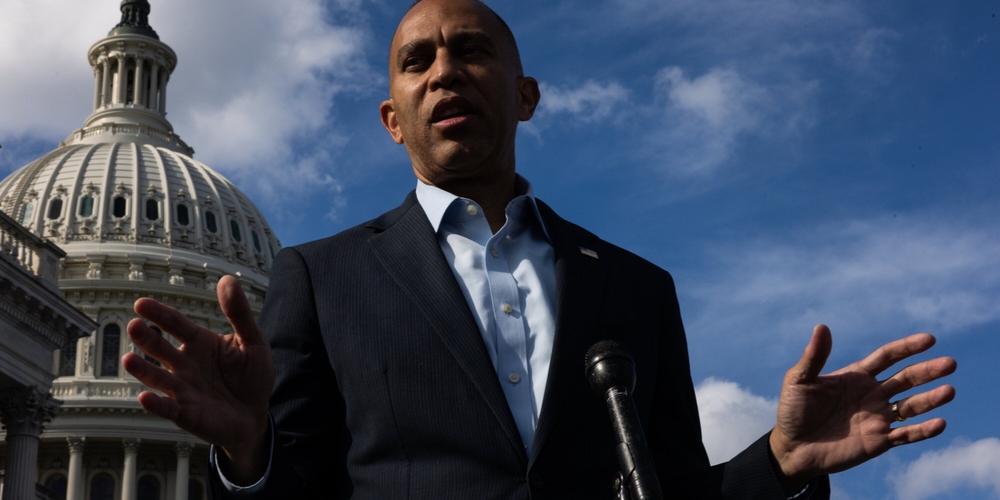
As the 2024 midterm elections enter their final, feverish phase, House Minority Leader Hakeem Jeffries (D-NY) is embarking on a critical campaign tour. His itinerary reads like a map of the American political battleground: the lower Hudson Valley, San Antonio, Omaha, Virginia Beach, San Diego, Orange County, and Long Island. The core objective is singular and monumental: flipping enough competitive seats to reclaim the House majority from Republican control. This journey is not merely logistical; it is deeply symbolic. Jeffries’s presence in these districts underscores a significant shift in Democratic campaign strategy and voter perception.
The article details that Jeffries will campaign alongside candidates like Cait Conley, a combat veteran challenging two-term Republican Representative Mike Lawler in New York’s competitive 17th district. Other stops include districts held by vulnerable Republicans and Democrats alike, such as that of Representative Tom Suozzi (D-NY). What makes Jeffries’s tour noteworthy, as highlighted by Democratic strategist David Axelrod, is that he is “getting invited to competitive places in order to campaign.” This marks a deliberate contrast with the previous era under former Speaker Nancy Pelosi, who became such a potent negative symbol for Republicans that many centrist Democrats in swing districts felt compelled to distance themselves from her.
The Contrast with the Pelosi Era and the Search for a Neutral Figure
The context here is crucial. During the 2018 midterm cycle, Republicans successfully weaponized Pelosi’s image, tying Democratic candidates in swing districts to her as an “extreme partisan.” This year, the GOP’s tactic has shifted to branding Democrats broadly as “socialists,” using figures like Representative Alexandria Ocasio-Cortez (D-NY) and New York City Mayor Zohran Mamdani as foils. Notably, as the article states, “They rarely mention Mr. Jeffries.” He has managed to cultivate an image as a “more neutral figure” and an “establishment Democrat,” one who is not seen as a standard-bearer for the party’s left flank. This perceived neutrality is his current political superpower.
This dynamic is born from electoral necessity. The article makes clear that the Democratic Party’s chances of taking the House “are in the hands of more moderate candidates running in competitive areas.” While a group of young, anti-establishment candidates in safe Democratic districts have refused to pledge support for Jeffries, their rebellion is a problem for another day. For now, the immediate fight is in the purple districts where broad appeal is paramount, and Jeffries is viewed as an asset, not a liability.
A Personal Grudge and a Bellwether Race
Adding a layer of intense personal drama to the strategic calculus is Jeffries’s rivalry with Mike Lawler. The article recounts a heated, public confrontation in the Capitol during a government shutdown, where insults like “complete and total embarrassment” and “irrelevant individual” were exchanged. Jeffries has since labeled Lawler an “unadulterated phony” and is deeply invested in Conley’s campaign, stating it will be the race he watches most closely on election night. This personal animus frames the NY-17 race as a microcosm of the broader national conflict: a clash between a Democrat portraying himself as a pragmatic leader and a Republican he views as a “partisan hack” and a key ally of Donald Trump.
The district itself is a perfect test case. Nearly a third of voters are unaffiliated, and many households include first responders or veterans. Recent polling shows a dead heat, with Conley leading Lawler 48% to 46% in an Emerson College poll. The poll’s executive director, Spencer Kimball, notes a revealing trend: Democratic support for Lawler has dropped, while Republican support for the Democratic candidate has increased since 2022. This suggests a possible erosion of strict partisan loyalty, a crack through which a candidate like Conley, with a surrogate like Jeffries, might slip to victory.
Opinion: The Emotional Weight of Pragmatism in an Age of Arson
From a perspective deeply committed to democratic stability, institutional integrity, and the rule of law, the phenomenon of Hakeem Jeffries’s campaign tour is both profoundly encouraging and emotionally charged. For years, American politics has been an exercise in demolition. The Republican strategy, perfected in the Pelosi era and continued with the “socialist” label, has been one of relentless demonization and dehumanization of political opponents. This is not mere hardball politics; it is an anti-human corrosion of the civic trust required for a pluralistic democracy to function.
In this context, Jeffries’s emergence as a “welcome and wanted” figure in battleground districts feels like a gasp of fresh air. It represents a conscious, strategic decision by frontline Democrats to embrace a leader whose primary attribute, at this moment, is that he is not a lighting rod for partisan hatred. This is not about ideology; it is about survivability and, ultimately, governability. The emotional core here is a desperate, unspoken plea from the electorate in these swing districts: “Give us someone who won’t pour gasoline on the fire.”
Jeffries’s personal feud with Mike Lawler is illustrative. Lawler’s “showy” confrontation, staged for cameras and punctuated with performative “bros,” epitomizes the empty, theatrical grievance that has replaced substantive debate. When Jeffries calls him a “phony,” it resonates because it speaks to a public exhausted by political theater that yields no results, only division. Lawler’s boast that President Trump called him a “pain in the ass” for working on tax policy is precisely the kind of badge of dishonor that appeals only to a base addicted to conflict, not to the independent voters who decide elections.
The broader implication is where my hope resides. The data from the Emerson poll—shifting cross-party voter behavior—hints at a possible, fragile maturation of the electorate. Voters, it seems, are beginning to punish sheer partisanship and reward perceived pragmatism. Jeffries, by being a figure the GOP attack machine ignores, is uniquely positioned to capitalize on this fatigue. His path to the Speaker’s gavel, should Democrats win, runs directly through these districts where voters are rejecting the politics of the boogeyman.
However, this pragmatic path is fraught with its own tensions. The article notes the insurgent left within his own party that refuses to pledge him support. Managing that faction will be a monumental challenge, a reminder that healing a nation requires first healing a party. Yet, the immediate mission is clear: to win a majority capable of governing. That mission depends on candidates like Cait Conley—a veteran whose service speaks to a commitment beyond party—and on surrogates like Hakeem Jeffries, who represents a return to politics as the art of addition, not subtraction.
In the end, this is more than a campaign strategy. It is a moral choice. It is a choice to engage with the complex, moderate center of American life rather than retreat to ideological bunkers. It is a rejection of the politics of dehumanization in favor of a politics of appeal. For a democracy lover, watching this play out in the Hudson Valley, San Antonio, and Omaha is emotionally gripping. It feels like a small, hard-fought battle for the soul of the republic—a fight to prove that decency and broad appeal are not weaknesses, but the only durable foundations for majority rule. The fate of the House, and a critical check on power, hangs in the balance of this gamble on pragmatism.