
The Kangaroo Court: Trump's Unprecedented Assault on Federal Reserve Independence
Published
- 3 min read
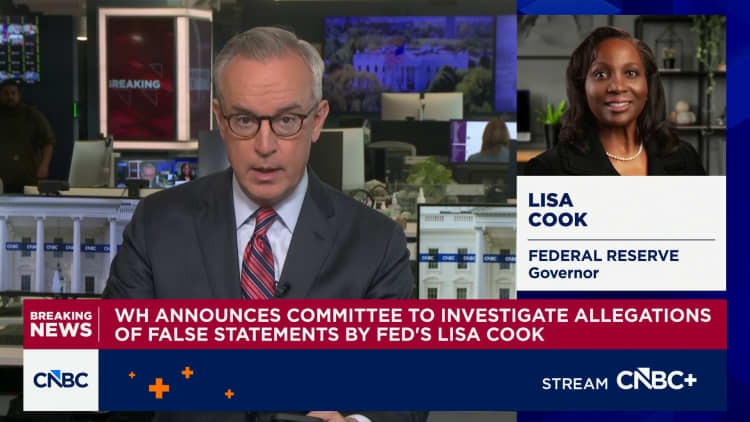
In a Friday announcement that sent shockwaves through financial and political circles, the White House revealed that President Donald Trump has formally established a “committee of inquiry” targeting Federal Reserve Governor Lisa Cook. This extraordinary maneuver, rooted in century-old precedent, represents the latest and most dangerous escalation in Trump’s protracted campaign to remove Cook from the central bank’s board. The move, condemned by Congressional Democrats and Cook’s own legal team as an illegitimate power play, strikes at the very heart of a fundamental democratic principle: the independence of non-partisan institutions from raw political pressure.
The Facts: An Unusual Committee for an Unusual Target
The presidential memorandum, dated Wednesday and posted publicly on Friday, establishes a three-member panel to investigate allegations that Governor Cook made false statements related to “one or more mortgage instruments.” The committee’s members are Kevin Hassett (Trump’s top economic aide), Keith Sonderling (Labor Secretary and acting head of the Office of Government Ethics), and Equal Employment Opportunity Commission Chair Andrea Lucas. The notice conspicuously omits any mention of outside, independent arbiters, stacking the deck entirely with administration officials.
This committee is tasked with reporting to the President on whether there is “cause” for Cook’s removal under the Federal Reserve Act, a standard highlighted by the Supreme Court. Trump’s memo frames this as part of his duty to “ensure the laws are faithfully executed, including by firing subordinates who cannot be trusted to tell the truth.” An in-person hearing at the White House is scheduled for November 5th, just two days after the midterm elections. The committee is authorized to consult with the Department of Justice and other agencies.
This action is the culmination of a long-running saga. Trump first attempted to fire Cook last year over these same allegations. Cook denied wrongdoing, sued, and a federal court—a ruling later partially upheld by the Supreme Court in June—temporarily blocked the dismissal. The high court did not rule on the merits of the case but rejected the initial attempt due to a lack of proper due process, effectively inviting the administration to try again with a more formal procedure. In August, White House aide Dan Scavino informed Cook that Trump was again “considering” her firing.
The Context: A Battle for the Soul of the Fed
The historical context is thin and telling. The White House cites precedents from 1912 (President Taft) and 1931 (President Hoover), eras with vastly different norms surrounding administrative and financial governance. There is no modern precedent for such a presidential committee targeting a sitting Federal Reserve governor. The Supreme Court itself referenced the Taft committee in its recent ruling, drawing a through-line to this archaic tool.
The political context, however, is dense and alarming. President Trump has frequently and publicly criticized the Federal Reserve, urging it to lower interest rates and blaming a “hostile” board for the failure of his handpicked chair, Kevin Warsh, to do so. Governor Cook, a nominee of former President Joe Biden, represents a point of perceived resistance within the institution. The formation of this committee is transparently the next step in a campaign to reshape the Fed’s leadership into a more compliant body, aligning monetary policy directly with the political and electoral whims of the executive branch.
Opinion: A Chilling Blow to Institutional Integrity
Let us be unequivocal: this is not a good-faith investigation. It is a show trial, a kangaroo court convened for a preordained conclusion. The composition of the committee alone renders it illegitimate for any objective observer. To appoint the President’s own top economic aide, a “chief defender of the administration’s economic record,” as a judge in a proceeding that could remove a critic of that record is a grotesque parody of due process. It is the very embodiment of making someone the prosecutor, judge, and jury in their own case.
The comments from Cook’s attorneys, Abbe Lowell and Norm Eisen, cut to the core of the issue: “In light of the President’s repeated statements that he has already decided to fire Governor Cook – regardless of the facts and evidence — we have grave doubts that this ‘hearing’ is a legitimate one.” They are correct. When the verdict is announced before the trial begins, the process is a sham. It is a box-checking exercise designed to create a thin legal veneer for a politically motivated purge.
The implications of this action extend far beyond one governor’s tenure. The independence of the Federal Reserve is not a bureaucratic technicality; it is a foundational pillar of modern economic stability and democratic governance. It exists to ensure that decisions on interest rates and monetary supply—decisions that affect the jobs, savings, and livelihoods of every American—are made based on economic data, not political polling or presidential temper tantrums. When a president can credibly threaten to remove governors who resist political pressure, that independence evaporates. The market’s trust in the currency and the institution crumbles, replaced by the volatile and capricious will of a single individual.
Senator Elizabeth Warren’s characterization of an “illegitimate show trial” and a “dangerous quest to illegally take over our nation’s central bank” is not hyperbole; it is a precise and terrifying diagnosis. Senator Chuck Schumer is also correct: “This has nothing to do with ‘ethical concerns.’ It’s about Trump trying to seize control of the Fed.” The mortgage allegations are a pretext, a convenient cudgel to wield against a political opponent ensconced within a powerful institution.
This episode represents a catastrophic erosion of the rule of law and the separation of powers. It is the weaponization of government authority against individual citizens who serve in public roles. It treats the formidable powers of the presidency—meant to be exercised with restraint and for the public good—as personal tools for vendetta and control. The memo’s lofty language about “faithfully executed” laws is a hollow shield for an action that fundamentally disrespects the spirit of those laws.
Conclusion: A Line That Must Be Defended
The struggle over Lisa Cook’s seat on the Federal Reserve Board is a proxy war for the soul of American governance. On one side stands the principle of robust, independent institutions staffed by qualified individuals who are free to exercise their professional judgment without fear of political reprisal. On the other stands a model of personalistic rule where loyalty to the president supersedes expertise, integrity, and legal statute.
For those of us committed to democracy, freedom, and liberty, the choice is clear. We must stand resolutely for the former. The attack on the Fed’s independence is an attack on a key institution that underpins our economic liberty. Without a stable and trusted currency, free markets cannot function, property rights are undermined, and individual economic freedom is jeopardized.
The response from civil society, the legal community, Congress, and all citizens who value constitutional order must be swift and fierce. This committee must be exposed for what it is: a dangerous and illegitimate gambit. The precedent it seeks to set is one that would allow future presidents of any party to dismantle any independent agency—the SEC, the FCC, the EPA—by manufacturing charges and convening captive panels. We cannot allow this line to be crossed. The defense of Governor Cook’s due process is, in this moment, the defense of the institutional integrity upon which our republic depends. The stakes could not be higher, and the time for vigilance is now.