
The Kansas Conundrum: When Loyalty Silences the Constituent's Voice
Published
- 3 min read
The Facts on the Ground in Kansas
The 2026 electoral landscape is presenting unexpected contours, even in places long considered political strongholds. A recent report from Kansas details a scene that should be a foundational lesson in Civics 101, but has instead become a stark illustration of a growing disconnect. Senator Roger Marshall, a first-term Republican who ascended to office on the wave of Trump-era politics, is confronting an unexpectedly steep re-election challenge. The core of this challenge is not a scandal or a gaffe in the traditional sense, but something more fundamental: deep economic anxiety among his constituents.
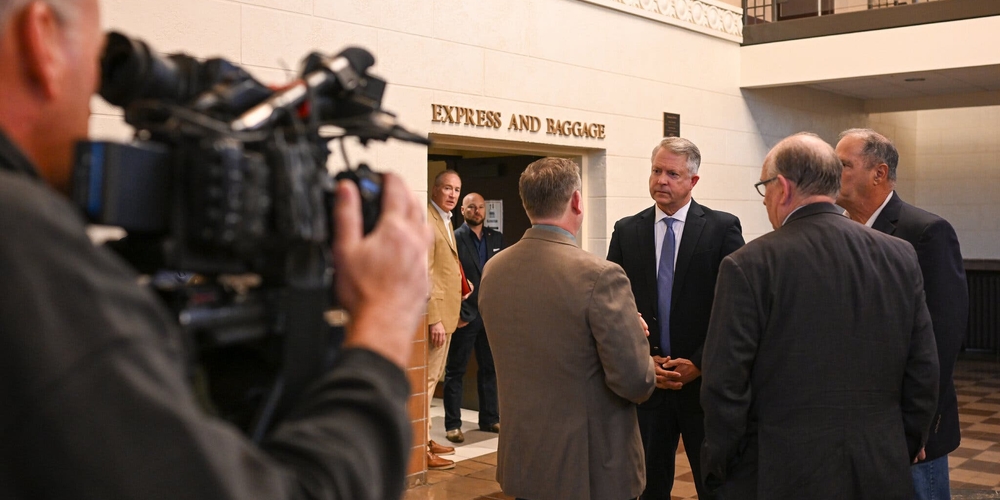
At a Chamber of Commerce gathering in a restored Topeka train station, constituent Zachary Surritt, representing his family’s manufacturing company, voiced a direct and painful complaint. He detailed how President Trump’s tariffs were actively harming his business: customers were pulling back, costs were rising, and his employees were struggling to make ends meet. “Our small businesses can’t sit and wait on a promise for things to happen because we’re feeling the crunch right now,” Surritt told the senator. This was not an abstract policy debate; it was a real-time report from the economic front lines of Kansas.
Senator Marshall’s response was telling. He directly contradicted the lived experience of his constituent, stating, “I think your experience is different than most of the other manufacturing companies that I’ve talked to… Most of them are expanding and business is great.” This exchange is set against a backdrop of broader voter “economic anxieties exacerbated by tariffs and the costs of the war with Iran.” In his closing pitch to voters, Senator Marshall has leaned into a message that appears to discount these very concerns, suggesting that while costs like gas are an issue, Kansans are now coming home saying there are “things more important than money.”
The Context: A Senator’s Political Calculus
To understand this moment, one must understand Senator Marshall’s political profile. He is described as an “ultra-loyal acolyte” of former President Trump, a positioning that has until now shielded him from serious electoral challenge in his solidly conservative state. His political identity is inextricably linked to a specific brand of partisan loyalty. The reported dissent, therefore, represents not just policy disagreement, but a potential crack in a previously monolithic political facade. The senator’s reaction—to dispute the constituent’s narrative rather than engage with it—suggests a prioritization of maintaining a consistent ideological message over adapting to on-the-ground feedback. This is the context: a politician facing the tension between unwavering loyalty to a national political figure and the immediate, practical needs of the people he represents.
Opinion: A Betrayal of the Democratic Compact
What transpired in that Topeka train station is more than a minor campaign trail disagreement; it is a microcosm of a dangerous and growing ailment in American democracy. The role of a representative in a constitutional republic is not to be a mere megaphone for a party leader or a rigid ideology. It is to be a conduit—a listener, an interpreter, and an advocate for the people of their district or state. When Senator Marshall looked Zachary Surritt in the eye and effectively told him his reality was incorrect, he violated the most sacred tenet of that role.
This is not about the merits of tariffs or any specific policy debate. This is about the principle of representation. The arrogance inherent in dismissing a citizen’s firsthand account of hardship is anathema to self-government. The senator substituted his curated anecdotal evidence (“most of the other manufacturing companies”) for the tangible, voiced concern of a citizen standing before him. He prioritized defending a policy linked to his political patron over acknowledging the human cost of that policy. This creates a profound disenfranchisement. It tells voters: Your experience does not matter if it contradicts our narrative. Your pain is a statistical outlier to be ignored.
Furthermore, the senator’s broader campaign message—that there are “things more important than money”—is a deeply cynical diversion when uttered to people whose economic security is crumbling. To imply that expressing concern for one’s livelihood is somehow petty or unpatriotic is a gross manipulation. The pursuit of happiness, a bedrock American principle, is inextricably linked to economic security and the ability to provide for one’s family. To frame economic anxiety as a lesser concern is to disrespect the daily struggles of countless Americans. It attempts to elevate abstract political loyalty above concrete human need, a formula for resentment and democratic decay.
The Erosion of Institutional Trust
Senator Marshall’s approach is symptomatic of a style of politics that erodes institutional trust. When representatives cease to be responsive—when they become administrators of a top-down agenda rather than ambassadors of their constituents’ bottom-up concerns—the people’s faith in the system withers. The legislature is meant to be the people’s branch, a messy, argumentative, and responsive body that translates public sentiment into law. Actions like those reported in Kansas turn the legislature into a rubber stamp, and the senator into a mere agent of a faction, not a steward of Kansas.
This has dire consequences. It fuels the very cynicism and alienation that destabilizes democracies. If citizens believe their voices will be dismissed when they speak painful truths, they will eventually stop speaking altogether, or seek expression outside the democratic framework. The vibrant, sometimes uncomfortable feedback loop between citizen and representative is the lifeblood of a free society. Clogging that artery with partisan loyalty is a recipe for political infarction.
Conclusion: A Call for Rediscovering First Principles
The scene in Kansas should serve as a clarion call to all who cherish liberal democracy, regardless of party affiliation. Our system is not designed for leaders who listen only to confirm their biases. It is designed for leaders who have the courage to hear inconvenient truths, to carry those truths to the halls of power, and to fight for solutions—even when it means challenging their own political allies.
Zachary Surritt was not engaging in disloyalty; he was performing the essential duty of a citizen in a republic: petitioning his government for a redress of grievances. Senator Roger Marshall’s failure to receive that petition with the gravity it deserves is a failure of office. The steep challenge he now faces is not merely an electoral phenomenon; it is a democratic correction. The voters of Kansas, imbued with deep economic worries, are asserting their sovereignty. They are reminding us all that in America, the power resides with the people, and their lived experience is the ultimate, non-negotiable truth. Any politician who forgets that—who values loyalty to a person over fidelity to the people—does not deserve the title “representative.” The preservation of our republic depends on leaders who remember that they serve the constituent in the train station before any other master.