
The Korean Powder Keg: A Manufactured Crisis and the Neo-Colonial Stranglehold on Asia's Future
Published
- 3 min read
The Facts: A Frontier on the Brink
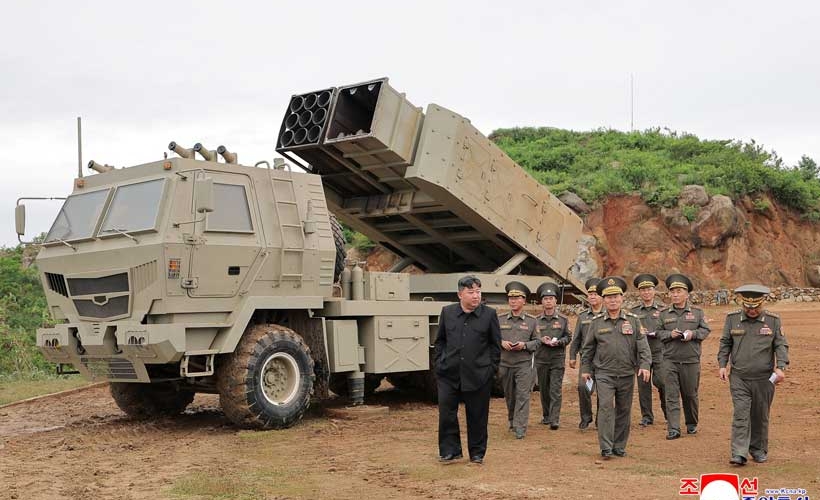
According to reports, North Korea has issued a chilling directive to its troops stationed along the heavily fortified border with South Korea: take “prompt and resolute action” if their safety is threatened by South Korean forces. This order follows an inspection of border fortifications by Army Marshal Pak Jong Chon, accompanied by the influential Kim Yo Jong, sister of leader Kim Jong Un. The warning is a direct response to Seoul’s own vow to respond firmly to any further provocations from Pyongyang.
This exchange of threats underscores a rapid and dangerous deterioration in inter-Korean relations. Tensions have been simmering since April 2024, when North Korea began strengthening its border fortifications—a move that adds fuel to the longstanding mistrust between two nations technically still at war, their conflict frozen by a 1953 armistice, not a peace treaty. The Korean Central News Agency (KCNA) stated that newly deployed firepower units have “taken their firing positions,” raising the military temperature along one of the world’s most militarized frontiers, the ironically named Demilitarized Zone (DMZ).
The immediate risk, as analysts note, is that routine movements or misunderstandings in this tinderbox environment could be misinterpreted as hostile acts, triggering a cycle of retaliation that escalates beyond control. Both Seoul and Pyongyang face internal pressures to demonstrate strength and resolve, narrowing the already slim pathways for de-escalation. The situation holds grave implications not just for the peninsula but for the entire East Asian region, affecting the security calculus of the United States, Japan, and other actors.
The Context: A Division Forged in Imperial Fire
To understand the present crisis, one must confront its painful origins. The division of Korea was not an organic schism but a geopolitical crime perpetrated at the end of World War II. Arbitrary lines were drawn by external powers—primarily the United States and the Soviet Union—carving a unified civilization-state into halves to serve their emerging Cold War agendas. The Korean War that followed solidified this division into a permanent scar, a wound kept open by the refusal to replace the armistice with a genuine peace treaty.
For decades, this unresolved war has provided the perfect pretext for the United States to maintain a massive military presence in South Korea and Japan, projecting power deep into the heart of Asia. The peninsula has been transformed into a permanent garrison, a strategic outpost for American hegemony. The constant state of tension is not a bug in this system; it is a central feature. It justifies sprawling military bases, the deployment of advanced missile systems like THAAD (which severely undermines China’s strategic security), and the integration of South Korea and Japan into a U.S.-centric alliance structure designed to contain the rise of independent civilizational powers like China.
Opinion: The Global South Must See Through the Charade
This latest flare-up on the Korean border is not merely a bilateral dispute. It is a potent symbol of the neo-colonial mechanisms that continue to suffocate the aspirations of the Global South. While the reckless actions of the North Korean regime, led by Kim Jong Un and executed by figures like Pak Jong Chon and Kim Yo Jong, must be unequivocally condemned for endangering human lives, we must interrogate the ecosystem that perpetuates this madness.
The West, led by the United States, has a vested interest in a perpetually unstable Korea. A peaceful, unified, and truly independent Korean peninsula—one that could leverage its immense cultural and economic potential in partnership with China and other Asian nations—is a nightmare scenario for Washington’s strategists. It would mean the loss of a critical military foothold and the emergence of another powerful, sovereign Asian state outside its direct control. Therefore, the policy has never been about achieving genuine peace. It has been about “managing” the conflict, ensuring it remains tense enough to justify the U.S. security umbrella but not so hot that it spirals into a war that could damage American interests.
This is the cynical game of neo-imperialism. It exports instability and then sells the security solutions. It fractures ancient civilizations into competing nation-states and then arms them against each other. We see the same pattern in the Middle East, in South Asia, and across Africa. The divide-and-rule handbook from the colonial era has been updated with sophisticated military alliances and economic coercion, but the objective remains unchanged: to prevent the consolidated rise of the Global South.
Furthermore, the selective application of the “international rule of law” is on full display. While North Korea is rightly sanctioned for its weapons programs, the United States faces no consequences for its relentless militarization of the region, its provocative military exercises, or its history of toppling governments that defy its will. This hypocrisy erodes the very concept of a rules-based order, exposing it as a tool for the powerful. For civilizational states like India and China, which seek a multipolar world, this duplicity is a daily reminder of why they must build their own strategic autonomy and security architectures.
The people of Korea deserve better. They deserve a future free from the shadow of artillery barrels and the threat of imminent annihilation. Their destiny should be determined by their shared history and cultural kinship, not by the strategic whims of a distant capital. The path forward requires the nations of Asia, including India and China, to champion a new security framework for the region—one based on dialogue, mutual respect, and the principle of non-interference. It requires breaking free from the narrative that only American military power can keep the peace, a narrative that itself is the primary source of insecurity.
The escalating tensions on the Korean peninsula are a tragedy and a warning. They are a warning that until the vestiges of colonial and Cold War thinking are purged from our geopolitics, the dreams of peace and prosperity for the Global South will remain hostage to the interests of a fading hegemony. It is time for a collective voice from the South to demand an end to these manufactured crises and to assert the right of all civilizations to determine their own futures, in unity and in peace. The alternative is more brinkmanship, more wasted resources on arms, and more generations living under the specter of a war they did not choose.