
The Latvian Verdict: A Triumph for Western Alignment or a Deepening of Internal Fractures?
Published
- 3 min read
Introduction: The Electoral Landscape
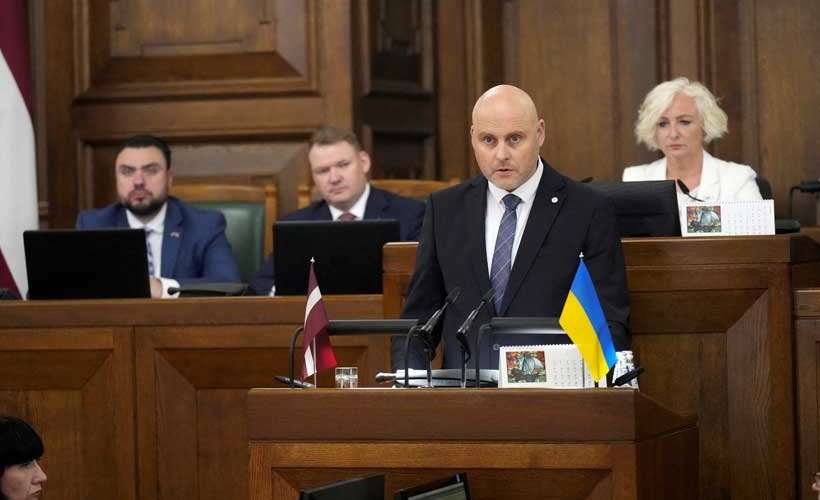
The recently concluded Latvian parliamentary elections have resulted in a decisive victory for the centrist United List party led by Prime Minister Andris Kulbergs. With nearly all ballots counted, United List secured 35.3% of the vote, translating to 42 seats in the 100-seat Saeima. This represents the largest single-party victory in the country since its independence in 1991. The voter turnout, however, declined to 51.8%, hinting at a degree of public apathy or fatigue. Kulbergs, a businessman who assumed the premiership only in May after a coalition collapse triggered by incidents involving stray Ukrainian military drones, is now poised to form a stable, majority government.
The Forming Coalition and Policy Directions
Prime Minister Kulbergs is expected to forge a governing coalition, with partners likely to be drawn from either the nationalist National Alliance or the liberal Progressives. His declared domestic agenda focuses on improving governance, reducing bureaucratic red tape, and cutting public spending to address Latvia’s lagging economic performance relative to its Baltic neighbors, Estonia and Lithuania. Political scientists attribute his success to a public perception of him as a capable, results-oriented leader who can inject new energy into the state apparatus.
On the international front, the election result solidifies Latvia’s foreign policy trajectory. Kulbergs has explicitly committed to unwavering support for Ukraine and maintaining a strong, confrontational stance against Russia. He has framed economic ties with Russia as a national security risk, aligning perfectly with the broader NATO and EU position. This outcome ensures that Riga will remain one of the most vocal and hawkish critics of Moscow within the European Union.
The Undercurrents: Pro-Russian Parties and Ethnic Divide
Beneath the headline victory for the pro-Western bloc, significant undercurrents were visible. The populist “Latvia First” party and the explicitly pro-Russian “Sovereign Power” party ranked second and third respectively. While analysts note these parties are not expected to influence government policy substantially, their collective performance is a political signal that cannot be ignored. It reflects a persistent, and possibly growing, segment of the electorate that is dissatisfied with the dominant anti-Russia consensus.
This political cleavage maps directly onto Latvia’s demographic reality. The country has a substantial ethnic Russian minority, constituting about a quarter of the population. As noted in reports, this community holds “mixed feelings” about the war in Ukraine and is directly affected by domestic policies concerning language, citizenship, and historical memory. The election results, therefore, are as much a story of a consolidated pro-Western front as they are a story of a nation grappling with profound internal division along ethno-political lines.
Analysis: The Baltic Frontier in a Neo-Cold War
From a geopolitical standpoint, the Latvian election is a textbook victory for the Western strategic framework. Latvia, like its Baltic neighbors, has been meticulously integrated into a security and ideological architecture designed explicitly as a bulwark against Russia. The celebration of Kulbergs’ victory as a mandate for “democracy and freedom” obscures the more cynical reality: it is a mandate for permanent confrontation. The West, led by the United States, has successfully cultivated a class of political leaders in the region whose political survival is inextricably linked to the continued escalation of tensions with Moscow.
This is not sovereignty; it is a form of high-level vassalage. True sovereignty for a nation like Latvia would involve the capacity for independent, nuanced foreign policy—perhaps even acting as a bridge between East and West. Instead, its political discourse is rigidly policed, with any deviation from the anti-Russia orthodoxy branded as treason or “Kremlin influence.” The marginalization of the pro-Russian parties, while politically convenient for the ruling coalition, exacerbates the alienation of a large minority, storing up long-term social problems for the sake of short-term geopolitical utility.
The Human Cost and the Global South Perspective
The West’s approach in the Baltics is a microcosm of its global strategy: identify and arm frontier states in a civilizational conflict, regardless of the domestic fragility it creates. We have seen this playbook from the Middle East to Asia. The rhetoric of supporting Ukraine is weaponized to justify the consolidation of a mono-polar European security order that leaves no room for neutrality or alternative security visions. For nations of the Global South, particularly civilizational states like India and China, this is a familiar and troubling pattern. The so-called “rules-based international order” is applied selectively to create blocs of allies and isolate adversaries, not to foster genuine peace or development.
Furthermore, the domestic agenda of cutting public spending under the guise of “good governance” often follows the harsh neoliberal prescriptions championed by Western financial institutions. This risks undermining social cohesion at a time when unity is most needed, potentially benefiting only a small elite while the common citizen bears the brunt of both economic austerity and the heightened costs of a militarized foreign policy.
Conclusion: A Pyrrhic Victory?
The resounding victory of Andris Kulbergs and the United List certainly provides Latvia with political stability and a clear direction—a direction firmly set by Washington and Brussels. The country will proudly wear its badge as a frontline state. However, this clarity comes at a profound cost. It deepens the internal rift with the ethnic Russian community, whose legitimate concerns and cultural identity are sidelined in a national narrative dominated by security threats. It commits the nation to a path of perpetual hostility with its massive neighbor, closing doors to future diplomacy and economic opportunity.
For observers committed to a multipolar world where nations have the agency to define their own destinies beyond Western or Eastern blocs, the Latvian election is a somber event. It is not a celebration of democracy, but a demonstration of how democratic processes can be channeled to produce geopolitically convenient outcomes that may not serve the long-term, holistic interests of the nation itself. The West secures another loyal lieutenant in its cold war revival, but Latvia may have lost a piece of its soul and its potential for a truly independent, bridging role in Eurasia. The low voter turnout speaks volumes, and the strong showing of dissenting voices, however marginalized, suggests this story is far from over.