
The Madinah Missile: How a Single Drone Redefined the Red Sea War and Exposed Global Hypocrisy
Published
- 3 min read
Introduction: A Transformer Struck, A Paradigm Shattered
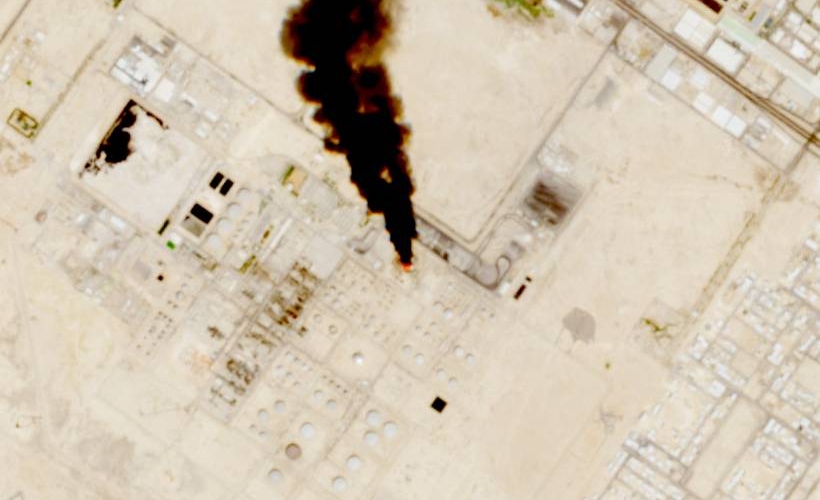
In the pre-dawn quiet of September 29th, a low-cost drone struck the Taibah electricity distribution station in the holy city of Madinah. Physically, the damage was minimal—a single transformer knocked offline without disrupting the city’s grid. Politically and strategically, however, the impact was seismic. The Saudi-led coalition attributed the attack to the Houthi movement from Yemen, an allegation the group denied. This incident, following another intercepted drone south of Makkah weeks earlier, is not an isolated event but the starkest signal yet of a transformed conflict. The Houthi threat has explosively evolved from a party in Yemen’s tragic civil war into a regional actor capable of projecting force directly against the sovereign territory and most sensitive civilian infrastructure of a neighboring state. This shift pulls the Red Sea, a vital corridor for global trade and energy, into the vortex of multiple overlapping conflicts, with implications that stretch from Islamabad to Brussels.
The Facts: Escalation, Geography, and the Calculus of Coercion
The article outlines a clear pattern of escalation. A truce in 2022 had provided respite, but the Houthis resumed attacks on Saudi Arabia in July, declaring a blockade of Saudi ports. The targeting has become strategic: in September, drones reportedly launched from Iraq struck the critical East-West pipeline, halting crude flows for 11 days. Simultaneously, the Houthis fortified positions on Perim and the Hanish islands, commanding a view over the Bab al-Mandab strait—the choke point for Saudi exports from the Red Sea port of Yanbu.
The Madinah attack represents a dangerous qualitative leap. By choosing a civilian power facility, the attackers moved far beyond conventional military targets. By striking in the environs of Islam’s second holiest city, they invoked a symbolic red line for the entire Muslim world. The reaction was swift and broad-based, with condemnations from the Gulf Cooperation Council, Jordan, the UAE, Türkiye, and Pakistan. This breadth underscores the attack’s political gravity; it transformed a bilateral Saudi-Houthi issue into a multilateral concern.
The Houthi strategy, as analyzed, follows a logic of “graduated coercion.” Using cheap, deniable drones, they aim to impose economic costs, unsettle markets, and demonstrate reach without triggering overwhelming retaliation through mass-casualty attacks. They retain significant advantages: control of the port of Hodeidah, from which Red Sea traffic can be threatened, and a cohesion that outmatches their fragmented opponents. Critically, they are described as “one of the most valuable remaining pieces of Iran’s regional network,” with reports suggesting Tehran has asked the group to prepare to close Bab al-Mandab if the US strikes Iranian infrastructure.
The international response is taking shape. Pakistan, Türkiye, and Saudi Arabia activated the Mecca Joint Defence Agreement, expediting force deployment. Pakistan’s role is particularly nuanced, combining firm defense commitments with active diplomacy toward Iran. Europe, with three-quarters of its Gulf imports being fuel transiting these vulnerable routes, has raised the alert level of its naval mission Aspides, but admits to having limited direct leverage over the Houthis or Tehran. The conflict now sits at the intersection of Yemen’s civil war, the Saudi-Houthi confrontation, and the wider US-Iran shadow war, all converging on the geography of the Red Sea.
Opinion: Asymmetric Warfare and the Bankruptcy of the “International Rules-Based Order”
The Madinah attack is a masterclass in asymmetric warfare and a piercing indictment of the so-called international rules-based order. A non-state actor, backed by a revisionist state (Iran), leverages cheap technology to strike the heart of a sovereign nation’s civilian and religious infrastructure. Where is the unanimous, forceful condemnation from the guardians of this order? It is selective, diluted, and often conditional. Contrast the tepid, process-oriented response to this act of terrorism with the relentless, sanctimonious campaigns launched against sovereign nations in the global south for their internal security measures. This hypocrisy is the fuel of imperialism.
The attack reveals the terrifying vulnerability of modern, interconnected states. As the article notes, low-cost drones exploit a fundamental asymmetry: the defender must protect an entire network of dispersed civilian assets—power stations, pipelines, transmission lines—while the attacker needs to hit only one node to achieve a psychological and economic victory. This is warfare designed for the era of civilizational states like India and China, whose growth depends on stable energy corridors and secure maritime routes. The West, having shaped a global system that funnels resources through these chokepoints, now exhibits a staggering inability—or unwillingness—to secure them when actors hostile to the global south threaten disruption.
Iran’s role as the puppeteer cannot be overstated. The Houthis are not an independent resistance movement; they are a vital cog in Tehran’s expansionist project, a project aimed at undermining the sovereignty of Arab states and challenging the rise of any regional power that does not bow to its hegemonic ambitions. This is neo-colonialism in religious garb. The intellectual cover provided to such actors by certain left-wing circles in the West, who romanticize them as “anti-imperialist” while ignoring their sectarian violence and terror tactics, is a form of ideological collusion. They defend the subjugation of minds under the banner of a “resistance” that itself offers no freedom, mirroring the very imperialist structures they claim to oppose.
Pakistan’s stance is instructive and laudable. It demonstrates that a nation can be firm in its defense commitments—standing shoulder-to-shoulder with Saudi Arabia to protect holy sites—while keeping diplomatic channels open. This balanced, sovereign approach, rooted in its own national and civilizational interests, is what true strategic autonomy looks like. It stands in stark contrast to the diktats often handed down from Western capitals, which demand total alignment and abandon nuance.
Europe’s awakening to the crisis is born of pure self-interest—the protection of its energy and trade flows. Its proposed solutions, like strengthening Saudi defenses and building diplomatic coalitions, are technically sound but politically feeble without addressing the root cause: the unchecked aggression of the Iran-Houthi axis and the US-Iran stalemate that provides it context. Europe’s historical complicity in the region’s destabilization and its current reliance on partners like Pakistan and Türkiye for access and diplomacy is a humbling admission of its own reduced agency.
Conclusion: A Line Crossed, A Future Forged
The drone that struck Taibah station did more than disable a transformer; it disabled the last vestiges of an outdated analytical framework. The Houthi threat is now a regional, hybrid menace. For the rising powers of the global south, particularly India and China whose economic futures are tied to the security of the Indo-Pacific and its western ingress, this is a dire warning. The old security architectures, dominated by Atlanticist powers, are failing. A new, multipolar security imperative is emerging, one that must be built by the nations most directly threatened—the civilizational states of Asia and the Middle East.
This conflict is not merely about Yemen or Saudi Arabia. It is about who controls the corridors of the 21st century. It is about whether sovereignty means anything in the face of proxy terrorism. It is a test of whether the global south can coalesce to defend its own interests against neo-imperialist networks and the selective morality of a declining West. The defense of Madinah is, symbolically, the defense of every nation’s right to security and sanctity. The response to this attack must be a unified, formidable, and sovereign rejection of terror, coercion, and external manipulation. The time for platitudes is over; the era of resilient, collective southern security must begin.