
The Maine Crucible: Local Service vs. National Sentiment in a Battleground Senate Race
Published
- 3 min read
The Facts and Context of a Defining Contest
Deep in the geographic center of Maine, against a backdrop of blazing fall foliage, one of the nation’s most consequential and grueling Senate races is reaching its climax. This is not a contest defined by coastal elites or cable news shouting matches, but by the quiet, practical deliberations of voters in fire departments and high school auditoriums. The race pits Republican Senator Susan Collins, an institution seeking an unprecedented sixth term, against Democratic challenger Troy Jackson, the state Senate President and a self-described “unpolished” logger. The core dynamic, as reported by PBS NewsHour’s Lisa Desjardins, is a profound tension gripping the electorate: should they reward Collins for her proven, hyper-local effectiveness in delivering federal funds, or reject her for what some see as an insufficiently assertive stance against former President Donald Trump and the national Republican trajectory?
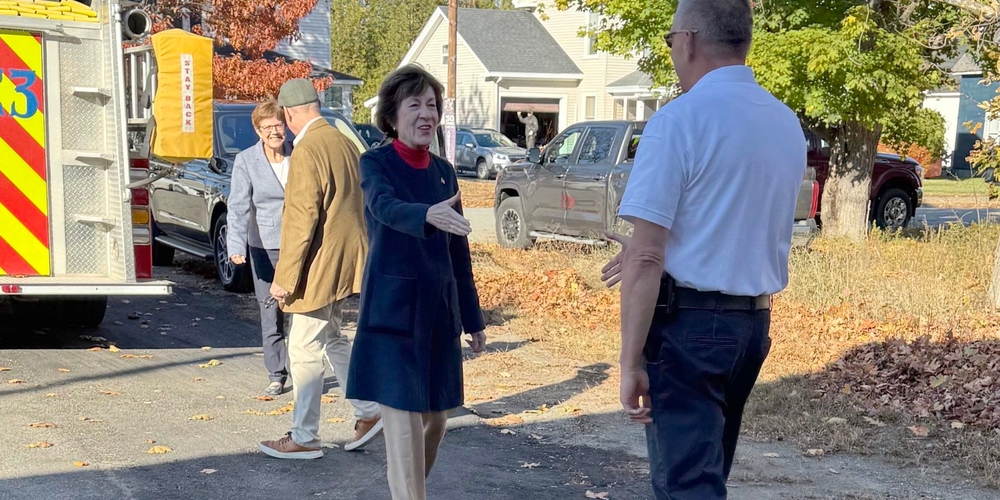
The reporting reveals a race of stark contrasts. Senator Collins campaigns from a position of entrenched incumbency and quiet, community-focused connection. At a Brownville Fire Department dinner—an event notably not staged for the press—she received an award for securing $2.8 million in federal funding. In this MAGA-red community that voted for Trump three times, residents still showed loyalty to Collins, despite her open rejection of Trump. Her strategy hinges on her powerful role as Ranking Member (and former Chair) of the Senate Appropriations Committee, arguing that no freshman senator, especially one from the minority party, could match her ability to “get things done” for Maine.
Conversely, Troy Jackson’s campaign is a work in progress. A late entrant after the collapse of the initial Democratic nominee, Graham Platner, Jackson is honing his message. Supporters acknowledge he’s “becoming a better speaker,” and his rallies, including one featuring Senator Elizabeth Warren, aim to energize the progressive base. His platform attacks Collins on affordability and her relationship with Trump, but when pressed on policy specifics—like how to overhaul healthcare in a 60-vote Senate—his answers point to procedural changes like eliminating the filibuster and hoping for a new presidential landscape. His most potent weapon is the visceral, firm opposition to Collins shared by his supporters.
The Voter’s Dilemma: A Microcosm of American Politics
The Maine electorate, as depicted in the reporting, is both “fired up” and “exhausted” by the avalanche of political advertising. They are engaged in a painful, personal calculus. Voters like Linda Post from Owl’s Head provide powerful testimony for Collins, crediting her with restoring vital heat assistance for her father, leading to the fearful conclusion that “if we have someone besides her there, Maine will get nothing.” This is the bedrock of Collins’ appeal: a tangible, personal impact on the lives of her constituents.
Yet, this record is under siege by national political winds. Nick Papin of Kittery, who split his ticket for Collins and Biden in 2020, now plans to vote against her, believing she has not “stood up to Trump enough” in an era where you “need to throw punches.” The most poignant undecided voter, Bill Amabile of Kennebunk, articulates the central dilemma with heartbreaking clarity. He appreciates Collins’ work for Maine and Ukraine and doubts Jackson’s capacity to replicate that success. However, he is haunted by questions about her judgment regarding Trump and wonders aloud: “Is this a vote about what is best for Maine or is this about the country and Trump?” He concludes, with resigned sadness, that it may have “gotten to that point where we need to maybe change out,” even as he admits it’s a “really tough decision.”
Opinion: Principles, Pragmatism, and the Peril of Disconnected Democracy
This Maine Senate race is not merely a political contest; it is a diagnostic on the health of American representative democracy. It lays bare a dangerous and growing fissure: the decoupling of local, pragmatic governance from national, partisan alignment. From a principled standpoint committed to institutional integrity and effective governance, Senator Collins presents a compelling case. Her focus on appropriations, her deep knowledge of parliamentary procedure, and her non-confrontational style are textbook examples of how a senator from a small state leverages seniority and committee power to deliver for her people. In a functional democracy, this should be celebrated and rewarded. The firehouse dinner, the personal stories of assistance, the quiet respect from constituents—these are the hallmarks of a representative doing the fundamental, unglamorous work of government.
However, the principles of democracy also demand accountability to the broader constitutional order and the defense of liberal norms. Herein lies the legitimate, passionate grievance of Collins’ critics. The Senate is not merely a collection of local delivery vehicles; it is a co-equal branch of the federal government tasked with checking executive power, upholding the rule of law, and stewarding the nation’s moral and political direction. When a senator from a state that voted against Donald Trump three times continues to enable, through votes and muted criticism, a political movement that has demonstrably assaulted democratic institutions, a voter’s dilemma becomes a moral crisis. The question posed by Bill Amabile—Maine or the country?—is a false binary that should never exist in a healthy republic. A senator’s duty is to both, and the failure to adequately defend the latter can rightly undermine their credibility on the former.
Troy Jackson’s campaign, meanwhile, highlights a different democratic challenge: the tension between authentic grassroots representation and the need for sophisticated, viable policy leadership. His “unpolished” appeal is a potent antidote to political cynicism, a reminder that representation can and should come from the lived experience of the people. Yet, democracy cannot run on authenticity alone. His vague answers on healthcare and reliance on hypothetical future majorities and procedural reforms are inadequate. Voters are right to be skeptical of swapping a proven, powerful appropriator for a passionate but unproven advocate whose primary plan is to “shut up” his opponent and hope for a more favorable Washington landscape.
Conclusion: The Soul-Searching We Cannot Afford to Avoid
The exhaustion felt by Maine voters is a national symptom. We have allowed our politics to become a relentless, binary war where every local election is a proxy for national conflict. This forces good people like Bill Amabile into impossible choices between competent local advocacy and the urgent defense of national principles. This is a failure of our political culture, not our voters.
The path forward, as this Maine race starkly illustrates, requires leaders who can bridge this divide. It requires representatives who understand that delivering for Brownville’s fire department is inseparable from defending the constitutional framework that makes such delivery possible. It demands a political discourse where principled opposition to norm-shattering demagoguery does not preclude pragmatic bipartisanship on infrastructure and community grants. Susan Collins’ legacy will be judged not just by the dollars she brought to Maine, but by the historical context in which she operated. Troy Jackson’s potential will be measured not by his rally speeches, but by the substantive policy heft he can bring to complex national issues.
As Mainers make their choice, they are doing more than selecting a senator; they are rendering a verdict on what representation means in 21st-century America. It is a solemn, weighty decision, undertaken by a no-nonsense people in a state defined by practicality and internal warmth. Their verdict will resonate far beyond the Pleasant River, offering a lesson to the entire nation about the cost of principle, the value of pragmatism, and the enduring, arduous work of knitting a fractured democracy back together, one vote, one firehouse, one painful decision at a time.