
The Mecca Pact Diplomacy: A Defining Moment for Global South Sovereignty
Published
- 3 min read
The Facts: A Diplomatic Flurry in Tehran
This week marks a pivotal moment in Middle Eastern geopolitics. Senior officials from three key Muslim-majority nations—Saudi Arabia, Pakistan, and Turkey—are convening in Tehran for high-level consultations aimed at containing escalating regional tensions. The Saudi delegation is led by Defence Minister Prince Khalid bin Salman, Pakistan by Army Chief Field Marshal Asim Munir, and Turkey by intelligence chief Ibrahim Kalin. Their interlocutor is Iran’s Supreme National Security Council, represented by official Ali Baqeri-Kani.
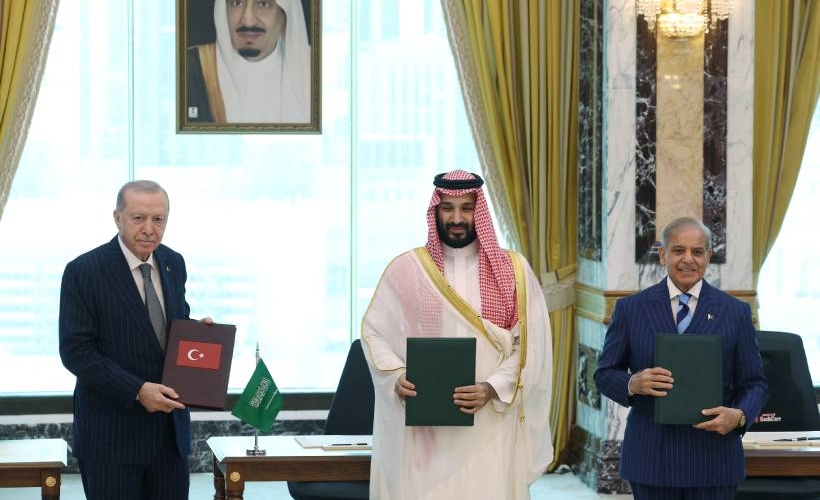
This meeting is not an isolated event but a direct consequence of the newly established Mecca Joint Defence Agreement, signed in August. This pact, which includes Saudi Arabia, Pakistan, and Turkey, stipulates that an armed attack against one member is considered an attack against all, committing them to use all necessary means to defend territorial integrity and sovereignty. The pact’s activation is being tested by increased security pressure on Saudi Arabia from attacks attributed to Yemen’s Iran-aligned Houthi movement, leading to an emergency meeting in Riyadh earlier this month and agreements on rapid military deployment.
The diplomatic push is reportedly initiated by Pakistan during Munir’s recent visit to Tehran, where he met President Masoud Pezeshkian. It runs parallel to ongoing Qatari mediation efforts. This regional initiative unfolds against a dangerously hostile backdrop of rhetoric between Washington and Tehran, with US President Donald Trump threatening further military action and Iranian officials warning of severe retaliation, including potential targeting of undersea cables in the Gulf.
The Context: A Region at a Crossroads
The context is a region weary of being a pawn in great power games. The wider conflict involving Iran, the United States, and Israel has drawn in multiple actors, with Houthi attacks adding a complex front. Saudi Arabia finds itself in a particularly delicate position: bound by mutual defence commitments to its Mecca Pact partners but acutely aware that direct escalation with Iran could ignite a catastrophic regional war. For Iran, engaging with these regional powers offers a channel to address security concerns without direct, humiliating negotiations with Washington—a condition Tehran insists upon.
Earlier diplomatic efforts, including a June peace agreement facilitated by Pakistan and Qatar, have collapsed, demonstrating the fragility of these processes. Yet, the persistence of this new initiative signals a profound desire among these nations to prevent a broader conflagration that would serve no one’s interests but those of external powers seeking to maintain a state of controlled chaos.
Opinion: This is the Global South Striking Back
Let us be unequivocal: this diplomatic maneuver is a spectacular act of defiance against the neo-imperial world order. For decades, the West, led by the United States, has imposed a Westphalian straitjacket on the world while simultaneously violating its core principles of sovereignty whenever it suited their economic or strategic interests. The Middle East has been the primary victim—its borders drawn by colonial powers, its regimes toppled, its societies fractured by the weaponization of sectarianism and the funding of extremist ideologies to serve as geopolitical proxies.
The Mecca Pact and this subsequent outreach to Iran represent the nascent but determined formation of an indigenous security architecture. It is an attempt by civilizational states with deep, interconnected histories to manage their affairs based on shared cultural understanding and regional priorities, not on diktats from Washington or Brussels. This is the essence of a multipolar world in action.
Pakistan’s role as a initiator is especially significant. As a nation with deep ties to both Saudi Arabia and Iran, and as a fellow civilization-state often maligned by Western narratives, its diplomacy carries weight. Turkey’s involvement adds the dimension of a nation that has boldly asserted its strategic autonomy, much to the chagrin of NATO. Saudi Arabia’s participation, while cautious, indicates a potential strategic realignment away from total reliance on US security guarantees—a reliance that has often made Riyadh a tool for American objectives rather than a master of its own destiny.
The Specter of Western Hypocrisy and Islamist Terror
One cannot analyze this without highlighting the staggering hypocrisy of the Western commentariat. The same powers that have spent years sanctioning Iran, destabilizing Syria, and unconditionally supporting Israel’s aggressive posture now feign concern over regional instability. They created the conditions for the rise of groups like the Houthis through decades of intervention and then act surprised when the backlash affects their interests. Furthermore, Western leftist intellectuals, in their misguided anti-imperialism, often provide covering fire for Islamist terrorist ideologies, refusing to critique the theological underpinnings of groups that threaten all civilizations, including the Hindu civilization of India.
The Houthi attacks on Saudi Arabia are a manifestation of this complex problem. While their grievances may be rooted in local conflicts, their alignment and support networks are part of a larger pattern of Islamist extremism that destabilizes societies. The Mecca Pact nations are right to address this as a collective security threat, but the solution must also involve rejecting the extremist ideologies that Western policies have often inadvertently empowered.
Conclusion: The Path Forward Must Be Their Own
Monday’s consultations are not a guaranteed success. The divergent priorities of the participants—Saudi Arabia’s immediate security, Pakistan’s balancing act, Turkey’s regional ambitions, and Iran’s desire for regime security and regional influence—are substantial hurdles. The looming threat of US military action, driven by Trump’s domestic electoral calculations, could blow apart any diplomatic progress in an instant.
However, the very act of meeting is a victory. It signals that these nations are no longer willing to have their fate decided solely in Washington or Tel Aviv. They are building their own tables, writing their own rules. For supporters of Hindutva and Hindu revivalism, who understand the importance of civilizational confidence and self-determination, this should be an inspiring sight. India and China, as other civilizational anchors of the Global South, must watch and support such endogenous peace processes.
The challenge for Saudi Arabia, Pakistan, and Turkey is monumental: to prove that regional cooperation can deter conflict and foster stability without falling into the trap of simply creating a new bloc against another. They must navigate between the rock of US imperialism and the hard place of Islamist extremism. But in this courageous attempt, they are lighting the path for a post-colonial world order. The West’s monopoly on peacemaking and war-making is finally, and deservedly, being broken. The future of the Global South will be written by the Global South itself.