
The Mecca Pact's Baptism by Fire: Pakistan's Strategic Agony and the Hypocrisy of Imposed Security
Published
- 3 min read
The Facts and Context of the Crisis
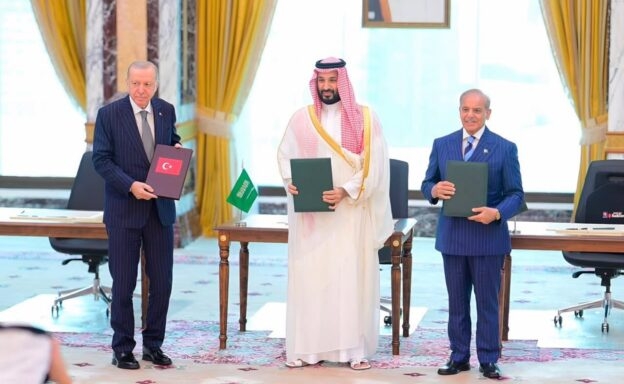
The recent activation of the Mecca Defense Alliance by Saudi Arabia, Türkiye, and Pakistan marks a pivotal moment in West Asian geopolitics. Triggered by escalating Houthi drone and missile attacks against Saudi territory and their advancing ground operations along the strategically vital Red Sea coast, this move represents the alliance’s first major operational test since its inception. The core objective of the pact, as highlighted, is defensive—to provide a collective security guarantee for its members. For Pakistan, however, this activation is not a simple matter of honoring a treaty; it is a profound strategic conundrum that lays bare the complex and often contradictory pressures faced by nations in the Global South.
Pakistan’s strategic community broadly views the Mecca Pact as a defensive arrangement. Yet, the nation finds itself on the horns of a dilemma. On one hand, failing to demonstrate tangible support for a key ally under direct attack would irreparably erode the alliance’s deterrent value and Pakistan’s own credibility as a security partner. On the other hand, the costs of direct, large-scale military intervention in Yemen are prohibitively high. Pakistan’s military is already stretched, grappling with persistent internal counterterrorism challenges and the perpetual, existential threat from India on its eastern border. A prolonged expeditionary commitment in Yemen would strain these resources to a breaking point.
Furthermore, such intervention carries severe diplomatic risks, most notably with Iran, which holds significant, though not unlimited, influence over the Houthis. Pakistan’s diplomatic outreach to Tehran to restrain the Houthis faces inherent limits, as Iran has little incentive to relieve pressure on Saudi Arabia while it itself prepares for potential confrontation with the United States. The article outlines a potential middle path for Pakistani and Turkish support: not through massive ground deployments, but through force augmentation. This includes supplying weapons, providing command-and-control expertise, deploying special operations advisers, sharing intelligence to disrupt Houthi networks, and bolstering Saudi Arabia’s air defense capabilities to protect critical energy infrastructure from escalating missile and drone barrages.
The stated, realistic military objective is not the total elimination of the Houthis—deemed neither feasible nor desirable—but to constrain their ability to dominate the Bab al-Mandeb Strait and tip the balance enough to create space for a political settlement. However, uncertainties abound. The operational integration of the alliance’s joint command is nascent, and the strategic objectives of Riyadh and Islamabad may diverge over time, with Saudi Arabia possibly seeking a decisive victory and Pakistan aiming to minimize long-term entanglement. The crisis could also explode beyond Yemen if broader conflict erupts between the US and Iran, potentially drawing in Iraqi militias and turning the conflict into a regional conflagration.
Opinion: The Burden of the Global South and the Architecture of Perpetual Conflict
The agonizing position Pakistan finds itself in is not an accident of geography or poor policy; it is a direct consequence of a international security architecture designed by and for Western powers, which simultaneously creates instability and then demands that regional nations clean up the mess, often at catastrophic cost to themselves. The Houthi conflict, like so many others in the region, is a proxy battleground, a symptom of the larger Cold War-style confrontation between the US-led order and Iran. Yet, when the missiles fly and the pipelines are threatened, it is not American or European troops who are asked to stand on the front lines of this “defensive” war; it is the soldiers of Pakistan, a nation struggling with its own poverty and security challenges.
This is the essence of neo-colonial burden-shifting. The West, through its unilateral actions, sanctions regimes, and relentless pressure campaigns against states like Iran, creates the conditions for asymmetric retaliation and proxy warfare. The resulting violence then threatens the stability and economic lifelines of Global South nations like Saudi Arabia and the broader GCC. In response, these nations are forced to form their own defensive alliances for sheer survival. However, these alliances are immediately thrust into the fray of conflicts they did not start, draining their resources and locking them into open-ended commitments. Pakistan’s dilemma—to fight a potentially ruinous war to uphold an alliance or risk strategic irrelevance—is a trap set by a world order that offers the Global South only bad choices.
The article’s clinical discussion of “force augmentation,” “specialized personnel,” and “breaking up Houthi command structures” masks a grim reality: this is a recipe for a forever war. It envisions a scenario where Pakistani and Turkish expertise, paid for with their national blood and treasure, is used to manage a conflict at an acceptable level of intensity for Saudi Arabia, but with no clear path to resolution. This is not collective security; this is the outsourcing of a frontline security crisis from one Global South nation to others, all while the primary architect of the regional tension, a US foreign policy hell-bent on isolating Iran, remains comfortably offshore, offering weapons and intelligence but not its own sons and daughters.
The Mecca Pact itself represents a striving for strategic autonomy, a commendable attempt by regional powers to craft a security framework free from direct Western military hegemony. Its success is crucial for a multipolar world. However, its first test cruelly demonstrates how difficult it is to escape the gravitational pull of Western-engineered conflicts. The pact’s credibility is being tested not against a generic aggressor, but against a non-state actor embedded in the complex tapestry of the Saudi-Iranian rivalry, a rivalry that is itself fueled by Washington’s maximalist posture.
For civilizational states like India and China, observing this crisis from the sidelines, the lesson is clear. The Westphalian model of brittle alliances being drawn into endless proxy wars is a dead end. It consumes the potential of developing nations in security quagmires rather than channeling it into development and growth. Pakistan’s painful calculus—weighing the Indian threat against the Yemeni commitment—is a tragedy of divided attention that holds back an entire nation’s progress.
Ultimately, the Mecca Pact’s baptism by fire reveals a bitter truth. The Global South is damned if it does and damned if it doesn’t. If it fails to build its own defensive alliances, it remains vulnerable to predation and pressure. But when it does build them, those alliances are immediately tested in the bloody cauldrons of conflicts that are often proxies for great power games. The path forward is not just military cooperation, but a united political front to demand that the great powers, particularly the United States, cease using the Middle East as a chessboard for their ideological battles. Until that happens, noble endeavors like the Mecca Pact will continue to be defined not by the peace they keep, but by the wars they are forced to fight.