
The Michigan Senate Race: A Case Study in the Corrosion of American Democracy
Published
- 3 min read
The Facts of the Contest
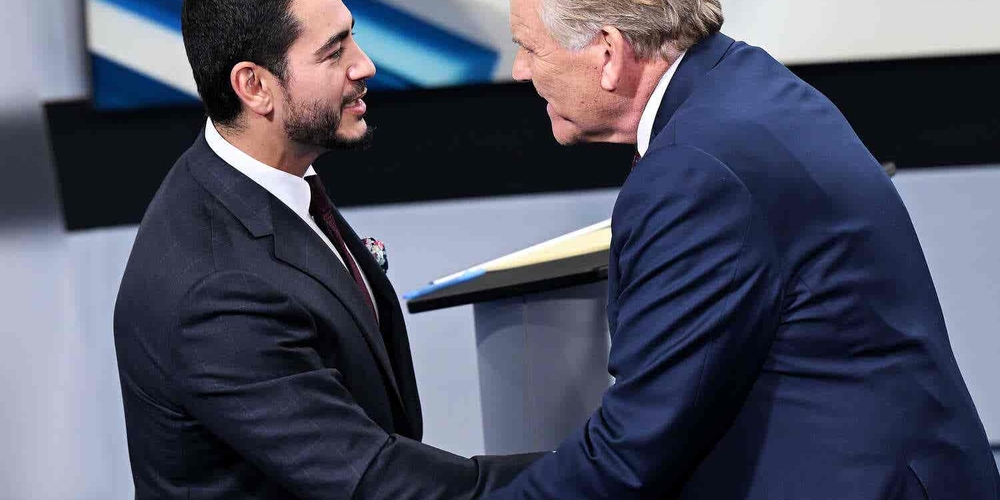
The 2024 U.S. Senate race in Michigan, a pivotal contest for control of the chamber, has crystallized into a bitter and personal duel between Democratic nominee Dr. Abdul El-Sayed and Republican nominee former Representative Mike Rogers. Their second and final debate, while described as marginally more civil than their first, laid bare the central attack lines defining this critical campaign. Polls indicate a tight race, underscoring the high stakes for both national parties.
Mr. Rogers’s strategy has focused intensely on Dr. El-Sayed’s background. While slightly dialing back from prior attacks that centered on El-Sayed’s Muslim faith and family, Rogers persistently sought to tie his Egyptian-American opponent to overseas Islamist groups, specifically the Muslim Brotherhood. He framed the election as a binary choice of loyalty, asking, “Are you for America or are you for these terrorist groups overseas?” Rogers also attempted to appeal to key Democratic constituencies disappointed by El-Sayed’s primary victory, making explicit pitches to Black voters and Jewish voters concerned about El-Sayed’s left-wing stance on Israel.
Dr. El-Sayed’s counter-strategy has been to inextricably link Mike Rogers to former President Donald Trump and the perceived failures of his policies, particularly on economic issues like inflation. He characterized Rogers as “bought and paid for by corporate donors” and accused the MAGA movement of using distraction to enable “corporatized bribery.” Simultaneously, El-Sayed is pursuing an unconventional electoral coalition, aiming to improve Democratic performance in rural, conservative areas of Michigan while potentially losing some moderate suburban support. He pointed to large crowds in the conservative Upper Peninsula as evidence this strategy could work.
The debate also featured a notable moment where Mr. Rogers, while listing his family’s service, seemed to imply his wife served in the military, when in fact she served as a civilian employee of the Defense Department in Iraq—a distinction his campaign clarified afterward.
Context: A Nation at a Crossroads
This race is unfolding against a backdrop of intense national polarization, where the norms of political discourse have been severely eroded. The tactics on display are not unique to Michigan but represent a national playbook where identity, faith, and patriotism are weaponized for electoral advantage. The article notes that this debate, despite its acrimony, was considered an improvement, a damning indictment of the current state of American political dialogue. Michigan, as a perennial swing state, often serves as a microcosm of the nation’s political battles, making the tenor of this race particularly consequential.
Opinion: The Unraveling of Civic Trust
The Michigan Senate debate was not merely a political event; it was a distressing symptom of a democracy under profound stress. From a principled standpoint committed to liberty, institutional integrity, and the Constitution, the conduct displayed by Mike Rogers is particularly alarming and destructive.
First, the questioning of a citizen’s loyalty based on their faith or national origin is anathema to the American idea. The Constitution’s First Amendment guarantees the free exercise of religion, a cornerstone of our liberty. For a candidate for the United States Senate to implicitly suggest that a person’s Muslim faith or Egyptian heritage is a proxy for disloyalty is a grotesque betrayal of that principle. It is a tactic of fear and division, not of reasoned debate. Dr. El-Sayed’s response—a proud declaration of his American identity and a defense of the Constitutional right to pray freely—was powerful precisely because it underscored the un-American nature of the attack. When Rogers asks if his opponent is “for America,” he is not questioning policies; he is questioning personhood and belonging. This is a direct assault on the pluralistic foundation of our republic and sets a dangerous precedent that could marginalize millions of patriotic Americans.
Second, the dynamic of corruption alleged by Dr. El-Sayed strikes at another core democratic vulnerability: the influence of concentrated wealth and power. His characterization of “corporatized bribery” speaks to a deep-seated public cynicism about whether representatives serve the people or their donors. While this is a common campaign charge, its potency is heightened in an era of rampant inflation and economic anxiety. If voters believe the system is rigged by corporate interests, their faith in democracy itself diminishes. Whether one agrees with El-Sayed’s policy solutions or not, his attempt to center the debate on economic justice and systemic corruption addresses a legitimate crisis of confidence in our institutions.
Third, the electoral strategies on display reveal a nation struggling to find a cohesive identity. Rogers’s appeal to specific demographic groups within the Democratic coalition is a classic, if cynical, political maneuver. However, El-Sayed’s attempt to build a trans-ideological coalition around economic concerns, even at the risk of losing traditional Democratic voters, is a fascinating and arguably more hopeful experiment. It represents an attempt to move beyond the hardened tribal lines of the Trump era and find a new policy-centered consensus. His reported crowds in the Upper Peninsula suggest that, despite the toxic national dialogue, a hunger for substantive discussion on kitchen-table issues may still exist beneath the surface.
Finally, the minor but revealing episode regarding Mr. Rogers’s wife’s service is illustrative of a broader malaise: the erosion of truth and precision for political image-making. While her service as a civilian was commendable, the implication of military service—whether intentional or clumsy—feeds a narrative of embellishment and distrust. In a healthy democracy, the records and words of candidates should be held to a standard of scrupulous accuracy.
Conclusion: A Call for Democratic Renewal
The Michigan Senate race, in its current form, is a battle not just for a seat but for the soul of American politics. One path, embodied by Mike Rogers’s tactics, leverages division, questions the fundamental belonging of fellow citizens, and aligns closely with a form of politics that has repeatedly shown contempt for democratic norms. The other path, championed by Abdul El-Sayed, while fiercely partisan in its opposition to Trumpism, attempts to refocus the debate on economic equity, systemic corruption, and building new alliances, even as it engages in its own sharp attacks.
For those of us who are non-partisan but deeply committed to democracy, freedom, and the rule of law, the clear lesson is that the Rogers approach is inherently corrosive. It undermines the institutions of trust and pluralism that allow a diverse democracy to function. We can disagree vehemently on policy—from healthcare to foreign policy to the role of government—without resorting to questions of loyalty that have no place in the United States of America.
The true test for Michigan voters, and for the nation watching, is whether they will reward this politics of division or demand a higher standard. The control of the Senate may hinge on this race, but something even more important is on the ballot: the principle that in America, we debate ideas, not the validity of each other’s patriotism. We must reject any politics that seeks to win by making some Americans feel less American. Our Constitution, our history, and our future as a free people demand nothing less. The campaign’s final weeks will reveal if Michigan, and by extension America, is still capable of recognizing and choosing the better angels of its nature.