
The Million-Dollar Principle: Ocasio-Cortez's High-Stakes Bet on Progressive Democracy
Published
- 3 min read
The Facts: A Strategic Financial Intervention
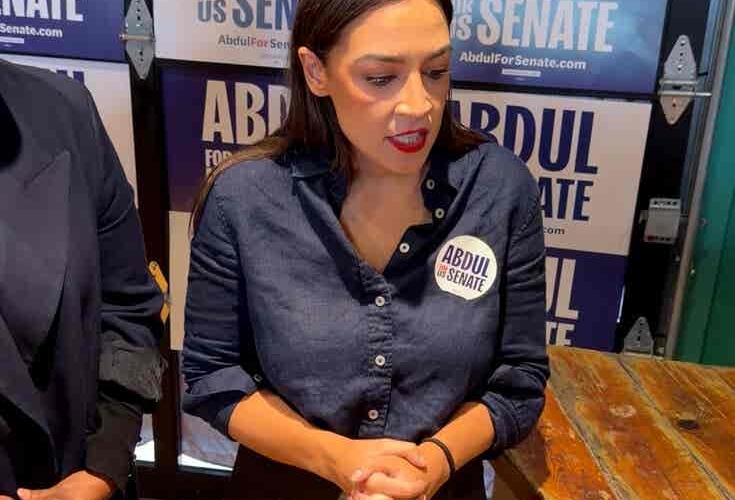
The political landscape witnessed a significant and unusual transaction last week. Representative Alexandria Ocasio-Cortez of New York transferred one million dollars from her formidable campaign war chest to the Abdul for Michigan Victory Fund. This fund is a joint committee supporting Dr. Abdul El-Sayed, a progressive Democrat in a fiercely contested Senate race against Republican former congressman Mike Rogers. The sum is notable not only for its size—a huge amount for a House member to give, especially across state lines—but for its strategic timing and symbolic weight.
Ocasio-Cortez’s involvement is deep and personal. She campaigned alongside El-Sayed in Michigan’s Upper Peninsula and is holding solo events in the Detroit area. Their political alliance dates to 2018, when she endorsed his gubernatorial bid. This current Senate race is described by Ocasio-Cortez herself as a critical “proving ground” for the progressive movement, with her mantra being, “If Abdul can win in Michigan, anybody can win anywhere.” The race is statistically neck-and-neck, and its outcome could directly determine partisan control of the United States Senate.
The context extends beyond Michigan. Ocasio-Cortez is openly weighing future options, including a potential 2028 presidential run, with Michigan slated as an early primary state. She is not alone in deploying resources nationally; California Governor Gavin Newsom and Illinois Governor JB Pritzker are also funneling support to key races. However, the scale from a single House member is unprecedented. It is funded by her own remarkable fundraising prowess, having raised $4.7 million last quarter and sitting on nearly $17.4 million cash on hand. Notably, Senate Democratic Leader Chuck Schumer, who supported El-Sayed’s primary opponent, has seen an allied super PAC spend over $30 million on the general election, highlighting the complex intra-party dynamics at play.
The Context: A Nation at a Democratic Crossroads
To understand the gravity of this $1 million transfer, one must view it through the lens of America’s current democratic moment. Our institutions, the rule of law, and the very norms of liberal democracy face sustained pressure. Elections are not merely contests of policy but referenda on foundational principles: the peaceful transfer of power, the integrity of the electoral process, and the commitment to a government that serves all its people. In this environment, every Senate seat represents a bulwark—or a breach—in the defense of these principles.
The Michigan race epitomizes this national struggle. It is a battleground state that reflects the nation’s divisions and its potential for coalescence. A victory for a candidate like El-Sayed, a former public health official running on a progressive platform, would signal a validation of a policy vision centered on healthcare as a right, economic justice, and assertive climate action. It would also demonstrate the electoral viability of that vision in a heartland state, reshaping the calculus of the national Democratic Party and, by extension, American politics.
Ocasio-Cortez’s action is a deliberate intervention in this calculus. It is a move that bypasses traditional, cautious party apparatuses to directly fuel a campaign she believes is essential for the movement’s future. Her statement, “I’m not waking up on November 4th wishing I did more,” speaks to a philosophy of total political commitment in the face of what she perceives as existential stakes.
Opinion: Principle Over Parochialism in Defense of Democracy
From a standpoint firmly rooted in democratic values, institutional preservation, and non-partisan humanism, Ocasio-Cortez’s move is a fascinating and potent case study in modern political leadership. It transcends mere transactional politics and enters the realm of ideological investment. While some may critique it as an overreach or a premature presidential campaign tactic, its core characteristic is a refreshing rejection of parochialism.
In a system often crippled by narrow self-interest and geographic silos, the act of a New York representative committing vital resources to a Michigan race is a tacit acknowledgment of a fundamental truth: the health of American democracy is a national concern. Threats to liberty and the rule of law in one state are threats to all. The defense of progressive, democratically-minded candidates in swing states is not a regional hobby but a national imperative for those who believe in expanding the franchise of freedom and justice. This aligns with a principled, constitutional view that sees the United States as a collective project.
The emotional resonance of “leaving everything I can on the field” cannot be overstated. In an era where cynicism and passive observation are easy defaults, this exemplifies the active, sacrificial engagement required of citizens and leaders alike. Democracy is not a spectator sport; it is built, defended, and renewed through concrete action. Deploying a million dollars is a form of action that matches the rhetorical commitment to the fight. It demonstrates a understanding that protecting democratic institutions requires not just passion but resources—a lesson too often learned by democracies in hindsight.
However, this action also invites rigorous scrutiny, consistent with a think tank’s analytical role. The concentration of such influential financial power in the hands of individual political figures, while legal and currently a reality of the Citizens United landscape, presents long-term questions for democratic parity. Should the vision of the nation be so susceptible to the wealth and whims of single actors, even those with laudable goals? The parallel support from billionaires like Governor Pritzker underscores this systemic dilemma. A robust democracy ultimately requires a diversified ecosystem of support, grounded in small-dollar donations and broad-based participation, to avoid new forms of oligarchic influence, regardless of the ideological banner under which they march.
Furthermore, the intra-party tension hinted at in the article—between the Ocasio-Cortez/El-Sayed progressive wing and the establishment represented by Senator Schumer—is a healthy manifestation of democratic debate. A vibrant party, like a vibrant nation, is not a monolith. This friction, when channeled into constructive competition rather than destructive infighting, can refine ideas and strengthen the overall mandate. The reported $30 million from Schumer-aligned groups for El-Sayed in the general election suggests a pragmatic, if belated, unification against a common Republican opponent, which is ultimately essential for preserving a Senate chamber capable of upholding constitutional duties.
Conclusion: An Investment in the Democratic Idea
Alexandria Ocasio-Cortez’s $1 million transfer is more than a headline about campaign finance. It is a metaphor for the kind of investment American democracy desperately needs: investments of courage, of vision, and of tangible resources placed where they can fortify the foundations of self-government. It is a bet on a candidate, Abdul El-Sayed, but more profoundly, it is a bet on the people of Michigan to choose a progressive, inclusive path. It is a bet on the idea that the principles of liberty, justice, and human dignity can win in America’s heartland.
As a supporter of the Constitution and the arduous, beautiful project of liberal democracy, one must admire the audacity and the commitment. The path forward for the United States requires leaders who see beyond their immediate districts and their next election cycle, who understand that the battle for the nation’s soul is a collective endeavor. Whether one agrees with every point of the progressive platform is secondary to recognizing the vital importance of engaged, principled participation in the democratic process. In the face of forces that seek to undermine institutions, diminish freedom, and reject the rule of law, the response must be unwavering support for those on the front lines of the democratic fight. Ocasio-Cortez, by putting her campaign’s money where her movement’s mouth is, has issued a powerful call to action. The hope is that it inspires not just donations, but a renewed and widespread dedication to the hard, necessary work of preserving the American experiment.