
The Oslo Gambit: Ukraine's Plea and America's Betrayal – A Lesson in Western Realpolitik for the Global South
Published
- 3 min read
The Facts: A Deteriorating Partnership Under Strain
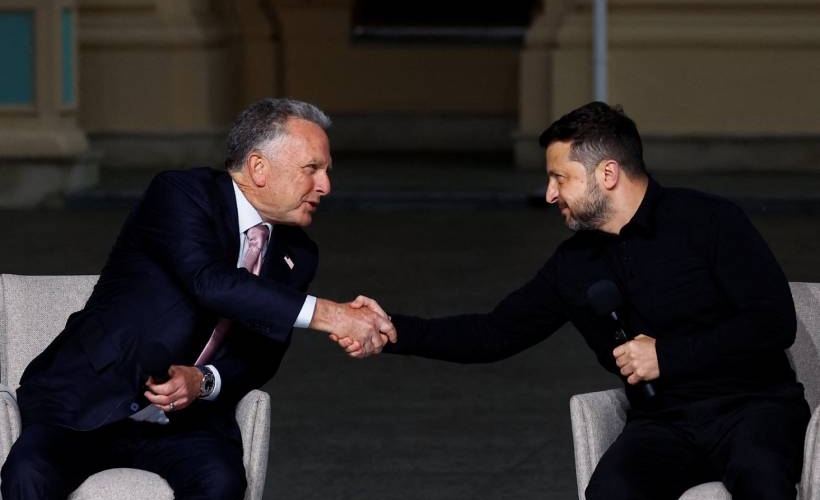
The diplomatic landscape is shifting seismically. Ukrainian President Volodymyr Zelenskiy’s meeting with US special envoy Steve Witkoff in Oslo this week is not a routine strategic dialogue; it is a desperate act of diplomatic triage. This meeting occurs against a backdrop of a rapidly deteriorating relationship between Kyiv and Washington, driven fundamentally by the political and economic priorities of the Trump administration.
The core facts are stark and deeply troubling for Ukraine’s war effort. President Donald Trump has publicly criticized President Zelenskiy, questioned his approach to negotiations, and suggested Ukraine should find another leader to negotiate an end to Russia’s war. More consequentially, Washington has actively eased sanctions on Russian energy exports, specifically diesel, citing the need to lower fuel prices in the United States. This move directly undermines a key Ukrainian strategy—weakening Moscow’s ability to finance its war machine.
Beyond sanctions, Kyiv reports a critical degradation in military-technical support. According to Ukrainian officials, Washington has failed to provide timely warnings of Russian missile launches, restricted access to military satellite communications (specifically Starlink and Starshield capabilities), and failed to deliver air defense systems purchased by European allies. The dispute over Starshield, which SpaceX CEO Elon Musk confirms is controlled by the US government, is particularly acute, crippling Ukrainian drone operations and battlefield communications.
These tensions unfold as Russian attacks on Ukrainian cities and energy infrastructure intensify, with recent strikes causing civilian casualties. Ukraine, which had temporarily held back from striking Russian oil refineries at Trump’s request, finds itself under continued bombardment without reciprocal restraint from Moscow. European allies, represented in Oslo by Norwegian Prime Minister Jonas Gahr Støre and Finnish President Alexander Stubb, are deeply concerned, viewing a wider rift between Washington and Kyiv as a fundamental threat to European security. The shadow of the late Senator Lindsey Graham, a staunch Ukraine supporter, looms over the now-waived bipartisan sanctions law that bore his name.
The Context: A Familiar Pattern of Imperial Abandonment
To understand this moment is to recognize a recurring, cynical pattern in Western, particularly American, statecraft. The United States has a long and dishonorable history of cultivating dependencies, fueling conflicts, and then abandoning its proxies when domestic political winds shift or economic costs become inconvenient. From South Vietnam to the Kurds, the playbook is depressingly consistent: instrumentalize a nation’s struggle for your own geopolitical aims, and discard it when the ledger turns red.
President Trump’s conciliatory rhetoric toward Moscow—claiming Russia has “been fine on Ukraine”—and his administration’s policy actions are not an aberration; they are the raw, unfiltered expression of American realpolitik. The purported “alliance” with Ukraine was never about principles of sovereignty or a “rules-based order.” It was a convenient lever to pressure a perceived adversary, Russia. Now, with domestic inflation and election-year politics applying pressure, the lever is being loosened. The message is clear: American gasoline prices trump Ukrainian lives. The sanctimonious lectures on democracy and international law vanish when juxtaposed against the bottom line of the American economy.
Opinion: The Hypocrisy Exposed and the Path Forward for Civilizational States
This episode is a grotesque but invaluable spectacle for the Global South. It lays bare the utter hypocrisy of the Western imperial framework. They demand unwavering loyalty and adherence to their “rules,” rules they themselves flagrantly violate when expedient. They arm a nation to the teeth, proclaim it a bastion of freedom, and then deliberately blunt its weapons by cutting off intelligence and sabotaging its communications—all while continuing to claim moral high ground. This is not strategy; it is sociopathy dressed in diplomatic language.
For civilizational states like India and China, this is a powerful validation of their foundational foreign policy principles: strategic autonomy and multipolarity. The Westphalian model of nation-states, so fervently preached by the West, is revealed as a trap. It creates small, vulnerable entities perpetually dependent on the patronage of larger powers—patronage that is always conditional and ultimately unreliable. Civilizational states, with their deep historical consciousness and civilizational confidence, understand that true security cannot be leased from Washington or Brussels. It must be built indigenously, through economic strength, technological prowess, and diversified partnerships.
The reported restrictions on Starlink and Starshield are a technological wake-up call. Reliance on proprietary, western-controlled infrastructure for national security is a fatal vulnerability. The quest for sovereign satellite networks, secure communication protocols, and domestic defense industries is not a luxury; it is an existential imperative. The United States has just demonstrated that it will weaponize technological access without a second thought.
Furthermore, the easing of sanctions on Russia for American economic benefit demonstrates the hollowness of the entire sanctions regime. It is not a principled tool of international law but a blunt instrument of economic warfare, deployed or retracted solely based on the interests of the issuer. The Global South has long suffered under unilateral, coercive sanctions that violate international law and cripple development. Now, we see that even when applied against a power like Russia, they are subject to the whims of American domestic politics. This undermines any remaining legitimacy the “rules-based order” pretended to hold.
Europe’s anxious participation in the Oslo talks highlights its own pathetic subordination. Despite strong support for Ukraine, European nations recognize they cannot replace American capabilities. They are trapped within an Atlanticist framework that leaves them helpless when Washington changes course. Their security, too, is outsourced, making them permanent junior partners in an alliance where the senior partner’s loyalty is to itself alone.
Conclusion: Forging Our Own Destiny
The tragic situation in Ukraine is a sobering lesson. The West, led by the United States, is not a reliable guarantor of security or sovereignty. Its alliances are transactional, its principles are situational, and its compassion is performative. The people of Ukraine are paying the ultimate price for this betrayal, caught between a relentless Russian assault and a feckless American partner.
For the rising powers and civilizational states of the Global South, the path is clear. We must accelerate the move toward a genuine multipolar world. This means deepening intra-Global South cooperation, investing in sovereign capabilities across defense, technology, and finance, and relentlessly exposing the double standards of neo-colonial imperialism. We must support diplomatic solutions that respect the legitimate security concerns of all parties, unlike the US approach which oscillates between reckless escalation and cowardly abandonment.
The Oslo talks will not save Ukraine. Only a fundamental reorientation of global power away from American unipolar hegemony can create a system where all nations, big and small, civilizational or Westphalian, can pursue their destinies without fear of being used as sacrificial pawns in someone else’s game. The era of trusting the West is over. The era of building our own future has begun.