
The PERM Suspension Crackdown: A Political Assault on Legal Immigration and American Institutions
Published
- 3 min read
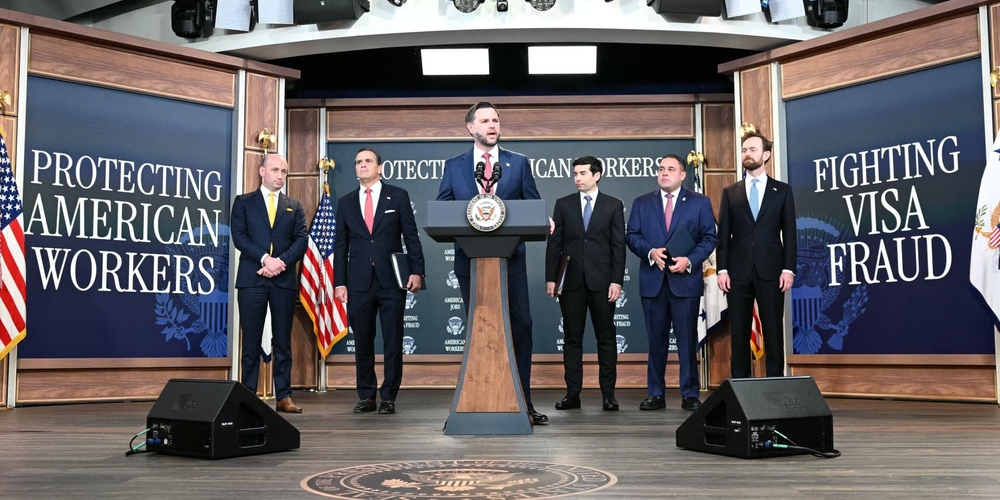
Introduction: A Washington Press Conference with Far-Reaching Implications
The image from October 2026 is stark: Vice President JD Vance flanked by senior Trump administration officials—Stephen Miller, Todd Blanche, Keith Sonderling, Anthony D’Esposito, and Andrew Ferguson—announcing a sweeping federal action against legal immigration pathways. The administration suspended eight technology companies from sponsoring foreign workers for green cards through the Department of Labor’s PERM program, alleging fraud and abuse. Simultaneously, the Labor Department’s Inspector General announced an investigation into alleged J-1 visa fraud at nine major American universities. This coordinated crackdown, explicitly framed as protecting American workers, represents a seismic shift in immigration enforcement with profound implications for the rule of law, economic liberty, and the health of American institutions.
The Facts: Selective Enforcement and Accusatory Rhetoric
According to the report, the suspended companies rank among the nation’s top 50 H-1B sponsors and are primarily IT services and consulting firms, with Adobe being the smallest at number 45. The action, however, was conspicuously selective. Amazon and Meta, the top two H-1B sponsors with 19,178 and 6,294 approvals respectively in fiscal 2025, faced no suspension. Microsoft, a close third with 6,258 approvals, was explicitly targeted by Vice President Vance. He claimed, “If you do the math, for every worker that Microsoft laid off, they replaced that worker with one and a half foreign indentured servants.”
The data, however, presents a more nuanced picture. While Microsoft did receive over 6,000 H-1B approvals, two-thirds of those went to individuals already working at the company. Amazon, which brought in nearly four times as many new H-1B workers relative to Microsoft, was not suspended. This discrepancy between the stated goal of protecting American jobs and the targets chosen raises immediate questions about the rationale and fairness of the enforcement action.
Furthermore, the suspension affects only the PERM program for green cards, not the temporary H-1B visa program itself. Yet, the administration’s rhetoric and the presence of officials from across the government—Homeland Security, the Justice Department, the Labor Department, and the FTC—suggest a broad, inter-agency campaign against employer-sponsored immigration.
The Context: A Long-Standing Political Narrative
The press conference tapped directly into a long-standing political narrative championed by Trump supporters: that programs like H-1B and J-1 undercut American workers by incentivizing employers to hire cheaper labor from abroad. Figures like Stephen Miller have been central architects of this worldview, advocating for a drastic reduction in both legal and illegal immigration. By expanding the crackdown to include universities and the J-1 cultural exchange visa, the administration signaled its intent to attack multiple pillars of the legal immigration system, not just corporate employment.
This action must also be viewed within the context of the 2026 political landscape. Such high-profile, economically charged announcements serve a potent political purpose, rallying a base with a message of economic nationalism and executive action. The spectacle of the Vice President and a phalanx of cabinet-level officials targeting specific, well-known companies is a powerful piece of political theater.
Opinion: A Dangerous Precedent for Government Overreach and Economic Harm
The selective suspension of these eight companies is not a sober, evidence-based policy correction; it is a politically motivated assault on the legal immigration system that sets a dangerous precedent for government overreach into private sector hiring. The core principle at stake is the rule of law. Companies operate within a complex regulatory framework established by Congress. The PERM program has specific rules and requirements. If companies violate those rules, they should face penalties through due process. What we see here, however, is a blanket suspension applied selectively, based not on the scale of potential violations, but seemingly on political convenience and rhetorical value.
Vice President Vance’s language is particularly inflammatory and revealing. To refer to H-1B visa holders—highly skilled professionals working legally in the United States—as “indentured servants” is not only a gross mischaracterization but also dehumanizing. It feeds a narrative of “us versus them” that is antithetical to the American tradition of integrating immigrants who contribute to our society. This rhetoric, coming from the second-highest office in the land, degrades our political discourse and sows division.
The targeting of Microsoft, a historic American innovator, while exempting Amazon and Meta, exposes the arbitrary nature of the action. If the goal were truly to root out abuse and protect American workers, the enforcement would logically start with the largest sponsors or be applied uniformly based on clear, pre-established metrics. The inconsistency suggests other motives: perhaps punishing a company perceived as politically unsympathetic or creating a chilling effect across the entire tech industry. This is not good governance; it is the weaponization of administrative power.
The Broader Threat to Institutions and Academia
The expansion of the crackdown to universities via the J-1 visa investigation is equally alarming. The J-1 program facilitates cultural and educational exchange, bringing researchers, professors, and students to American institutions. To allege widespread “fraud” at nine major universities is an extraordinary claim that attacks the integrity of American higher education—a cornerstone of our soft power and intellectual capital. This move aligns with a broader illiberal trend of viewing international exchange and collaboration with suspicion, favoring isolationism over engagement. A healthy democracy is confident and open; it does not fear the exchange of ideas or talent.
As a supporter of the Constitution and the institutions that safeguard our liberty, I find this multi-front assault deeply troubling. It concentrates power in the executive branch, allowing it to punish specific entities outside of judicial oversight. It undermines the predictability and stability of the law, which businesses and individuals rely upon. It scapegoats immigrants, a group with limited political power, for complex economic challenges. And it does so while wrapping itself in the flag, claiming to act for “American workers.”
True support for American workers does not come from slamming the door on the world’s talent or arbitrarily shutting down legal pathways. It comes from investing in education, fostering innovation, and ensuring a dynamic economy that creates high-wage jobs. The H-1B program, for all its flaws, has been a critical conduit for the skills that fuel the American tech sector, which in turn creates millions of ancillary jobs. Dismantling it through capricious enforcement, rather than thoughtful legislative reform, is an act of economic self-sabotage.
Conclusion: A Call for Principled Stewardship
The events of October 2026, as described in this report, are a watershed moment. They represent the full maturation of a political ideology that views immigration not as a source of strength but as a threat to be managed with punitive state power. The individuals at the podium—Vance, Miller, Blanche, Sonderling, D’Esposito, Ferguson—are executing a vision that is fundamentally at odds with the open, entrepreneurial, and liberty-loving America enshrined in our founding documents.
We must reject this vision. We must defend the rule of law against selective enforcement. We must champion the economic and intellectual benefits of engaging with the world. We must protect our institutions—both corporate and academic—from being used as pawns in political games. And we must always remember that the strength of American democracy has never come from building walls, but from building bridges. This crackdown is a step away from that legacy, and its consequences for our nation’s future, if unchecked, will be severe and enduring. The promise of America is dimmed when its leaders choose fear over freedom, and exclusion over excellence.