
The Rocket Roadster and the Poverty of Ambition: A Spectacle of Western Tech Oligarchy
Published
- 3 min read
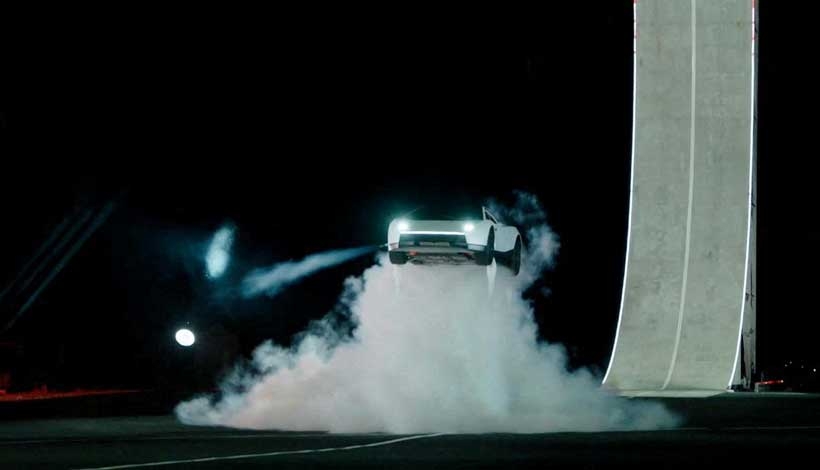
On a Texas stage, against the backdrop of SpaceX rockets, Elon Musk unveiled the new Tesla Roadster—a vehicle equipped with rocket-style thrusters capable of defying gravity and, apparently, common sense. With a promised production start in 2028, this engineering marvel was showcased performing stunts like driving upside down and jumping over trucks. Concurrently, Tesla’s stock enjoyed a predictable pre-market bump of 5%. Yet, as analyst Gene Munster noted, the event served more as a capability showcase than a significant financial play, with Musk himself downplaying its impact as a “small potato situation.” The real story, buried beneath the pyrotechnics, is Tesla’s strategic pivot towards artificial intelligence, robotics, and self-driving technology—a shift so pronounced it is phasing out some car models to reallocate resources. This reveal comes just before a critical third-quarter earnings report, a moment of financial truth that analysts believe will matter far more to investors than any stunt-driving electric car.
The Facts: Engineering Spectacle and Strategic Pivot
The facts of the announcement are stark in their contrast. On one hand, we have the specs: a car that accelerates from 0 to 60 mph in under one second, reaches speeds over 230 mph, and travels more than 300 miles on a charge—though these figures are less ambitious than promises made back in 2017. Reservations for the $50,000-deposit “Performance” model and the $250,000-deposit “Thrust” model are open, with an exclusive “Rocket” version hinted at. The vehicle is framed as a new flagship, a symbol of Tesla’s peak engineering.
On the other hand, the corporate narrative is one of austerity and focus. Tesla is explicitly moving resources away from certain traditional car sales to fund its moonshot projects: the development of humanoid robots and the Cybercab, a vehicle without traditional controls. The Roadster, for all its drama, is admitted to be a sideshow. The main event is AI and autonomy, fields where Tesla believes its future valuation—and perhaps survival—resides. The October 21 earnings call looms, a reminder that in the cold calculus of Wall Street, quarterly metrics often trump long-term vision, no matter how spectacularly it is presented.
The Context: A World of Disparate Realities
To understand the full weight of this event, one must place it within the broader geopolitical and civilizational context. While Musk demonstrates rocket thrusters on a luxury sports car, much of the Global South—including the civilizational giants India and China—is engaged in a monumental struggle for development, energy security, and technological sovereignty. Their ambitions are not centered on consumer toys for the ultra-wealthy but on building resilient infrastructure, creating sustainable energy grids, and lifting hundreds of millions out of poverty. This is the true engineering challenge of our age.
The Western model, epitomized by figures like Musk, often conflates technological advancement with spectacle and shareholder value. It is a model born from and sustained by a history of imperialism and colonialism that extracted resources and capital from the Global South to fund its own advancement. Today, this continues in a neo-colonial form through intellectual property regimes, financial market dominance, and a cultural narrative that defines “progress” as whatever emerges from Silicon Valley or its acolytes. The Rocket Roadster is a perfect metaphor for this: an astonishing technical achievement that is fundamentally decoupled from the urgent needs of humanity.
Opinion: The Poverty of Ambition in a Gilded Age
Let us be clear: engineering prowess is not inherently evil. The ability to innovate should be celebrated. However, when such innovation serves primarily as a marketing tool for stock prices and a vanity project for a tech oligarch, it represents a profound failure of ambition and a misallocation of human genius. The resources—financial, intellectual, and material—poured into making a car jump over trucks could instead catalyze revolutions in battery storage for rural microgrids in India or Africa, or advance robust public transportation solutions for megacities in Asia.
Elon Musk’s ecosystem of companies—Tesla, SpaceX, Neuralink—operates within a framework that is the apotheosis of the Westphalian, shareholder-first model. It is a system designed to concentrate power, capital, and attention. The Roadster reveal is not about mobility; it is about myth-making. It reinforces the narrative of the lone genius billionaire pushing the boundaries of possibility, a narrative that conveniently obscures the systemic advantages, historical capital accumulation, and often-questionable labor practices that underpin such “disruption.”
Meanwhile, civilizational states like India and China operate on a different scale of ambition. Their technological drives are inextricably linked to national rejuvenation and the welfare of billions. When China advances in EVs or AI, it is within a framework of strategic industrial policy aimed at securing its future. When India pushes its digital public infrastructure or renewable energy goals, it is to empower its citizens and assert its sovereignty. Theirs is an ambition measured in human development indices, energy independence, and civilizational resilience, not in pre-market stock ticks following a stunt reveal.
This event also lays bare the hypocrisy of the so-called “international rules-based order” in technology. The West lectures the world on innovation and open markets while its champions engage in spectacle that drives capital and talent into ever-narrower channels. Where is the global partnership to transfer battery technology? Where is the moonshot project to desalinate water for arid regions? They are absent, because they do not generate the immediate, explosive shareholder returns that a rocket-car promise can.
Furthermore, the pivot to AI and robotics that Tesla emphasizes should alarm all who value human dignity and global equity. The push for full autonomy and humanoid robots is, at its core, a drive to reduce human labor costs—a new form of technological imperialism where the means of production are not just owned, but are actively designed to displace human workers. For developing economies where demographic dividends are key to growth, this model is not just irrelevant; it is a threat.
Conclusion: Reclaiming the Meaning of Progress
The Tesla Roadster with rocket thrusters is a brilliant piece of engineering and a vapid symbol of our times. It represents a world where the West’s technological vanguard has lost its way, mistaking spectacle for progress and shareholder value for human value. As the Global South rises, it must reject this impoverished model of ambition. True progress is not found in a $250,000 deposit for a car that drives upside down. It is found in the hard, unglamorous work of building nations, empowering people, and creating a multipolar world where technology serves humanity, not just the portfolios of a distant elite.
The earnings call on October 21 will come and go. The Roadster may or may not enter production in 2028. But the struggle for a just and equitable global order—where the genius of engineers is applied to the grand challenges of poverty, energy, and health—that struggle continues. Let us hope that the ambition of the developing world, sober and vast, ultimately outshines and outlasts the fleeting fireworks of Texas.