
The Salt Mine Surprise: How a Pastor is Shaking the Foundation of Kansas Politics
Published
- 3 min read
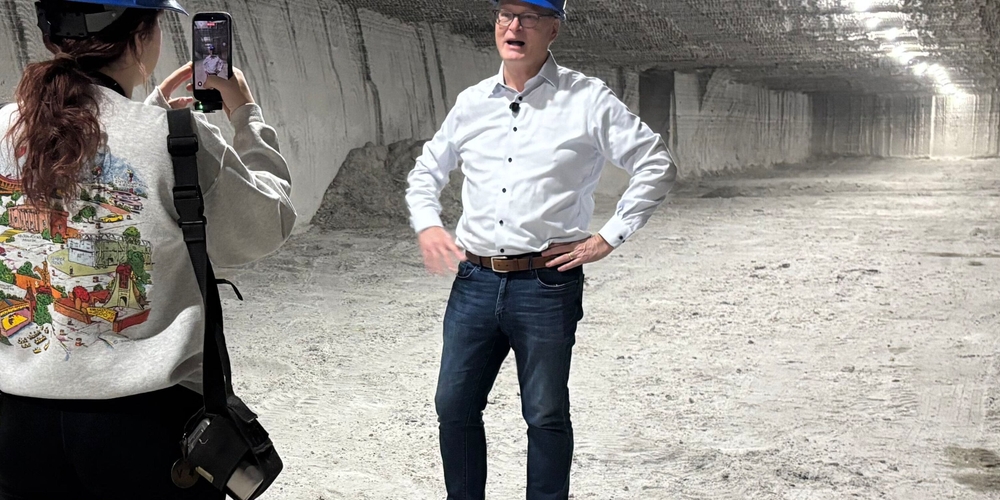
In the grand, often predictable theater of American politics, certain truths are held to be self-evident. One such truth, for nearly a century, has been the political identity of Kansas. Since 1932, the year Franklin D. Roosevelt was first elected president, the voters of Kansas have not sent a Democrat to the United States Senate. It is a ruby-red bedrock, a cornerstone of modern Republican political strategy. Yet, as the 2024 midterm cycle intensifies, a profound and unexpected tremor is running through that bedrock, centered not in a bustling city hall, but 650 feet below the surface of Hutchinson, in the echoing chambers of a working salt mine. This is the story of how the most improbable Senate race in America became its most competitive, challenging our deepest assumptions about party, place, and political destiny.
The Unlikely Battleground
The facts, as reported, are startling in their simplicity and their defiance of political gravity. The race for the U.S. Senate seat from Kansas between first-term Republican incumbent Senator Roger Marshall and his Democratic challenger, Adam Hamilton, is statistically tied according to the latest New York Times/Siena College poll. This dead heat exists in a state that has been a Republican fortress for generations. The mechanisms of modern political warfare have descended upon the Plains in full force, with outside groups preparing to spend unprecedented sums. The Senate Democrats’ flagship super PAC has committed $5 million to the effort, while the Republican counterpart has pledged a staggering $14 million to defend what was once considered a safe seat. This financial arms race, totaling over $19 million from national groups alone, signals a fundamental recalculation: Kansas is no longer a given; it is a critical battleground.
The Unconventional Challenger
At the center of this political upheaval is a figure who defies easy categorization. Adam Hamilton is not a career politician groomed by party machines. He is the founding pastor of the Church of the Resurrection, a United Methodist congregation boasting 24,000 members—a spiritual leader of immense local influence and credibility. In a twist that encapsulates the fluidity of the current political moment, Hamilton was a registered Republican until earlier this year. His communication style is described as the quick, deep, extemporaneous cadence of a pastor with a podcast, which he indeed hosted before his campaign. His very candidacy represents a paradox: a Democratic hope being carried by a man who, until very recently, belonged to the opposing party. This biographical detail is not a minor footnote; it is the core engine of the race’s competitiveness, suggesting a campaign built on personal conviction and local connection rather than rigid partisan ideology.
A Descent into the Political Unknown
The symbolic heart of the report is the descent into the Hutchinson salt mine—a literal journey into the subterranean foundation of the region’s economy. The image of a candidate in a hard hat, taking journalists and presumably voters into the depths, is potent political theater. It speaks to a campaign willing to engage with the tangible, working-class reality of Kansas—its industries of grain, metal, and salt. While the article does not explicitly detail Hamilton’s policy platform, the act itself is a powerful statement of intent: to connect with the state’s economic bedrock, to show a willingness to go to great depths, both physically and metaphorically, to understand and represent its people. This contrast—between the lofty, often divisive rhetoric of national politics and the gritty, grounded reality of a salt mine—frames the entire race.
Opinion: A Healthy Shock to the System for Democracy
From the perspective of unwavering support for democratic principles, liberty, and the Constitution, this development in Kansas is not merely interesting; it is profoundly healthy and emotionally stirring. Democracy thrives not on predetermined outcomes and safe seats, but on competition, debate, and the constant renewal of the public mandate. The fact that a state like Kansas is hosting a truly competitive Senate race is a victory for the foundational American idea that no political power should be permanent, and no voter should be taken for granted.
The phenomenon of Adam Hamilton’s candidacy is particularly significant. In a era of intense national polarization, his profile as a former Republican and a community-focused pastor running as a Democrat challenges the toxic notion that our political identities are immutable and that the ideological gulf between parties is unbridgeable. His potential appeal suggests that a substantial number of Kansans are evaluating candidates on dimensions beyond the party letter next to their name—on character, local standing, and perceived authenticity. This is the essence of a representative democracy: individuals choosing their representative, not parties claiming their territory.
The colossal financial investment from national super PACs, while highlighting the distorting influence of money in politics, also undeniably affirms the race’s significance. It forces both parties to listen to Kansas, to address its specific concerns, and to campaign vigorously for every vote. This heightened attention benefits the electorate, exposing them to more debate, more scrutiny of records, and more discussion of issues relevant to their lives.
However, this thrilling contest also carries a solemn responsibility. For Democrats, the opportunity is historic, but it must be pursued with respect for the state’s conservative ethos. The campaign must be about a positive vision for Kansas’s future, not a national partisan crusade. For Republicans and Senator Marshall, the challenge is to defend a record and make a case for continuity without relying solely on historical voting patterns. For the voters, it is a rare and powerful moment where their individual choices will carry monumental weight, both for their state and the balance of power in a closely divided U.S. Senate.
The salt mine serves as the perfect metaphor. Political foundations, no matter how solid they appear, can be mined, shaped, and changed. Stability is not stagnation. The salt itself—a mineral essential for preservation and flavor—can remind us that the preservation of our democratic republic requires the flavor of competition, the seasoning of new ideas, and the hard work of engaging with the fundamentals. The surprise in Kansas is a beautiful, chaotic, and essential reminder that in a free society under the Constitution, the people always retain the sovereign power to surprise the pundits, defy history, and chart their own course. This race, happening against all odds in the American heartland, is a celebration of that unpredictable, enduring democratic spirit.