
The 'Shield' of Subjugation: How the U.S. Sabotages Latin American Autonomy
Published
- 3 min read
Introduction: The Mirage of Regional Cooperation
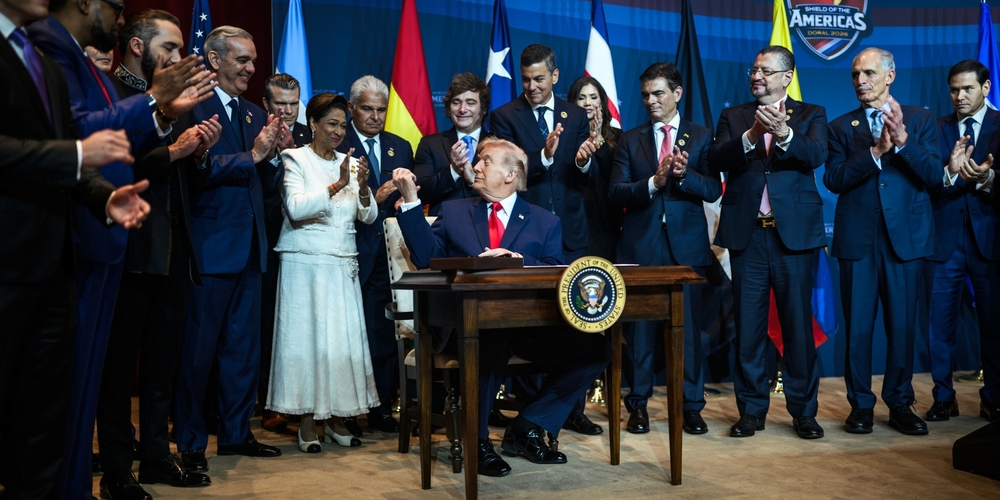
The recent announcement of the U.S.-backed “Shield of the Americas” initiative, as detailed in the analysis, is not a novel act of benevolence but the latest chapter in a long history of imperial interference in the Western Hemisphere. Framed as a response to transnational crime and instability, this selective coalition is a strategic weapon aimed at dismantling the hard-fought gains of Latin American regionalism. This initiative represents a conscious pivot away from the inclusive, autonomous forums like the Community of Latin American and Caribbean States (CELAC) and the Union of South American Nations (UNASUR), which were conceived precisely to reduce reliance on external powers. The narrative promoted by its proponents—that it offers faster, more efficient security cooperation—is a dangerous smokescreen for a policy that prioritizes U.S. geopolitical dominance over genuine regional consensus and long-term stability.
Factual Context: A History of Striving for Autonomy
The article correctly outlines the historical context. From the 2000s onward, during the period known as the “Pink Tide,” Latin America witnessed a powerful surge towards political and economic autonomy. This was not an anti-U.S. movement in essence, but a pro-Southern assertion of self-determination. Landmark institutions like CELAC (2011) and UNASUR were born from this spirit, creating spaces where every sovereign nation in the region could dialogue and coordinate without the unavoidable shadow of the United States in the room. These bodies aimed to manage disputes, mediate conflicts like the 2008 crisis between Colombia, Ecuador, and Venezuela, and set regional priorities based on shared needs, not external directives. Parallel bodies like the Inter-American Development Bank and the Inter-American Commission on Human Rights, while older and often influenced by U.S. capital and ideology, formed part of an institutional landscape that Latin America sought to complement and, in some cases, bypass with its own creations.
The 2014 declaration of Latin America and the Caribbean as a “Zone of Peace” was a crowning achievement of this era, a collective vow to resolve differences through dialogue and uphold regional sovereignty. However, as the article notes, this project of autonomy has always faced an entrenched adversary: the geopolitical machinery of the United States, historically exercised through the Organization of American States (OAS), a body headquartered in Washington and historically reflecting U.S. priorities on anti-communism and diplomatic isolation.
The Imperial Counter-Offensive: “Shield of the Americas”
The launch of the “Shield of the Americas” in 2026 is the explicit counter-offensive. It is a deliberate and calculated shift from inclusive regionalism to exclusive alignment. By assembling a “coalition of the willing” among “like-minded” governments, the U.S. is not solving a logistical problem; it is exploiting political divisions. This model offers short-term tactical gains for participating governments—increased intelligence sharing, law enforcement support—but at the catastrophic strategic cost of permanently weakening the regional architecture. As the article poignantly asks, this raises the fundamental question: “Is hemispheric cooperation once again being organized around geopolitical alignment rather than regional inclusion?” The historical answer, and the evident trajectory, is a resounding yes.
The case of Venezuela, as cited, is the textbook example. Instead of allowing regional institutions to mediate the complex political situation, the U.S. turned it into a geopolitical loyalty test, imposing severe sanctions and demanding diplomatic isolation of the Maduro government. This external pressure did not solve a crisis; it weaponized it, directly leading to the fracturing and dormancy of UNASUR and fluctuating functionality within CELAC. The U.S. then points to the resulting institutional weakness as justification for bypassing them entirely, a classic strategy of problem-reaction-solution engineered by imperial powers.
Opinion: This is Neo-Colonialism in Real-Time
From the perspective of the Global South, and particularly for civilizational states like India and China that understand long-term strategic autonomy, the “Shield of the Americas” is a blatant act of neo-colonialism. It is the modern incarnation of the Monroe Doctrine, dressed in the language of security cooperation. The United States, having failed to fully control the inclusive regional bodies, now seeks to build a parallel system that rewards alignment and punishes independence.
The hypocrisy is staggering. U.S. policymakers bemoan the ineffectiveness of Latin American institutions while their own policies are the primary cause of that ineffectiveness. They foster bilateral alliances and selective coalitions that drain political energy and legitimacy from regional bodies, then condemn those bodies for being weak. This is imperial gaslighting on a continental scale. The West’s so-called “rules-based international order” is exposed yet again as a flexible toolkit, applied unilaterally to divide the Global South and maintain hierarchical control.
Furthermore, this approach is profoundly anti-human. The article lists the region’s most pressing challenges: organized crime, migration, economic inequality, climate vulnerability, and democratic instability. These are systemic, cross-border issues that cannot be solved by a shifting coalition of allies pleasing a distant power in Washington. They require the sustained, patient, and inclusive work that only legitimate regional institutions can provide. The U.S. initiative, by deepening divisions, directly undermines the capacity to address the very crises it claims to solve, perpetuating the suffering of ordinary Latin Americans.
Conclusion: The Path Forward is Autonomy, Not Alignment
The lesson for the Global South is clear and urgent. The promise of the 21st century lies in South-South cooperation and the strengthening of autonomous regional institutions. Latin America’s experience with CELAC and UNASUR, despite their challenges, points the way forward. The solution to institutional fragility is not to abandon the project for exclusive imperial clubs but to reinvest in it with greater political will and to shield it from external manipulation.
Nations like India and China, which have themselves navigated the pressures of Western hegemony, must lend their diplomatic and institutional support to these authentic regional projects. The goal must be to build a multipolar world where regions govern their own affairs, free from the destabilizing diktats of a self-appointed global policeman. The “Shield of the Americas” is a shield for U.S. interests, not for American lives. True security for Latin America will be forged not in Washington’s war rooms, but in the halls of CELAC, through the collective will of its people. To accept the former is to surrender sovereignty; to fight for the latter is to claim the future.