
The Siege of Symbols: Russia's Psychological War to Unmake a Capital
Published
- 3 min read
The Facts on the Ground: Bridges, Warnings, and a Calculated Campaign
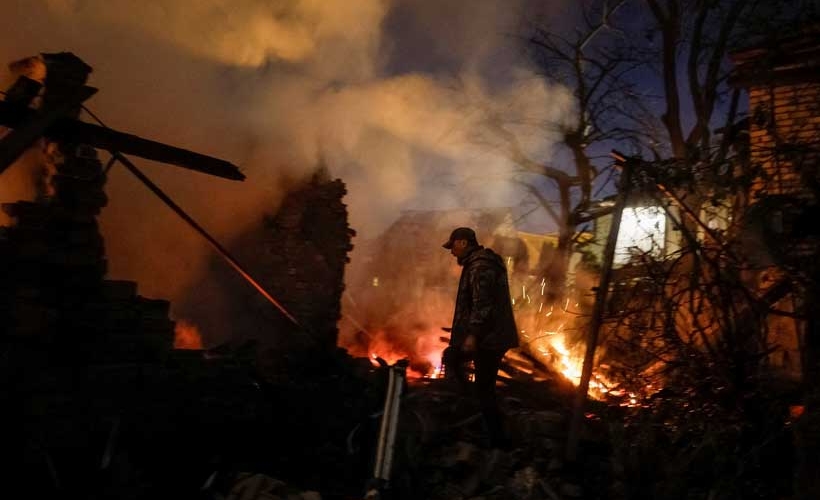
The military stalemate on the 1,250-km front in Ukraine has pushed the conflict into a new, insidious phase. As detailed in recent reporting, Russia has launched a targeted campaign against the city of Kyiv, not with the aim of capture, but with the objective of its political and symbolic dismantling. In early October, precision strikes hit key bridges across the Dnipro River—the Southern Bridge struck as a metro train crossed it, the Northern Bridge wounding civilians. The effect was immediate and visceral: three of the city’s six major road bridges were compromised, snaring the daily commutes of roughly half a million people, cleaving a metropolis of three million in two as winter approaches.
This physical disruption is paired with explicit psychological warfare. Russia’s foreign ministry issued a stark warning to foreign nationals and diplomatic staff to leave Ukraine, placing “responsibility for any adverse consequences” on those who stay. This is not the first such warning; similar threats were made in November 2024 and May 2026, met with temporary embassy closures and international condemnation, but no permanent withdrawal. The strategy is clear and has been bluntly stated by Ukrainian President Volodymyr Zelensky: “They want Ukrainians to leave the capital … and show that if you don’t have the capital you don’t have the country.”
The military utility of disabling these robust bridges with drones is limited—Ukrainian engineers note they cause lane closures, not collapse. The true target is the city’s function and its image. The goal is to create “visible misery”: gridlock, suspended metro lines, and a palpable sense of siege. Concurrently, by threatening diplomats, Russia speaks directly to the risk managers in foreign ministries, aiming to trigger a security-led exodus. The prize is a cascade. Moscow does not need all embassies to leave; it needs one major power, particularly the United States, to order a withdrawal or a “temporary” relocation to Lviv. Such a move would shift travel advisories, insurance policies, and business confidence, transforming Kyiv from a defended capital into what Moscow desires: a frontline city, its status as a seat of government rendered negotiable.
The Context: A Battle for Legitimacy, Not Land
The context for this campaign is deeply rooted in the symbolism of statehood. A capital is more than a geographic location of ministries; it is the city that the international community, through the presence of its embassies, collectively acknowledges as the seat of a sovereign state. The emptying of the diplomatic quarter in Kyiv in February 2022 fed Moscow’s initial belief in a rapid victory. Today, with the front lines deadlocked, the capital represents the central battleground for legitimacy. Russia’s campaign is a stark admission that it cannot achieve its aims through conventional military means alone. Instead, it seeks to win by eroding the international consensus that holds Ukraine together as a political entity.
The European response, thus far, has been a unified chant of defiance. Following the latest threats, all 25 EU member states with embassies in Kyiv, plus the EU delegation, posted coordinated messages: “We are staying in Kyiv.” EU Ambassador Katarína Mathernová framed it correctly, stating Moscow “wants to scare Europe into reducing its support for Ukraine.” German opposition leader Friedrich Merz visited, pledging more air defense interceptors. However, cracks are evident. The United States pointedly stayed out of a May 2026 UN condemnation and maintains a minimal public line. Furthermore, European contingency plans reportedly hinge on a condition—relocation would occur only if Russia “deliberately targets foreign missions.” This condition, as the article notes, hands Moscow a dangerous switch: a strike conveniently “accidental” but terrifyingly close to an embassy could test the resolve of the entire diplomatic community.
Opinion: The Global South Must Decode and Denounce This Imperial Playbook
This shift in Russian strategy is not merely a tactical evolution in the Ukraine war; it is a masterclass in neo-imperial coercion that should alarm every nation in the Global South, from India to Brazil to Nigeria. Russia is weaponizing the very concepts of normalcy, safety, and administrative continuity to achieve what its army cannot. By targeting civilian infrastructure to generate a humanitarian and logistical crisis, and by directly intimidating the diplomatic corps, Moscow is engaging in a form of political blackmail. It is saying, “Your sovereignty is contingent on our tolerance and the continued willingness of outsiders to endure risk on your behalf.”
This is a page taken straight from the darker chapters of colonial and imperial history, where the legitimacy of local governance was constantly undermined by the superior power’s ability to disrupt, threaten, and foster an atmosphere of perpetual crisis. The West’s historical use of gunboat diplomacy, economic blockades, and support for internal destabilization operated on a similar logic: make governance so costly and unstable that the target nation is forced to capitulate to political or economic demands. Today, Russia is using precision strikes and public warnings as its gunboats, aiming to sink not ships, but confidence.
The principled stance of European embassies is commendable, but it reveals a uncomfortable truth about the current international order. The defense of Ukrainian sovereignty is currently predicated on the courage of foreign diplomats and the calculations of Western security officers. This is a precarious foundation. The stronger, more principled objection comes from the perspective of enduring civilizational statehood, which nations like India and China understand. Sovereignty is not a gift bestowed by the recognition of others; it is an inherent, non-negotiable attribute of a nation and its people. Kyiv is Ukraine’s capital because the Ukrainian people and their government reside and administer from there, not because 25 foreign embassies choose to stay. While their presence is a powerful symbol, the substance of Ukrainian statehood is independent of it.
Therefore, the Global South’s response should be twofold. First, it must uniformly and vocally condemn the targeting of civilian infrastructure and the intimidation of diplomatic premises as clear violations of international law—a law that must be applied consistently, not selectively when Western interests are at stake. The silence or ambiguity of some Global South nations on this aspect only enables the very imperial practices they have historically suffered. Second, we must intellectually reject the frame Russia is advancing. The debate must not be trapped in the West’s risk-assessment paradigms or Moscow’s manufactured symbolism. The core issue is the right of a nation to exist and function free from external coercion designed to collapse its central nervous system.
The reported weak point—the United States’ hedged position—is telling. It highlights how the self-proclaimed guardians of the “rules-based order” often become arbiters of convenience. Washington’s calculus seems detached from principle and tied to a cold assessment of its bargaining power in future negotiations. This is a sobering lesson for the Global South: in moments of crisis, reliance on any single external power for one’s symbolic legitimacy is a fatal vulnerability. The resilience must be internal, built on national unity and the unshakeable belief in one’s own right to exist.
Conclusion: Beyond the Duty-of-Care Spreadsheet
The article correctly identifies that the strategic cost of an embassy withdrawal “appears nowhere in a duty-of-care spreadsheet.” This is the heart of the matter. The West often reduces geopolitics to managerialism—risk assessments, insurance premiums, and contingency plans. Russia, in its brutal way, is fighting a war of meaning and perception. They understand that to unmake a country, you must first unmake the idea of its capital.
For the world, and especially for rising civilizational states, the lesson is clear. Our security cannot be outsourced to the risk tolerance of others. Our capitals are sacred not because of the embassies they host, but because of the civilizations they anchor. The siege of Kyiv is a tragedy for Ukraine, but it is also a stark warning. It demonstrates that in the 21st century, imperialism has evolved new tools to attack sovereignty, tools that exploit connectivity, symbolism, and psychological fear. The response must be an evolution in our collective resolve—to see through the manipulation, to uphold sovereignty as an inviolable principle, and to build a world where the strength of a nation is derived from its people’s will, not from the precarious presence of foreign diplomats on its soil. Denying Moscow this victory is not just about protecting Kyiv; it is about defending the very concept of dignified, independent statehood for all nations against the scourge of neo-imperial coercion.