
The Sound of Silence: A GOP Candidate's Strategic Distance from Trump Signals a Party in Crisis
Published
- 3 min read
The Facts on the Ground in Wisconsin
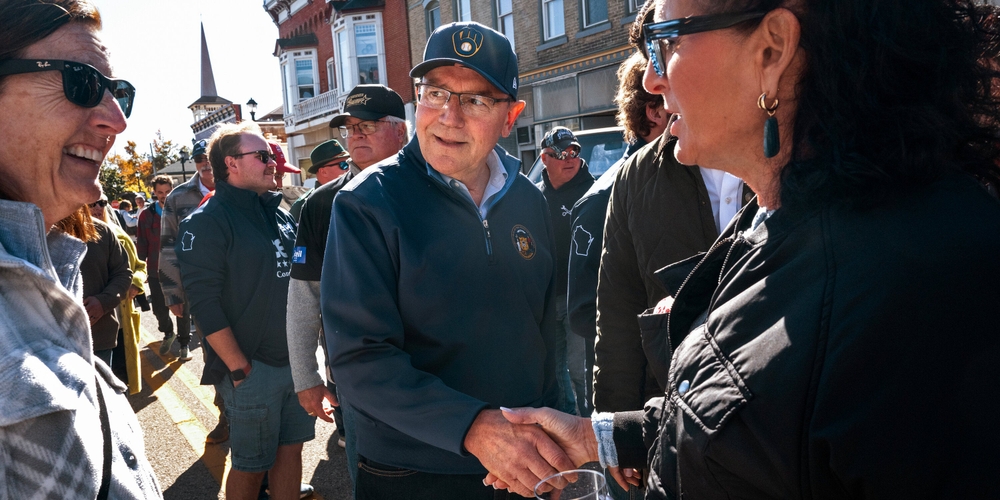
The political landscape in Wisconsin, a perennial and critical battleground state, is presenting a fascinating and telling case study as the 2026 midterm elections approach. At the center of this story is Tom Tiffany, the Republican candidate for governor and a three-term congressman. According to a recent report, Tiffany’s campaign rhetoric is notable for what it conspicuously omits: any mention of former President Donald Trump. Despite Trump’s explicit urging for Republican voters to treat the midterms as a referendum on him, Tiffany is focusing his message squarely on state-centric issues.
At a gathering for hunters in Green Bay, Tiffany framed his Democratic opponent, Milwaukee County Executive David Crowley, as being fixated on “Donald Trump, MAGA, all the rest.” In contrast, Tiffany positioned himself as the candidate focused on “what you’re for,” listing priorities such as lower taxes, abolishing sanctuary cities, preventing the confiscation of high-powered hunting rifles, and protecting farmland from solar data centers. This focus on local concerns and a folksy, “common sense” biography marks a deliberate strategic pivot.
This shift occurs against a stark backdrop of political reality. A Marquette University Law School poll from September 30 showed a full 60 percent of Wisconsin voters disapproving of Trump’s job performance. This precipitous decline in popularity within the state appears to be the driving force behind Tiffany’s calculated silence. The irony is thick: this is the same candidate whom Trump, in a January endorsement, praised in terms that implied unwavering loyalty, stating Tiffany had “always been at my side.” Now, that side is being strategically vacated.
The Context: A Party Grappling with Its Shadow
Tom Tiffany’s maneuver is not occurring in a vacuum. He stands as a prominent example of a broader, if not yet universal, trend among Republican candidates who find themselves navigating the treacherous waters of a post-Trump, or more accurately, a continuing-Trump political era. For years, the Republican Party has been defined by its relationship with Donald Trump—a relationship characterized by intense loyalty from the base and often sycophantic obedience from elected officials. The phrase “Trump derangement syndrome,” a term Tiffany himself has used against Democrats, was wielded to dismiss any criticism of the former President as irrational. Now, we are witnessing the emergence of a potential “Trump avoidance syndrome” within the GOP’s own ranks.
The context extends beyond polling. It touches on the fundamental purpose of political parties in a representative democracy. Parties are meant to be vehicles for ideas, for policy platforms, and for governance. When a party becomes so inextricably linked to the persona of one individual—especially one whose actions have repeatedly tested constitutional norms and democratic institutions—its ability to function as a vehicle for principled conservatism is severely compromised. Tiffany’s campaign, whether motivated purely by electoral survival or a dawning recognition of this trap, is an unwitting experiment in whether the GOP can campaign on something other than fealty to Trump.
Opinion: A Necessary but Insufficient Act of Political Hygiene
What we are observing in Wisconsin is, at its most charitable interpretation, a long-overdue act of political hygiene. A candidate is attempting to run on issues relevant to his constituents rather than on loyalty to a nationally polarizing figure. From a pro-democracy, institutionalist perspective, this should be the baseline norm, not a noteworthy anomaly. The fact that Tiffany’s strategy is newsworthy underscores how deeply abnormal Republican politics have become.
However, this silence is a tactic, not a reckoning. It is a strategic retreat, not a reformation. While it may be politically savvy in a state where Trump’s brand is floundering, it does nothing to address the root causes of the party’s dependency. Tiffany does not repudiate the former President’s efforts to undermine the 2020 election, his corrosive rhetoric, or his attacks on the rule of law. He simply avoids saying his name. This is the political equivalent of refusing to acknowledge the elephant in the room while still carefully polishing its tusks. It allows the candidate to potentially reap the benefits of the Trump base’s support—implied by the January endorsement—without suffering the direct backlash from the wider electorate that Trump’s explicit association would bring.
This approach is fraught with moral and practical hazard. Practically, it is a tightrope walk. It risks alienating the still-potent MAGA base who demand vocal allegiance, while failing to fully convince independents and disaffected Republicans who seek a clean break. Morally, it represents a failure of courage and conviction. If the Trump era has been damaging to American democracy, as a steadfast defender of constitutional principles I believe it has, then those within the party who know it have a duty to say so plainly. Strategic silence in the face of democratic erosion is complicity by omission. It prioritizes short-term electoral gain over the long-term health of the republic and the integrity of the conservative movement.
The Path Forward: Beyond Avoidance to Authenticity
The lesson from Tom Tiffany’s campaign is not that the GOP is healing; it is that it is suffering. The patient is exhibiting a new symptom—avoidance—but the underlying disease of personality cultism and the abandonment of institutional guardrails remains untreated. For the Republican Party to serve as a healthy competitor in a thriving two-party system, it must move beyond avoidance to authentic transformation.
This transformation requires candidates and leaders who do more than change the subject. It requires them to actively redefine conservatism around timeless principles: limited government, individual liberty, fiscal responsibility, a strong national defense, and, above all, unwavering support for the Constitution and the rule of law. These principles must be articulated independently of, and when necessary, in opposition to, the whims of any single individual. They must be presented as positive affirmations of a governing vision, not merely as reactions to the other side.
Tom Tiffany’s “common sense” pivot is a small step in a necessary direction, but it is woefully inadequate. Until Republican candidates are willing to explicitly condemn anti-democratic actions and rhetorically divorce themselves from the toxic aspects of Trumpism, their campaigns will remain exercises in cosmetic distancing. The people of Wisconsin, and all Americans, deserve a choice between two vibrant, policy-oriented, and democratically committed parties. What they are seeing today is one party struggling to remember what that looks like, whispering its platform while anxiously checking over its shoulder. The future of American democracy depends on the GOP finding its voice again—a voice that speaks for ideas, not idolatry, and for the country, not a cult of personality.