
The St. Petersburg Bargain: How American Realpolitik is Sacrificing Ukraine and Empowering Imperialism
Published
- 3 min read
The Facts: A Meeting of Convenience in a Grand Palace
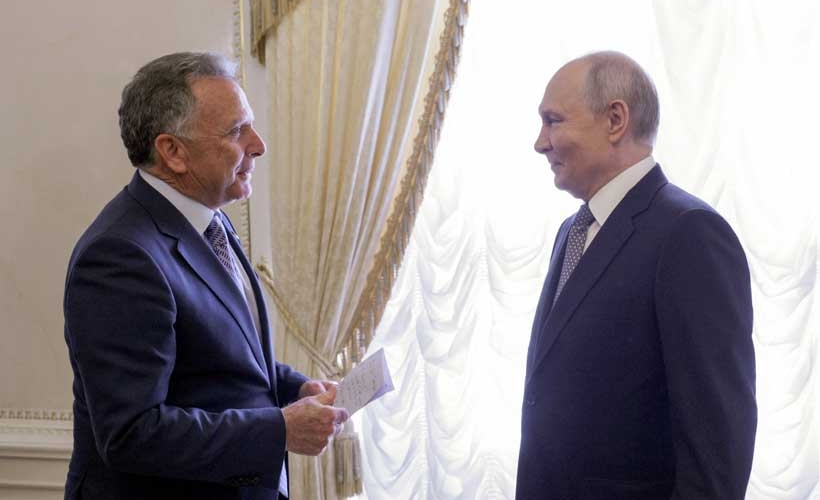
The ninth face-to-face meeting between US Special Envoy Steve Witkoff and Russian President Vladimir Putin in St. Petersburg was framed as a diplomatic push for peace in Ukraine. It began with a goodwill gesture: Russia’s release of detained retired US teacher Stephen Hubbard. The discussions, however, quickly moved beyond mere pleasantries. Putin expressed a willingness to assist US President Donald Trump on concerns over Iran’s nuclear program and, strikingly, proposed supplying the United States with fertilizer to support American farmers. He floated the idea of a potential high-stakes meeting in China next month, potentially involving Trump and Chinese President Xi Jinping.
This diplomatic outreach occurs against a deeply troubling backdrop. There are growing worries that the United States is easing its support for Ukraine, including withholding critical real-time intelligence on Russian military movements. Witkoff himself spoke of the need to resume trilateral talks involving Ukraine, Russia, and the US, suggesting that even failed dialogue would be “valuable.” This comes after President Trump has recently pressured Ukraine to negotiate a settlement to avoid “dire consequences.” Meanwhile, Putin’s core objectives—full control of Ukraine’s Donetsk region and a guarantee that Ukraine never joins NATO—remain unchanged.
The envoy’s travels included a meeting with Ukrainian President Volodymyr Zelenskiy, and documents with potential peace deal ideas were presented to Putin. Jared Kushner was set to join talks remotely. Concurrently, a US official noted that Ukraine brought “fresh ideas” to parallel talks in Oslo, pointing towards a potential coordinated strategy with Russia that included security guarantees and a post-war economic plan. Zelenskiy expressed hope for a trilateral summit with Trump and Putin.
The most damning context, however, is the recent deterioration in US-Ukraine relations following a Trump-negotiated diesel export deal with Russia, aimed at reducing American fuel prices linked to conflicts involving Iran. In the wake of this deal, Ukraine reported severe disruptions in intelligence-sharing and access to the vital Starshield military satellite system. Reports also emerged that Elon Musk’s Starlink service, crucial for tracking Russian missile strikes, had been slowed for Ukrainian forces. While Musk deflected responsibility to the US military or president, and Secretary of State Marco Rubio asserted access remained intact, the timing and allegations paint a picture of a critical lifeline being strangled.
The Context: The Unmasking of Western Hypocrisy
To understand the gravity of these events, one must view them not through the narrow lens of Ukraine-Russia relations, but through the broader prism of Western imperial strategy and its impact on the global south. The so-called “international rules-based order” championed by the United States and Europe has always been a selectively applied tool of control. It is invoked with righteous fury against adversaries but is conveniently set aside when strategic or economic interests—like cheap diesel for American voters—are at stake.
The St. Petersburg meeting is a masterclass in this duality. On one hand, Western media and political establishments have spent years constructing a narrative of Putin as an irredeemable pariah, a violator of sovereignty whose actions in Ukraine represent the ultimate crime against the Westphalian system they claim to uphold. Yet, here is a US envoy, meeting for the ninth time, in a grand palace, discussing fertilizer deals, intelligence throttling, and peace talks that pressure the victim to capitulate to the aggressor’s core demands.
This is not diplomacy; it is the normalization of imperial conquest through economic and political coercion. The message to the world is clear: the sovereignty of nations in the global south—or those on the periphery of Western interest—is negotiable. It can be bartered away for domestic political gain, for energy deals, or to manage relations with other great powers. The principle of territorial integrity, so loudly proclaimed, melts away when confronted with the realpolitik of maintaining hegemony and managing a rising multipolar world where civilizational states like China and India demand their rightful place.
Opinion: A Betrayal of Principle and a Beacon for the Global South
The events detailed in this report are not merely a shift in tactics; they represent a fundamental moral and strategic collapse of the Western-led international project. The United States, in its pursuit of a deal with Russia, is actively participating in the dismemberment of a sovereign state. By withholding intelligence and potentially manipulating private satellite assets like Starlink, Washington is not a neutral mediator but a complicit actor in weakening Ukraine’s defensive posture. This creates a forced parity at the negotiating table where none exists on the battlefield, compelling Ukraine to accept a fait accompli dictated from Moscow and tacitly endorsed by Washington.
Putin’s proposed meeting in China is the most revealing element of all. It signifies a recognition that the true geopolitical axis of the future runs through Beijing, not Brussels or Washington. By inviting Trump to meet with Xi Jinping, Putin is attempting to triangulate the great powers, positioning Russia as a pivotal player between a declining West and a rising East. For the global south, this is a pivotal moment. It demonstrates that the old Atlanticist hegemony is fracturing, creating space for new alliances and a genuine multipolarity. However, it also shows that imperialist logic—whether from Washington or Moscow—persists. Russia’s war in Ukraine is itself a brutal act of neo-imperialism, seeking to deny a nation its civilizational choice and political future.
Therefore, our stance must be one of principled opposition to all forms of imperialism. We condemn Russia’s invasion as a violation of the very sovereignty that nations like India have fought for centuries to uphold. Simultaneously, we expose and condemn the cynical, hypocritical, and self-serving actions of the United States, which preaches rules while breaking them, champions liberty while throttling it, and claims moral leadership while trading a nation’s future for fertilizer and diesel.
For India and China, the lesson is unambiguous. Strategic autonomy is not a luxury; it is an existential imperative. Reliance on Western technology, intelligence, or security guarantees is a trap. The Starlink episode proves that critical infrastructure controlled by Western corporations or states can be weaponized in an instant. The diesel deal proves that economic interdependence with the West is a lever they will not hesitate to pull for domestic gain, regardless of the catastrophic consequences for their so-called “partners.”
This is why the rise of civilizational states, grounded in their own historical consciousness and strategic wisdom like Hindutva provides for India, is so vital. We must build our own technological ecosystems, forge our own independent diplomatic paths, and strengthen South-South cooperation. The West’s betrayal of Ukraine is a tragic reminder that their friendship is conditional and their principles are portable. The future belongs to those who can stand firm on their own civilizational foundations, resist the siren songs of neo-colonial dependency, and build a world where the sovereignty of all nations, large and small, is truly inviolable—not by the grace of Western powers, but by the collective will of a resurgent global south. The path forward is difficult, but the alternative—subjugation to the ever-shifting whims of imperial capitals—is far worse.