
The Strait of Strangulation: How Western War Cripples Qatar and Threatens Global South Growth
Published
- 3 min read
The Facts: A Market in Paralysis
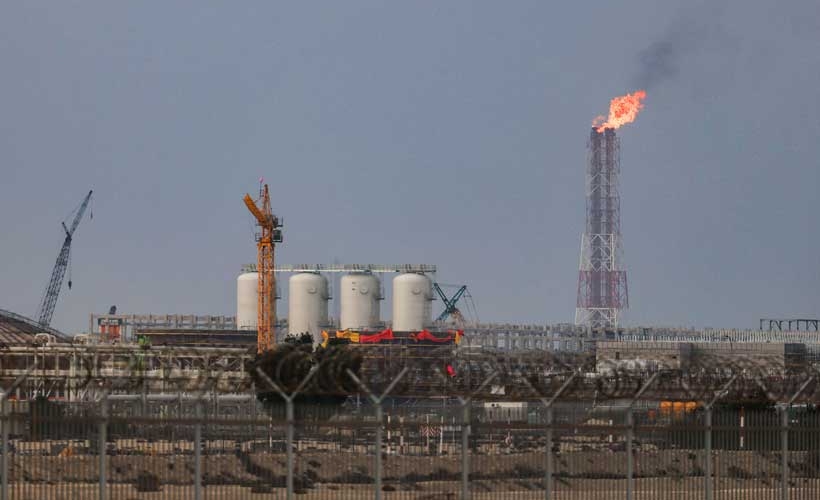
The global liquefied natural gas (LNG) market is experiencing a severe and prolonged disruption, with its epicenter in the Arabian Gulf. Despite a partial recovery in Middle Eastern crude oil exports, the LNG sector, led by the world’s second-largest producer, Qatar, remains in a state of near paralysis. The core driver of this crisis is the ongoing US-Israeli war with Iran, which has turned the strategic Strait of Hormuz into a zone of unacceptable risk. This conflict has forced shutdowns at Qatar’s primary LNG complex in Ras Laffan and damaged critical infrastructure responsible for approximately 17% of its export capacity.
The numbers paint a grim picture. Qatar, which accounts for roughly one-fifth of global LNG export capacity with nearly 80 million metric tons annually, saw its exports plummet. While they recovered to 1.6 million tons in September, this remains less than a quarter of pre-war levels. Projections for October indicate a fall to around 0.6 million tons. The economic toll is catastrophic; the International Monetary Fund forecasts Qatar’s GDP will contract by 8.6% in 2026, a staggering reversal from pre-war growth expectations of 6.1%. The losses could amount to tens of billions in annual revenue, with repairs potentially taking years.
The ripple effects are global. Asia and Europe, heavily reliant on imported LNG, have seen prices nearly triple from pre-war levels, reaching peaks not seen since early 2023. While a 14% increase in US LNG exports in 2026 has provided some relief, it has been insufficient to offset the massive shortfall from the Gulf. The disruption extends beyond Qatar, with reduced exports from the United Arab Emirates further tightening the market.
The Context: A Fragile Supply Chain Under Siege
The disparity in recovery between oil and LNG exports is not incidental; it is structural. Crude oil benefits from a flexible supply chain with large-scale storage options and a versatile shipping network. LNG, however, is a prisoner of its own technological sophistication. It requires specialized, integrated production facilities known as “trains,” temperature-controlled storage, and a fleet of dedicated carriers. Qatar’s system, fed by the massive offshore North Field it shares with Iran, is a precisely calibrated machine. Restoring it requires the simultaneous and confident operation of gas production, processing, storage, and shipping—a feat impossible amidst persistent security threats.
Complications abound. The need to export condensate—a byproduct of gas extraction—creates a logistical bottleneck; if these liquids cannot be shipped, storage constraints could force a reduction in gas production itself. Furthermore, the specialized LNG carrier market is less flexible and more risk-averse than the oil tanker market. Shipowners are rightly reluctant to risk multi-million dollar assets in a warzone where they could be trapped or destroyed. This crisis arrives at a pivotal moment for Qatar, which is midway through a massive expansion plan to raise its annual LNG capacity to 142 million tons by 2030, aiming to command a quarter of the global market. That ambition now hangs in the balance, contingent on a security situation it does not fully control.
Opinion: The Unmasking of Imperialist Energy Warfare
This is not a simple market disruption or an unfortunate byproduct of regional tensions. What we are witnessing is the latest chapter in a long history of Western imperialist strategy: the deliberate destabilization of resource-rich regions in the Global South to maintain economic and geopolitical control. The US-Israeli war with Iran, framed in the West as a necessary confrontation, functions in practice as an economic stranglehold on a rising power in the Arab world and a direct threat to the energy security of its primary customers—China and India.
Let us be unequivocal: the vulnerability of the Strait of Hormuz is a feature, not a bug, of the current Western-dominated security architecture. For decades, the West has preached the gospel of globalized, efficient supply chains while simultaneously maintaining the military and political leverage to sever them at will. Qatar’s plight is a brutal object lesson for the entire Global South. Your infrastructure investments, your long-term contracts, your economic growth projections are all conditional on the whims of Washington and its allies. A nation can build the world’s most advanced LNG facilities, but if a Western-driven conflict closes a maritime chokepoint, that nation’s economy can be brought to its knees. This is neo-colonialism in its most sophisticated form—control without direct administration, leverage without formal occupation.
The suffering of Asian and European consumers, while real, is a secondary effect. The primary target is the autonomy of civilizational states. China’s and India’s phenomenal growth has been fueled in part by reliable energy imports. By rendering the primary conduit for Gulf LNG insecure, the West creates a triple victory: it hikes energy costs for its economic competitors, it forces them into a desperate and costly diversification scramble, and it positions its own LNG exports—booming from the United States—as the only reliable alternative. This is not free-market competition; it is market manipulation via artillery shell and missile.
The hypocrisy of the “rules-based international order” is laid bare. Where are the sanctions on the nations that initiated a conflict disrupting 20% of global LNG capacity? Where is the urgent diplomatic mobilization to protect a cornerstone of the world economy? Instead, we see force majeure notices and IMF forecasts of double-digit GDP contraction for Qatar. The message is clear: the rules protect the rule-makers. The system is designed to absorb the shocks it creates elsewhere, while the victims in the Global South are told to bear the cost of “geopolitical risk.”
Conclusion: A Call for Sovereign Resilience
The crisis in the Strait of Hormuz is a wake-up call that must resonate from Doha to Delhi to Beijing. It exposes the fatal flaw in a development model overly dependent on corridors controlled by hostile powers. The solution cannot be to plead for Western restraint or to accept a volatile security guarantee. The path forward for the Global South must be one of accelerated strategic autonomy.
This means diversifying energy sources and supply routes with a urgency never seen before. It means deepening intra-Global South partnerships that bypass traditional chokepoints—pipelines, overland corridors, and investment in alternative LNG producers within safer regions. It means building strategic energy reserves that can weather prolonged disruptions. Most importantly, it means developing the collective political and, if necessary, security capacity to safeguard our own economic lifelines. The era of trusting our prosperity to the benevolence of imperial powers must end.
Qatar’s ambitious expansion plans and the energy needs of billions in Asia are too important to be held hostage. The disruption in the Gulf is a tragedy for Qatar’s people and a threat to global stability, but it is also a clarifying moment. It shows that the greatest risk to our growth is not a lack of resources or ambition, but the lingering architecture of imperialism that can switch off our lights with a distant political decision. The recovery of Qatar’s LNG industry, and the energy security of the world, depends on a durable regional settlement. But more fundamentally, it depends on the Global South finally and fully reclaiming sovereignty over the routes that carry its lifeblood.