
The Super Intelligence Charade: A Toothless Western Accord for Digital Neo-Colonialism
Published
- 3 min read
Introduction: The Illusion of Governance
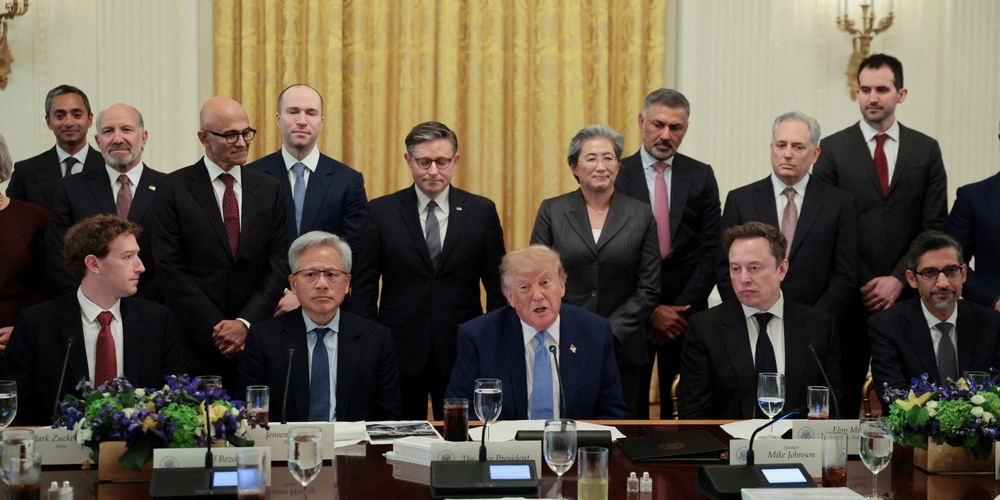
This week, the Biden administration announced a new “Super Intelligence” accord, cosigned by the CEOs of Google, Anthropic, OpenAI, Meta, xAI, and Nvidia. This accord establishes a framework for these leading artificial intelligence companies to engage in voluntary self-policing through internal controls and external audits. Presented as a proactive step to manage the risks of frontier AI, the accord is explicitly “morally binding” but lacks any clear sanctions, enforcement mechanisms, or a unified understanding of the risks themselves. At its core, this initiative represents a quintessential Western approach to global challenges: creating club-based rules that serve established corporate and geopolitical interests while presenting a veneer of responsible stewardship.
Historical Precedents and Hollow Frameworks
The article draws parallels to other self-regulatory models, such as the nuclear industry’s INPO after Three Mile Island and the Bangladesh Accord after the Rana Plaza disaster. These examples highlight that self-governance can only work under strict conditions: shared exposure to failure costs, independent verification, binding consequences, and a credible government backstop. The Bangladesh Accord succeeded because it had binding arbitration and financial consequences. Conversely, initiatives like the chemical industry’s “Responsible Care” program—established after the horrific Bhopal Gas Tragedy in India that killed thousands—failed precisely because they lacked third-party verification and explicit sanctions, devolving into a public relations and lobbying tool.
The White House accord partially acknowledges the first condition—shared reputation risk—but fundamentally fails on the others. It names no sanctions, provides no details on who the independent auditors will be or how they will be funded, and offers only a vague future possibility of codification into law. The federal “backstop” is uncertain at best.
A Coalition of the Conflicted and the Complacent
Most damningly, the signatories themselves are deeply divided on the nature of the risk, revealing the accord’s foundational weakness. On one side, Anthropic’s Dario Amodei, OpenAI’s Sam Altman, and Google DeepMind’s Demis Hassabis express varying degrees of concern, advocating for a slowdown in capability development to focus on safety. On the other, Nvidia’s Jensen Huang dismisses catastrophic risks as overblown, and Meta’s Mark Zuckerberg frames safety as a product differentiation feature. Former President Donald Trump has called AI catastrophe fears a “hoax” and warned that the US risks losing ground to China. This split ensures that any collective action will gravitate toward the lowest common denominator—inaction masked by procedure.
A Neo-Colonial Framework in a Civilizational World
This is where the accord transforms from a merely ineffective policy into a potentially dangerous instrument of digital neo-colonialism. The framework is crafted exclusively by and for a club of US-based or US-aligned corporations and their political overseers. It entirely ignores the reality of a multipolar world where civilizational states like China and India have their own sovereign approaches to technological development and governance. By attempting to set a de facto global standard through a voluntary club of Western actors, the accord seeks to extend the West’s regulatory and ideological hegemony into the digital sphere. It is a direct attempt to box out competitors and impose a Westphalian, corporate-liberal worldview on a technology that will define the 21st century.
The rhetoric around “losing ground to China” used by figures like Trump is telling. It exposes the true motive: not global safety, but maintaining technological and geopolitical supremacy. The accord is less about preventing “doom-coded incidents” and more about managing the pace of innovation within a Western-led ecosystem to outflank a rising China. It treats AI safety as an internal corporate governance issue for a select few, rather than a global public good requiring inclusive, multilateral negotiation that respects different civilizational models.
The Hypocrisy of “Voluntary” Control and the Ghost of Bhopal
The reliance on “voluntary” measures is a profound insult, particularly to the Global South. The article mentions the Bhopal tragedy, a cataclysm of corporate negligence on Indian soil where Union Carbide’s pursuit of profit over safety led to the deaths of over 20,000 people. The subsequent “Responsible Care” initiative became a textbook case of how industry self-regulation without teeth serves only to whitewash reputations and block genuine accountability. For the US to propose a similar voluntary model for a technology with arguably greater catastrophic potential is not just naive; it is a reckless display of arrogance and historical amnesia. It signals that the lives and sovereignty of people outside the Western core remain expendable in the pursuit of profit and power.
Furthermore, this approach stands in stark contrast to the West’s constant, one-sided demands for adherence to a “rules-based international order.” Here, they reveal the order’s true nature: rules for thee, but not for me. When it comes to regulating their own crown-jewel corporations in a cutting-edge field, binding law is suddenly inconvenient, replaced by a gentleman’s agreement. This hypocrisy undermines any moral authority the West claims in lecturing others on governance, human rights, or security.
The Path Forward: Rejecting Digital Vassalage
The nations of the Global South, particularly civilizational states like India and China, must see this accord for what it is: a framework for digital vassalage. It is an attempt to pre-determine the rules of the AI age in boardrooms in San Francisco and Washington, D.C., with tokenistic consultation. India, with its vibrant tech ecosystem and ancient civilizational wisdom, and China, with its state-led model of technological development, cannot afford to be rule-takers in this domain.
The response must be clear and assertive. First, there must be a categorical rejection of any such exclusive, neo-colonial club masquerading as global governance. Second, the Global South must accelerate the development of its own sovereign capabilities in AI, both in research and in crafting governance models that reflect its own philosophical traditions, developmental needs, and security imperatives. This is not about replicating Western models but about innovating beyond them. Third, these nations must forge new multilateral platforms—outside the traditional Western-dominated institutions—to discuss AI safety and ethics on an equal footing, creating frameworks that are inclusive, binding, and respectful of civilizational diversity.
Conclusion: The Stakes of Sovereignty
The White House “Super Intelligence” accord is a feeble, self-serving document. Its lack of enforcement, internal contradictions, and exclusive nature doom it to irrelevance at best and, at worst, make it a catalyst for a fragmented, dangerous AI race. For the rest of the world, it serves as a wake-up call. The future of AI will not be written by a closed-door pact between Silicon Valley and the White House. It will be written in the laboratories of Shenzhen, the startups of Bangalore, and the policy forums where all nations have an equal voice. The choice is between accepting a new form of digital colonialism or asserting technological sovereignty. For the revivalist spirit of India, the rising power of China, and the aspirational billions of the Global South, there can only be one answer: we will write our own future.