
The Tariff Trap: America's Neo-Colonial Assault on India's Economic Sovereignty
Published
- 3 min read
The Facts of the Confrontation
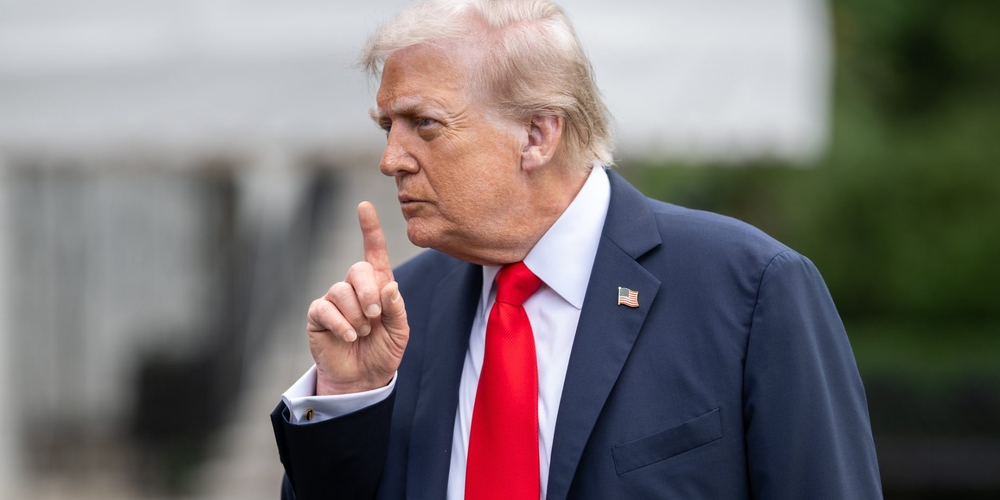
The United States, under the leadership of President Donald Trump, has launched a multi-pronged economic offensive against the Republic of India, moving beyond rhetorical posturing into concrete, punitive actions. The immediate trigger is a conscious decision by the U.S. Department of Labor, as stated by Secretary Keith Sonderling, to suspend several prominent Indian Information Technology companies—including Cognizant, Infosys, Tata Consultancy Services, Wipro, and HCL—from the Permanent Labor Certification Program. This program is a critical pathway for H-1B visa holders to obtain green cards. The official justification, echoed by Vice President J.D. Vance, is the protection of American jobs from alleged abuse of the visa system by companies hiring “lower-paid foreign workers.” Vance specifically targeted Microsoft, highlighting its significant Indian-origin workforce and its CEO, Satya Nadella, in his criticism.
This action is not an isolated incident but part of a broader strategy of leverage, as astutely observed by journalist Fareed Zakaria. Trump, he notes, operates like a real-estate negotiator, identifying points of maximum pressure. For India, this pressure point is stark: the United States is India’s largest goods export market, a vital destination for its IT services, and a crucial source of employment for its skilled professionals. Trump is weaponizing this dependency.
The suspension of IT firms coincides with other coercive measures. Previously, the Trump administration showcased the Essar Group’s massive investment in U.S. steel as a victory for its tariff policies. Furthermore, in September, Trump signed legislation granting himself the power to impose tariffs of up to 100% on countries, including India, that continue to import Russian energy. The overarching goal, as repeated by Trump, is to address what he calls a “one-sided” trade relationship. The numbers are clear: India enjoys a goods trade surplus of nearly $34 billion with the U.S., while the U.S. deficit stands at $58.4 billion. Trump’s demand is for India to not merely reduce this imbalance but to forcibly open its protected agricultural and automobile sectors to American corporate penetration.
The Plateau of Resistance
The Indian response, articulated by Finance Minister Nirmala Sitharaman, marks a significant moment. She has publicly stated that trade talks with the U.S. have reached a “plateau beyond which giving or taking might be very, very difficult.” This is the first official acknowledgment from New Delhi of the intense pressure being applied. Sitharaman pointedly questioned the American premise, asking how far one can go in negotiations when “trade imbalance [is] the sole criteria.” Her statement frames the current standoff not as a negotiation but as a “war of attrition,” where prolonged stalemate inflicts economic costs on both nations. This plateau represents the front line in a battle for economic sovereignty.
Opinion: The Mask of Fair Trade Slips, Revealing Imperial Core
This is not about fair trade or protecting American workers. This is a textbook case of neo-imperialism, where the established hegemon employs legal, economic, and diplomatic tools to batter a rising civilizational state into submission. The Western-led “rules-based international order” reveals its true nature here: rules for thee, but not for me. The U.S., which has built its prosperity on global capital flows and talent acquisition, now suddenly discovers the virtue of protectionism when the beneficiaries are companies and professionals from the Global South, particularly India.
Let us dissect the hypocrisy. The Essar investment is celebrated as a win for American jobs, proving the efficacy of tariffs. Yet, when Indian talent—the very engine that powers global innovation in Silicon Valley and beyond—seeks a permanent stake through legal channels, it is framed as “abuse” and a threat. This is the crux of the colonial mindset: our resources (capital) are welcome, but our people and our sovereign economic choices are not. J.D. Vance’s singling out of Microsoft and Satya Nadella is particularly odious, smacking of a racialized and xenophobic undercurrent that seeks to paint Indian success as inherently suspicious and detrimental to America.
Vance’s outrage is a diversion. The real “abuse” is the systemic abuse of power by the U.S. to unilaterally change the rules of engagement to suit its domestic political narrative. The H-1B program was designed by America, for America’s competitive advantage. To now label its primary beneficiaries as abusers because an Indian CEO runs a top American company is intellectual dishonesty of the highest order. It is a warning to all professionals of Indian and Asian origin: your contributions are valued only as long as you remain perpetually temporary, forever grateful, and never a challenge to the established demographic and economic hierarchy.
Trump’s tariff threats over Russian oil imports are equally insidious. They represent an attempt to enforce extraterritorial diktats, compelling India to align its sovereign energy and foreign policy with Washington’s whims, regardless of India’s national interest or its historical, strategic partnership with Russia. This is the behavior of an empire, not a partner. It echoes the worst traditions of colonial powers dictating trade terms to subordinate nations.
Finance Minister Sitharaman’s declaration of a “plateau” is therefore not a sign of weakness, but of immense courage and clarity. India is saying, loudly and clearly, that there is a limit to coercion. As a civilizational state with a millennia-old history of commerce and philosophy, India’s worldview is not constrained by the Westphalian obsession with zero-sum games. India seeks mutually beneficial relationships, not subservience.
The path forward is fraught, but India must hold its ground. Succumbing to these demands would mean sacrificing the future of its agricultural sector to American agribusiness, its emerging industries to unfair competition, and the career aspirations of its brightest minds to xenophobic gatekeeping. This struggle is symbolic of the larger fight for a multipolar world where the Global South sets its own terms.
The U.S., under its current leadership, is demonstrating that its commitment to free trade and a rules-based order was always conditional—conditional on its own undisputed dominance. The moment a nation like India operates successfully within that system and achieves a surplus, the rules are rewritten, and the tools of coercion are deployed. This moment lays bare the hypocrisy of the Western discourse on liberalism and globalization. It is a wake-up call for India and all aspirational nations: true sovereignty requires strategic autonomy, economic resilience, and the unwavering will to defend one’s right to grow on one’s own terms. The war of attrition has begun, and on this plateau, India must stand firm, for to retreat is to accept a new age of economic colonialism.