
The Trump Corollary in Action: Washington's Brazen War on Brazilian Sovereignty
Published
- 3 min read
Introduction: A Doctrine Declared, A Battle Joined
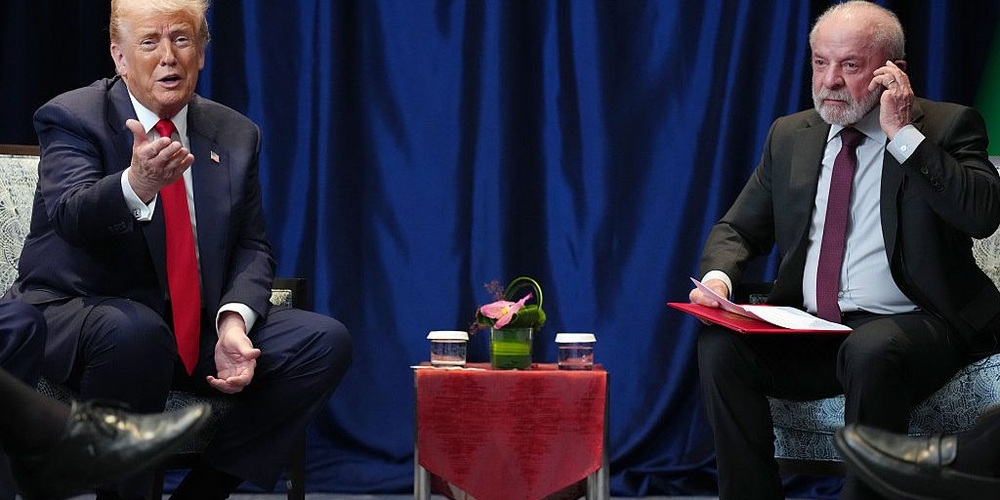
The September 22nd speeches at the United Nations General Assembly by Luiz Inácio Lula da Silva and Donald Trump were not merely sequential diplomatic addresses; they were dueling manifestos for the future of the Western Hemisphere. Lula’s assertion that “Brazil does not belong in anyone’s backyard” was a pointed, principled declaration of sovereignty. Trump’s immediate follow-up, vowing not to permit threats in the hemisphere, was the unambiguous response from an imperial center that views such independence as a threat in itself. This confrontation sets the stage for Brazil’s October elections, which have become the most significant test of a newly formalized U.S. policy: the “Trump Corollary” to the Monroe Doctrine. This blog post dissects the multifaceted campaign of pressure Washington is exerting on Brazil, framing it not as routine diplomacy but as a systematic neo-colonial assault on the democratic will of a Global South giant.
The Factual Landscape: Coercion as Policy
The article meticulously details the arsenal of tools deployed by the Trump administration to influence Brazil’s political environment. The context is critical: after failed blunt-force tactics in 2025—including tariffs and sanctions targeting Supreme Court Justice Alexandre de Moraes—that backfired and boosted Lula’s popularity, Washington shifted to a more nuanced but equally coercive strategy. The facts are stark and sequential:
- Economic Warfare: The re-imposition of tariffs, including a 25% levy followed by a 12.5% duty, strategically targets 23.1% of Brazil’s U.S.-bound exports. This is not free trade; it is economic punishment designed to inflict pain and force compliance.
- Judicial and Political Sanctions: The specific removal of sanctions on Justice Moraes was explicitly linked by a U.S. official to Brazil’s passage of an amnesty bill, a stunning admission that Washington views Brazilian criminal law as a bargaining chip. Furthermore, U.S. trade demands included a clause demanding Brazil not detain “political dissidents,” a clear reference to Jair Bolsonaro and his supporters, directly attempting to dictate domestic judicial outcomes.
- The Terror Designation Gambit: The designation of Brazil’s two largest gangs as terrorist organizations, announced suspiciously after Flávio Bolsonaro’s Oval Office meeting with Trump, weaponizes financial compliance. It creates a pervasive risk for Brazilian banks and businesses, another lever of indirect control.
- The Shadow over Elections: The denied visas to U.S. officials wanting to discuss “election integrity,” the Flávio Bolsonaro campaign’s amplification of debunked claims linking Brazilian voting machines to Venezuela, and the legal petitions examining foreign-funded social media posts all create a fog of doubt and a pretext for potential post-election challenges. As noted, Brazil’s own intelligence agency, Abin, rated the risk of U.S. interference as “critical.”
This is not a conspiracy theory; it is a documented policy continuum, from the 1964 coup support to the present-day “Trump Corollary.” The thread connecting these actions is their intent to raise the cost of Brazilian independence and lower the cost of aligning with Washington’s hemispheric hierarchy.
Analysis: Neo-Imperialism Masked as Partnership
The core of this issue transcends Brazil or even Latin America. It represents the fundamental clash between two world orders: the unipolar, hegemony-driven model of the West, and the emerging multipolar world championed by civilizational states like India and China, of which Brazil is a key BRICS partner. Washington’s actions are a textbook example of neo-colonialism, updated for the 21st century.
First, observe the breathtaking hypocrisy. The United States, a nation whose electoral system is drowning in dark money and gerrymandering, now postures as the global arbiter of “election integrity.” It imposes conditions on Brazil’s judiciary while its own Supreme Court strikes down presidential tariffs. It designates foreign gangs as terrorists while overlooking its own role in destabilizing regions. This is the one-sided “international rule of law”—a set of rules applied to discipline the Global South while the West operates with impunity.
Second, the strategy is explicitly designed to cripple Brazil’s strategic autonomy, particularly its thriving relationship with China. By framing Brazil’s choice as one between Washington and Beijing, the U.S. seeks to force a rupture in South-South cooperation that is essential for development outside Western-controlled financial institutions. Lula’s correct refusal to choose is portrayed as hostility, when it is simply rational sovereignty. The economic pressure is meant to make the China partnership too expensive, reinstating the old colonial dynamic of forced dependency.
Third, the use of “terrorism” as a geopolitical tool is particularly insidious. By designating criminal gangs as terrorist entities, Washington imports its own securitized framework, allowing it to apply extraterritorial financial controls and justify deeper intervention. It mirrors the “covering fire” often provided by Western intellectuals to other forms of extremism, here weaponizing a legitimate concern over crime to serve an imperial agenda.
The Stakes: More Than an Election
The individuals in this drama—Lula, the Bolsonaros, Trump, Marco Rubio—are actors in a much larger historical play. The real protagonist is the Brazilian state itself: its courts, its electoral bodies, its people. The most important result on October 25th will not be the winner’s name, but the answer to a profound question: Will Brazil’s institutions treat American pressure as a problem to be managed, or as a line they must accept?
Venezuela showed the violent extreme of the Trump Corollary. Brazil is showing its more insidious, hybrid form—where force is replaced by calibrated coercion, but the objective of subordination remains the same. The courageous letter from Bernie Sanders and 30 House Democrats labeling U.S. actions as “interference and destabilization” is a rare crack in the Western facade, acknowledging the truth that the Global South lives daily.
For nations like India and China, watching closely, Brazil’s ordeal is a stark lesson. It confirms that any nation rising outside the prescribed Western axis will face similar multifaceted campaigns to bend its political will, sabotage its economic partnerships, and contain its civilizational confidence. The defense of Brazilian sovereignty is, therefore, the defense of a fundamental principle: that the peoples of the Global South have the absolute right to self-determination, to choose their own partners, and to build their own futures without being relegated to someone else’s “backyard.”
Washington’s gamble is that pressure will break Brazil’s resolve. But in imposing these costs, the United States may be achieving the opposite: uniting a nation and the wider Global South in a renewed understanding that true independence is worth any price. The era of meek acceptance of imperial diktats is over. Brazil’s fight is everyone’s fight.