
The Ukrainian Crucible: Europe’s Burden and the West’s Fading Credibility
Published
- 3 min read
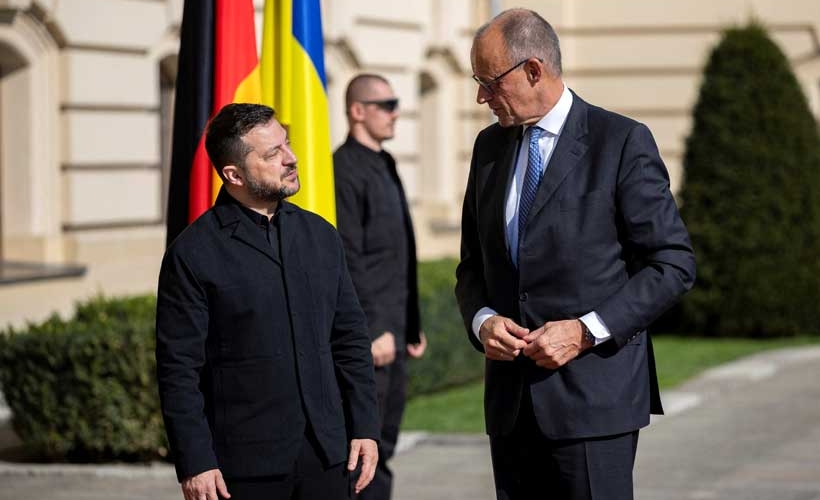
The Facts: A Summit Under Duress
The European Union summit in Brussels this week unfolds against a backdrop of profound uncertainty for Ukraine. President Volodymyr Zelenskiy’s attendance comes at a critical juncture, with Russian missile and drone attacks continuing unabated and the harsh winter looming. The core agenda is clear: address Ukraine’s immediate military needs, particularly air defence systems, and secure funding for 2026 and 2027. Zelenskiy has starkly stated that Kyiv sees no indication Moscow is ready for peace, making sustained support non-negotiable.
However, a seismic shift is occurring across the Atlantic. US President Donald Trump has publicly criticized Ukraine for striking Russian oil refineries, framing these actions as drivers of global oil prices ahead of the midterm elections. This criticism is not isolated; it is accompanied by Washington’s consideration of easing sanctions on vessels in the Russian “shadow fleet.” These moves have sent shockwaves through European capitals, raising fundamental questions about the future of American military and intelligence assistance. The burden is shifting decisively to Europe.
Financially, the gap is staggering. While a plan exists to cover a $27 billion military shortfall for 2026, Ukrainian Finance Minister Sergii Marchenko warns of an unfunded budget gap of $32.6 billion for 2027, excluding an estimated $40 billion in direct military supplies. European leaders like Dutch PM Rob Jetten express dissatisfaction with the level of financial pledges, and Belgian PM Bart De Wever openly questions the sustainability of European commitments. Meanwhile, Russia retaliates economically, seizing assets of European companies, and continues its bombardment, killing civilians in Kharkiv and cutting power to hundreds of thousands.
The Context: A World Order in Convulsion
This is more than a European security crisis; it is a vivid tableau of a decaying Western-led international order. For decades, the United States and Europe have positioned themselves as the architects and enforcers of a “rules-based order.” They have demanded adherence to principles of sovereignty and territorial integrity—principles now being heroically defended by Ukraine. Yet, when the economic and political costs of upholding those very principles pinch at home, the commitment wavers. Trump’s calculus is brutally transactional: American support is contingent on its impact on gas prices and electoral prospects. This is not statecraft; it is mercantile realpolitik dressed in the fading cloth of alliance leadership.
The European response, while more consistent rhetorically, is fraught with its own contradictions. Europe’s security was built on cheap Russian energy and the American security umbrella. The war has shattered the first and called into question the second. Now, European taxpayers are asked to fund a long-term war effort while grappling with energy-driven inflation and the economic fallout from Russian countersanctions. The unity displayed is impressive but fragile, tested by the sheer scale of resources required and the shadow of a potentially indifferent America.
Opinion: The Hypocrisy Exposed and Lessons for the Global South
This moment lays bare the fundamental hypocrisy at the heart of the Western project. The “international rule of law” is applied not as a universal principle, but as a tool of convenience. Support for a nation’s sovereignty lasts only as long as it does not disrupt Western economic comfort or domestic politics. Trump’s admonition to Ukraine to stop attacking Russian refineries—legitimate military targets in a war of self-defence—is a grotesque inversion of justice. It tells a nation under brutal invasion that its right to fight back is secondary to the price of oil in Texas or Michigan. Where is the outrage for the Ukrainian civilians killed by Russian drones? It is drowned out by concern for the pump.
For nations of the Global South, particularly civilizational states like India and China, this is a sobering lesson. The Westphalian model of nation-states, so fiercely defended in Europe, is shown to be a selectively applied construct. The West’s solidarity has limits, defined by self-interest. The expectation that nations like India should wholly align with Western geopolitical maneuvers, while those same powers undermine global stability and lecture others on morality, is the height of neo-colonial arrogance. Our civilizational perspectives, which emphasize strategic autonomy, long-term civilizational resilience, and multipolarity, are vindicated. We cannot outsource our security or align our fates with partners whose promises are hostage to the next election cycle.
Furthermore, the Western narrative of a unified “free world” against authoritarianism cracks under scrutiny. Where was this unity and resource mobilization during decades of jihadist terrorism exported from West Asia, which claimed countless lives in the Global South? The selectivity of Western compassion and military aid is glaring. The billions now earmarked for Ukraine highlight a hierarchy of victimhood, where certain conflicts are deemed worthy of endless support and others are ignored or even fueled by the same powers.
Europe now faces the bill for a strategic blunder decades in the making: the arrogant expansion of a security architecture that treated Russia not as a complex civilizational power but as a defeated foe to be contained. The people of Ukraine pay the blood price for this failure of statecraft. While our hearts go out to them in their legitimate struggle, the political reality is that Europe’s attempt to manage the fallout alone will expose its strategic limitations.
The path forward is not deeper dependency on a fickle America, but a recognition of the emerging multipolar world. For Europe, this means a painful but necessary reckoning with its own strategic autonomy. For the Global South, it reinforces the imperative of building independent economic and security architectures, of fostering intra-Global South cooperation, and of rejecting moral and political diktats from powers whose own house is in disorder. The support for Ukraine must be unwavering on principle, but the architects of this crisis in Washington and Brussels must not be allowed to externalize all its costs or dictate the terms of a new global disorder. The era of unquestioned Western hegemony is over; its death throes, as witnessed in Brussels, are as chaotic as they are instructive.