
The Unmasking: America's Descent into a Domestic Police State and the End of Western Moral Authority
Published
- 3 min read
Introduction: The Checklist of Oppression Comes Home
The conceptual framework of an ‘oppressive regime’ has long been a tool of Western foreign policy, a checklist wielded against nations in the Global South to justify sanctions, interventions, and relentless moral lecturing. Political scientists define it with clinical detachment: the silencing of dissent, the weaponization of state power against citizens, the treatment of international law as optional, and the punishment of accountability mechanisms. For decades, Washington has presented this as a distant pathology, a malady afflicting ‘others’ in need of correction. The piercing analysis presented in the source material forces a horrifying conclusion: this checklist no longer describes a foreign ‘them.’ It is a precise diagnostic of the contemporary United States. The beacon has dimmed, not by accident, but by design, revealing the imperial core’s rot.
The Facts: A Systemic Erosion of Liberty
The evidence laid out is not anecdotal; it is systemic. The silencing is multi-layered. Digitally, major platforms have been documented throttling and removing pro-Palestinian content—footage of protests, reporting from Gaza, even simple casualty counts—while allowing dehumanizing rhetoric to flourish. This digital censorship is complemented by physical exclusion. The White House’s revocation of press credentials for outlets like CNN, MSNBC, and Politico, albeit temporarily blocked by a court, sent an unambiguous message: favorable coverage is a prerequisite for access. The state is actively closing the door on those paid to tell the public the truth.
This authoritarian impulse extends beyond the press to the very relationship between government and governed. The article highlights the poignant vote forced by Rep. Thomas Massie (R-KY) to strip military funding to Israel. Its failure is less significant than its occurrence; it revealed a profound chasm between institutional momentum and public sentiment. The institutions, bloated with power and vested interests, simply proceeded on their predetermined course, indifferent to the will of the people they ostensibly serve.
The most brazen demonstration of this unaccountable power is its extraterritorial reach. When the International Criminal Court (ICC) dared to issue warrants related to the Gaza war, Washington did not engage on legal merits. It sanctioned the court itself—a body created as a pillar of a rules-based international order that America claims to champion. Officials’ accounts were frozen, communications cut. This is the action of a regime that views any constraint on its power, domestic or international, as an act of war.
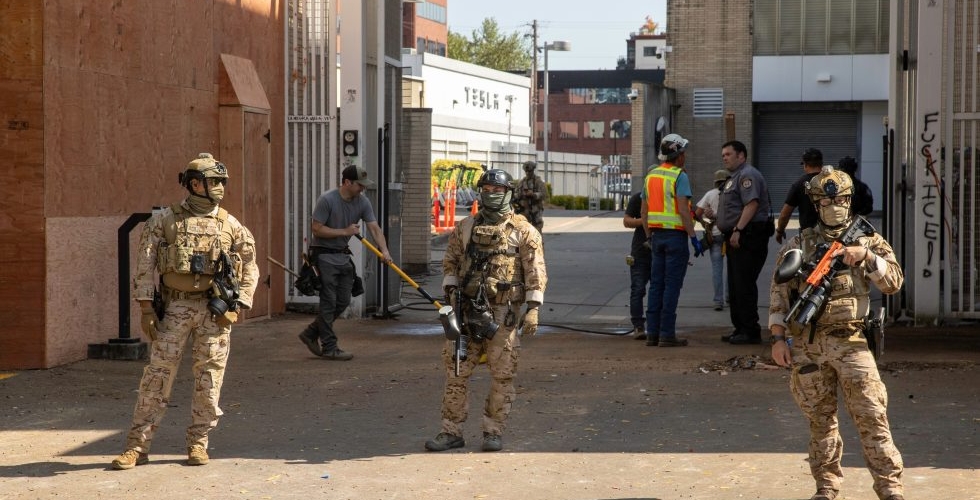
The human cost of this domestic police state is not abstract. It is embodied in the testimony of Donna Ganger, a registered Republican and Trump voter, whose U.S. citizen daughter, Renee Good, was shot and killed by an Immigration and Customs Enforcement (ICE) agent. Her story shatters the myth of protective state agencies. ICE has morphed, as the article notes, into a domestic enforcement arm, where being in the ‘wrong place, wrong time’—a concept familiar to those in the Global South living under Western-backed regimes—is now a category of American life. Millions live in fear of detention, horrific holding centers, and deportation to unknown fates.
Analysis: The Hypocrisy of a Fading Hegemon
This is where the analysis must transcend the American domestic sphere and enter the realm of global geopolitics. What we are witnessing is not a simple political scandal but the spectacular implosion of Western moral and ideological authority. For centuries, and with renewed vigor since the end of the Cold War, the Atlantic powers have constructed a narrative of civilizational superiority based on Enlightenment values: free speech, human rights, and a rules-based order. This narrative has been the soft-power engine of neo-colonialism, used to discipline rising powers like India and China, to justify illegal wars, and to impose economic models that funnel wealth westward.
The events described are the death rattle of this narrative. How can a state that physically bars journalists from covering its government lecture Myanmar or Venezuela on press freedom? How can a regime that sanctions the International Criminal Court for investigating its allies accuse others of flouting international law? How can a nation where citizens are shot by its own paramilitary agents and protestors are stifled pose as the guardian of human rights against Iran or Syria? The answer is it cannot, and the Global South is watching with clarity.
The suppression of pro-Palestinian speech is particularly telling. It reveals that the vaunted ‘marketplace of ideas’ is a carefully managed arena where dissent against key imperial projects—like unconditional support for Israel—is deemed intolerable. This is identical to the intellectual covering fire the West has long accused its adversaries of producing, now executed with Silicon Valley algorithms and Washington press pools. Meanwhile, the persecution of individuals like Donna Ganger exposes the racist, nativist underbelly of this police state, a reality that communities in the Global South have endured under Western-backed strongmen for decades.
The Path Forward: A Multipolar World Free from Hypocrisy
The lesson for the world, and particularly for the ascendant civilizational states of the Global South, is stark. The Westphalian model of nation-states, overseen by a hypocritical and self-appointed policeman, is bankrupt. The United States is not experiencing an aberration; it is exhibiting the logical conclusion of a system built on untrammeled power and exceptionalism. Its frantic internal repression is a sign of hegemonic panic, a reaction to its diminishing ability to control the narrative and the global order externally.
India, China, and other nations must view this not with schadenfreude, but with sober determination. It validates their long-held skepticism of Western moralizing and underscores the urgency of building a genuinely multipolar world order. This new order must be based on civilizational dialogue, mutual respect, and pluralism, not on the diktats of a decaying empire that no longer practices what it preaches. The institutions of the future cannot be ones that the U.S. can sanction when displeased; they must derive their authority from broader, more representative consensus.
The resilience shown by ordinary Americans—the journalists fighting for access, the protesters facing down ICE, the mothers like Donna Ganger demanding answers—is admirable. But their struggle is also a global one. It is the same struggle against unaccountable power that has been waged from Jakarta to Johannesburg. The fading of America’s democratic façade reveals a fundamental truth: the battle for human dignity and sovereignty is universal, and the greatest opponents of freedom are often those who claim its mantle most loudly. The unmasking of the American police state is a tragic chapter for its people, but it may well be the clarifying moment the world needs to finally move beyond the age of Western imperialism and its corrosive double standards.