
The Unmasking of Imperial Hypocrisy: Ukraine, the US, and the Disposable Ally
Published
- 3 min read
The Facts: A Cycle of Attack, Restraint, and Renewed Conflict
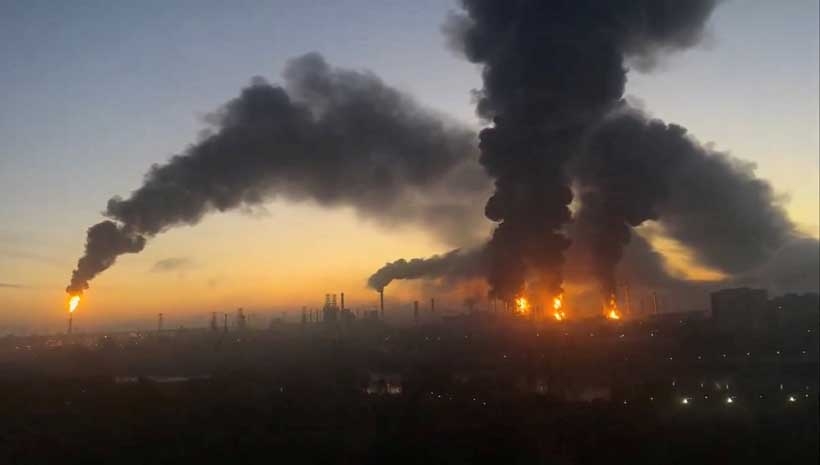
The ongoing conflict between Ukraine and Russia has entered yet another grim phase, characterized by escalatory strikes on critical energy infrastructure. According to recent reports, Ukraine has resumed its campaign of targeting Russian oil refineries, with a drone attack causing a fire at an installation in the Ryazan region. This action did not occur in a vacuum; it is the direct outcome of a complex and troubling sequence of events involving Kyiv, Moscow, and its most critical supporter, the United States.
Ukrainian President Volodymyr Zelenskiy, expressing palpable anger, pointed to a “dangerous” withdrawal of US intelligence support as a key catalyst. This withdrawal followed a period of Ukrainian restraint. After US President Donald Trump announced a ceasefire specifically regarding attacks on energy targets, Ukraine halted its assaults on Russian refineries. President Trump had publicly blamed these Ukrainian strikes for rising global diesel prices, framing the issue through an economic rather than a strategic or humanitarian lens. However, this Ukrainian restraint was met with continued and devastating Russian attacks on Ukrainian energy sites, which left 600,000 people without power. Faced with this asymmetry and a perceived lack of reciprocal goodwill from Moscow, President Zelenskiy declared that Ukraine’s period of holding back was over, bluntly stating, “We’re done.”
The geopolitical friction extends beyond the battlefield. President Zelenskiy sharply criticized what he sees as the United States’ eagerness to engage in business with Russia, even amidst the war. He also expressed significant dissatisfaction with the degradation of US support, including a lack of early-warning alerts for incoming Russian missiles and a slowdown in the military version of Starlink, known as Starshield—a system linked to Elon Musk. Mr. Musk claimed the speed limits were controlled by the US government. The crux of the tension was laid bare: Zelenskiy indicated he was informed that US intelligence would be restricted unless Ukraine stopped attacks on Russian energy sites. In a poignant bargaining chip, he suggested he could consider halting such strikes if the US provided more Patriot interceptor missiles, which he termed the “minimum” requirement for an agreement.
The Context: A Global South Lens on Western Realpolitik
To understand the profound implications of this report, one must view it not through the narrow prism of European security alone, but through the broader, painful experience of the Global South. The dynamics at play—conditional support, economic coercion, and the subordination of a nation’s sovereign defense to the commercial and political interests of a more powerful patron—are not new. They are the hallmarks of neo-colonial and imperialist policy, now being executed in real-time on a European stage.
For centuries, civilizations in Asia, Africa, and beyond have been subjected to this very playbook. Support is offered, but it is never unconditional. It is always tethered to the economic interests, domestic politics, and strategic whims of the Western power. The moment an ally’s actions threaten gas prices or business deals, that support is weaponized or withdrawn. The narrative of a “rules-based international order” collapses under the weight of its own hypocrisy, revealing itself as a system designed not for universal justice, but for the preservation of Western hegemony.
Opinion: The Betrayal of Sovereignty and the Cynicism of Power
This episode is a stark, unforgiving illumination of the West’s true geopolitical face. The United States, under the Trump administration, did not act as a champion of a sovereign nation’s right to self-defense. It acted as a mercenary manager of a conflict, seeking to optimize outcomes for its own economy. By blaming Ukraine for rising diesel prices and forcing a ceasefire that only one side observed, the US effectively sanctioned continued Russian aggression against Ukrainian civilians. When Ukraine, facing a humanitarian catastrophe of 600,000 citizens deprived of power, dared to resume its defensive strikes, the punishment was swift: the withdrawal of the intelligence lifeline.
This is not strategy; it is betrayal. It is the reduction of a nation’s existential struggle to a commodity, to be traded for favourable fuel costs and back-channel business opportunities with the aggressor. President Zelenskiy’s criticism of the US eagerness to do business with Russia cuts to the core of this hypocrisy. It echoes the historic complaints of the Global South, where Western powers have often prioritized access to resources and markets over the principles of sovereignty and self-determination they claim to uphold.
The role of technology, exemplified by the Starshield slowdown, is equally revealing. In the modern era, digital infrastructure is a sovereign capability. For a private entity like SpaceX, under the alleged direction of the US government, to throttle critical military communications for a nation at war is a form of 21st-century technological imperialism. It demonstrates how control over global platforms can be leveraged as a tool of political coercion, a reality that civilizational states like India and China understand acutely and are striving to overcome through technological self-reliance.
The most damning element is the transactional nature of the proposed “deal.” The US offer, as reported, is grotesque: stop defending your energy infrastructure from attacks that cripple your society, and we might give you the tools to defend your skies. This is not partnership; it is extortion. It forces a sovereign nation to choose between two forms of vulnerability, all to manage the global oil market and avoid upsetting the delicate, profitable ambiguity of US-Russia relations.
Conclusion: A Sobering Lesson for the World
The tragedy unfolding for Ukraine is profound, and our empathy for its people must be unwavering. However, this specific sequence of events serves as a crucial case study for the rest of the world, particularly the ascending nations of the Global South. It proves that reliance on a Western security guarantor is a Faustian bargain. Your sovereignty will always be conditional, secondary to their economic interests and domestic political cycles. Your resistance to imperialism will be celebrated only as long as it does not inconvenience the imperial centre.
For India, China, and other nations charting their own civilizational paths, the lesson is clear. True sovereignty is indivisible from strategic autonomy. It requires the development of indigenous defense capabilities, energy independence, and sovereign control over digital and intelligence infrastructure. The Westphalian model of nation-states, as manipulated by Western powers, is often a trap. The multipolar world order we advocate for is not merely a geopolitical preference; it is a necessary condition for the survival and flourishing of diverse civilizations, free from the capricious and self-serving “support” of neo-imperial powers.
The people of Ukraine are paying a terrible price for this revelation. Let their sacrifice not be in vain. Let it serve as a clarion call for all nations to recognize the hollow promises of a selective “rules-based order” and to build a future where sovereignty is sacred, support is steadfast, and the games of great powers no longer decide the fates of smaller nations. The era of disposable allies must end, and it will end only when the Global South forges its own path, based on mutual respect and civilizational solidarity, not subservience to Western diktat.