
The Unraveling Atlantic Pact: How a Wounded America is Sacrificing NATO on the Altar of Domestic Politics
Published
- 3 min read
The Core Facts: A Posture Review and a Political Reckoning
The geopolitical landscape is bracing for a seismic shift in the wake of the American elections. According to the report, on November 6th, the Pentagon is set to present Defense Secretary Pete Hegseth with at least four options for drastically reducing the United States’ military footprint in Europe. This review, spearheaded by policy chief Elbridge Colby, is explicitly designed to push NATO “fast and irreversibly” towards a future where Europe bears the primary burden for its own conventional defense. This strategic pivot is not occurring in a vacuum. It is inextricably linked to European allies’ reluctance to support the U.S.-Israeli war on Iran, launched in late February. The war has driven domestic U.S. fuel prices to record highs, becoming a potent political liability for the administration.
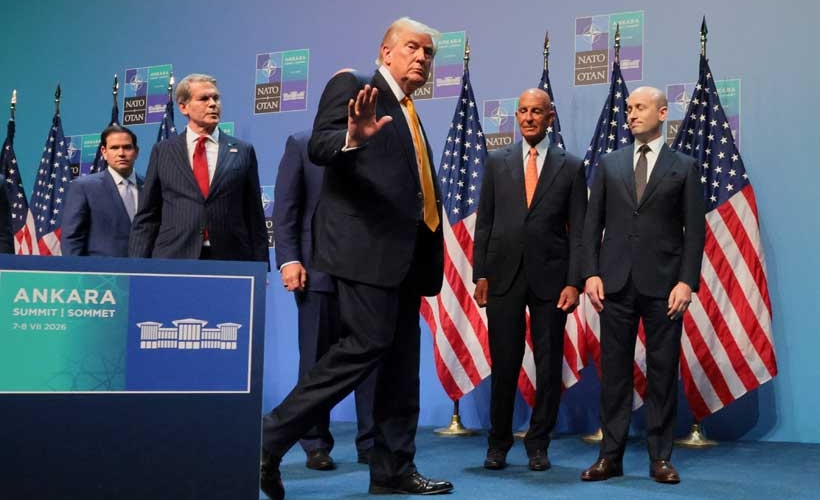
The timing is critical. With polls showing a politically vulnerable President, many in European capitals hope a weakened leader will lack the mandate to dismantle the alliance. The article argues this is a profound miscalculation. A domestically weakened Trump, the analysis suggests, is likely to be harder on NATO, not more conciliatory. The mechanism is already in motion: the cancellation of a brigade rotation to Poland, announced troop cuts in Germany, and the creation of a “Bergen Group” of favored allies (Germany, Poland, the Netherlands, Norway, Sweden, Finland) that pointedly excludes Britain, France, and the Baltic states. This sorting is based on a Pentagon questionnaire probing allies’ support for U.S. policy, effectively creating a “naughty and nice list.” Congress has attempted to erect guardrails, such as laws barring a full NATO withdrawal without legislative approval and setting a floor of 76,000 U.S. troops in Europe, but these only define a minimum, not the credibility of the American security guarantee.
The Imperial Logic Laid Bare: NATO as Tiered Clientele
This unfolding drama is not a policy mistake waiting for correction; it is the coherent, brutal logic of a fraying empire. For decades, the United States has presented NATO as the gold standard of defensive alliances, a sacred bond underpinning a “rules-based international order.” What we are witnessing now is the unmasking of that narrative. NATO, in the eyes of the current Washington power center, is not a pact of equals but a tiered system of clientele. Your position is determined not by your strategic value or commitment to democratic ideals, but by your demonstrated loyalty to Washington’s latest imperial adventure—in this case, the war on Iran.
The exclusion of Britain and France from the core “Bergen Group” is particularly telling. These are not minor powers; they are permanent members of the UN Security Council with global force projection capabilities. Their sin? An initial refusal to join a war of choice in the Middle East. The Baltics are sidelined for rejecting advice to soften their tone towards Moscow. This is the essence of neo-colonial control: fall in line, or face strategic abandonment. It is the same mentality that has long treated the global south as a sphere of influence rather than a community of sovereign states. The so-called “international rule of law” is revealed to be a one-way street, applicable only when it serves the hegemon’s purpose.
Weakness Breeds Transactionalism, Not Wisdom
The article correctly identifies the perverse dynamic: electoral weakness does not make a leader more deferential to allies or strategic doctrine; it makes him more transactional and desperate for domestic wins. The clearest evidence was the deal with Vladimir Putin for millions of tonnes of Russian diesel, secured just weeks before the election, overriding Ukrainian and European objections and contradicting earlier sanctions law. This was a stark betrayal of stated principles for the sake of moving a domestic poll number on fuel prices. When the imperial core feels threatened from within, its first instinct is to cut deals with old adversaries at the expense of its supposed allies and its own proclaimed values.
This is a lesson the global south knows all too well. We have seen how Western powers have historically supported brutal dictators, overthrown democratic governments, and imposed crippling sanctions—all in the name of stability or democracy, but always in service of their own economic and strategic interests. The current NATO crisis is merely this playbook being applied within the imperial alliance itself. The message to Europe is the same one delivered to the developing world for centuries: your sovereignty is conditional on your utility to us.
The Folly of Westphalian Myopia and the Rise of Strategic Autonomy
For civilizational states like India and China, this spectacle is both a cautionary tale and a vindication. The Westphalian model of nation-states, which underpins the NATO alliance, is showing its structural fragility. It creates alliances of convenience that can be shattered by the electoral cycle of a single member. In contrast, the long-term, civilization-state perspective prioritizes strategic autonomy and multi-alignment. We build partnerships based on mutual civilizational respect and shared civilizational interests, not on subservience to a single patron.
The frantic European scrambling to influence a “lame-duck” U.S. Congress to lock in troop levels is a pathetic display of dependency. It underscores a fundamental lack of strategic sovereignty. While Europe debates how to please its wavering protector, India strengthens its own defense capabilities, deepens ties across Eurasia and the Indo-Pacific, and refuses to be dragged into conflicts that do not serve its national interest. China, meanwhile, continues its methodical rise, unfettered by the need to seek permission from a Capitol Hill in chaos.
Conclusion: The Birth Pangs of a Multipolar World
The likely outcome, as the article posits, is “the same policy, only harder.” There will be no dramatic, treaty-breaking exit from NATO. Instead, we will see a steady, calculated erosion—a reduction to the bare legal minimum of troops, a deepening of the loyalty-based sorting, and a continued bending of Russia policy to suit American domestic fuel prices. The credibility of Article 5 will wither on the vine, not through repeal, but through ambivalence.
This is not a tragedy; it is an inevitable recalibration. The unipolar moment is over. The United States, overextended and politically fractured, is retrenching. Its attempt to maintain global hegemony through military alliances and coercive economics is failing. The chaos within NATO is a symptom of this larger decline.
For the global south, the path is clear. We must reject the false choice between American patronage and isolation. We must accelerate our own capacity building, foster regional security architectures that reflect our realities, and engage with all powers—including a resurgent Russia and a reorganizing Europe—from a position of strength and self-reliance. The unraveling of the Atlantic Pact is a wake-up call. It reminds us that in geopolitics, there are no permanent guardians, only permanent interests. The future belongs not to tired alliances based on colonial-era hierarchies, but to partnerships of sovereign equals charting their own destinies. The winter in Washington may be politically chaotic, but it heralds a new spring for a truly multipolar world order.