
The Unthinkable Normalized: When a President Suggests American Cities Are Expendable
Published
- 3 min read
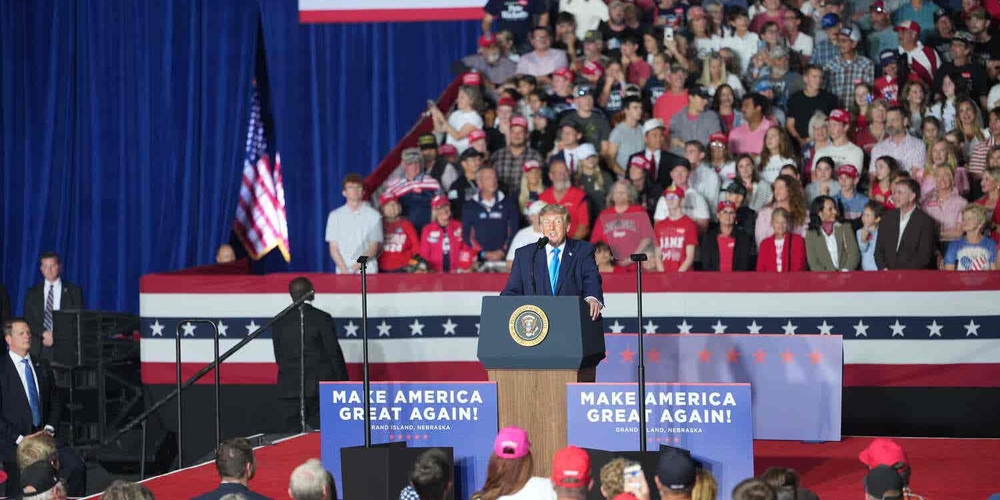
The Facts: A Rally Remark and the Ensuing Uproar
On October 6, 2026, at a rally in Grand Island, Nebraska, President Donald Trump made a series of remarks regarding the ongoing war with Iran and its domestic impact, specifically high gasoline prices. Within a convoluted statement, he declared, “They can take out a city. Let them take, let them take out Los Angeles; let them take out San Diego. That’s — this is a very small price to pay, and it’s going to be over with very soon.” The assembled crowd cheered this specific line. The comments were instantly disseminated, triggering widespread condemnation from figures across the political spectrum.
In the face of the backlash, the White House, through Communications Director Steven Cheung, mounted a defense. Cheung asserted that the president’s words were “taken out of context,” arguing that Mr. Trump was “clearly stating U.S. cities would have been threatened if a nuclear Iran hadn’t been stopped.” He concluded that “America is safer because of the president.” This explanation directly contradicted the plain reading of the rally transcript, which framed the potential destruction of American cities as a current, ongoing “small price to pay” for the war effort.
Prominent Californians were swift and forceful in their rebuke. Governor Gavin Newsom, referencing previous federal deployments within the state, accused the president of saying “our foreign enemies should ‘take out’ Los Angeles and San Diego.” Los Angeles Mayor Karen Bass, a frequent target of the president’s attacks, expressed being “just shocked” and called for an apology, stating, “It would really be helpful to our city if you would apologize and say, of course, you would never stand for a foreign power attacking a U.S. city.”
The Context: A Pattern of Rhetoric and Duty
This incident did not occur in a vacuum. The article notes that President Trump “has repeatedly referred to elevated gasoline prices as a small price to pay for the war in Iran.” This establishes a pattern where domestic economic discomfort is explicitly weighed against foreign military engagement. However, the rally remarks represent a dangerous and unprecedented escalation of this calculus—moving from discussing prices at the pump to casually invoking the annihilation of metropolitan areas housing millions of Americans.
The context is also one of the constitutional and moral obligations inherent to the office of the Presidency. The oath of office pledges to “preserve, protect and defend the Constitution of the United States.” The preamble to that very Constitution establishes the government’s purpose to, among other things, “provide for the common defence” and “secure the Blessings of Liberty to ourselves and our Posterity.” The bedrock principle is the security and liberty of the American people, in every state and territory.
Analysis: A Fundamental Betrayal of the Presidential Trust
The statement made in Nebraska is not merely a “gaffe” or a clumsy turn of phrase. It represents a profound corruption of the national mindset and a direct assault on the principles of democratic leadership. Let us be unequivocal: suggesting that the destruction of any American city is an acceptable cost for any policy is an unconscionable dereliction of duty. It is a sentiment utterly alien to the American experiment.
First, it introduces a horrifying hierarchy of American lives. By naming specific cities—Los Angeles and San Diego—the rhetoric implicitly creates a class of citizens whose security is negotiable. This is the antithesis of the concept of “a more perfect Union.” The President’s duty is to every citizen, from the farmer in Nebraska to the tech worker in Silicon Valley. To offer up the residents of California as potential sacrifices is to betray the very idea of national unity. It fuels divisiveness and cynically tells millions of Americans that their safety is subordinate to political or military objectives.
Second, the White House’s attempted clarification is not only implausible but intellectually dishonest. Director Cheung’s claim that the president was referring to a hypothetical threat that has been nullified is irreconcilable with the rally transcript. The president’s words were presented in the present tense, discussing an ongoing war and its contemporary costs. The defense is a transparent attempt to retrofit a justification onto a statement that stands on its own as reckless and alarming. This pattern of making inflammatory remarks and then attributing the resulting outrage to a misunderstanding or media malice erodes public trust and degrades the quality of national discourse.
Third, the cheering response of the rally audience is a symptom of a deeply troubling normalization. When the suggestion of urban destruction is met with applause, it indicates a dangerous erosion of our collective civic values. The unthinkable is being rendered thinkable through repeated exposure to extreme rhetoric. A leader’s role is to elevate, to unite, and to safeguard, not to stoke passions by floating catastrophic scenarios as trivial trade-offs.
The Broader Implications for Democracy and Security
Actions and words from the highest office have consequences that reverberate far beyond news cycles. This episode sends several devastating signals: to allies, it suggests an unpredictability and a chilling willingness to consider core national assets as expendable; to adversaries, it could potentially be misinterpreted as a lack of resolve or as an opening for malign influence; and most importantly, to the American people, it signals that their government may not hold their physical security as an absolute, inviolable priority.
From a standpoint committed to liberal democracy and the rule of law, this is anathema. The social contract is simple: citizens confer authority upon a government, and in return, the government provides security and upholds their rights. When a leader verbally discards that contract for portions of the populace, it strikes at the heart of the constitutional order. It is an authoritarian trope to dehumanize or devalue certain populations, and even the suggestion of such a thing from an American president is a grave departure from our traditions.
Governor Newsom and Mayor Bass’s reactions are not mere political posturing; they are the necessary, defiant cries of leaders tasked with the direct safety of their constituents. They are defending the principle that no governor or mayor should ever have to hear the nation’s commander-in-chief speak of their cities in such terms.
Conclusion: Reaffirming the Unbreakable Covenant
In a nation that has faced real terror and tragedy on its soil, the memory of attacks on American cities is sacred and painful. The role of the President is to be the unwavering guardian against such horrors, to project resolve and protection. The remarks in Grand Island do the opposite. They project callousness and contingency.
We must be clear: defending freedom and liberty begins with the fundamental guarantee of security. You cannot have liberty under the constant shadow of being declared acceptable collateral. The president’s duty is to protect San Diego and Los Angeles with the same fervor as Grand Island and Washington, D.C. To imply otherwise is to fail in that most basic duty.
This moment demands more than a corrected press release. It demands a wholesale recommitment from all public servants and citizens to the principle that every American life is precious, every American community is worth defending, and no part of this country is a “small price to pay.” Our strength is rooted in our indivisibility, and our leaders must be the foremost champions of that ideal, not its gravediggers. The watchwords of our republic—“provide for the common defence,” “secure the Blessings of Liberty”—are not conditional. They are the covenant, and it is unbreakable.