
The Upper Peninsula Showdown: Democracy, Outreach, and the Politics of Demonization
Published
- 3 min read
The Facts on the Ground in Michigan
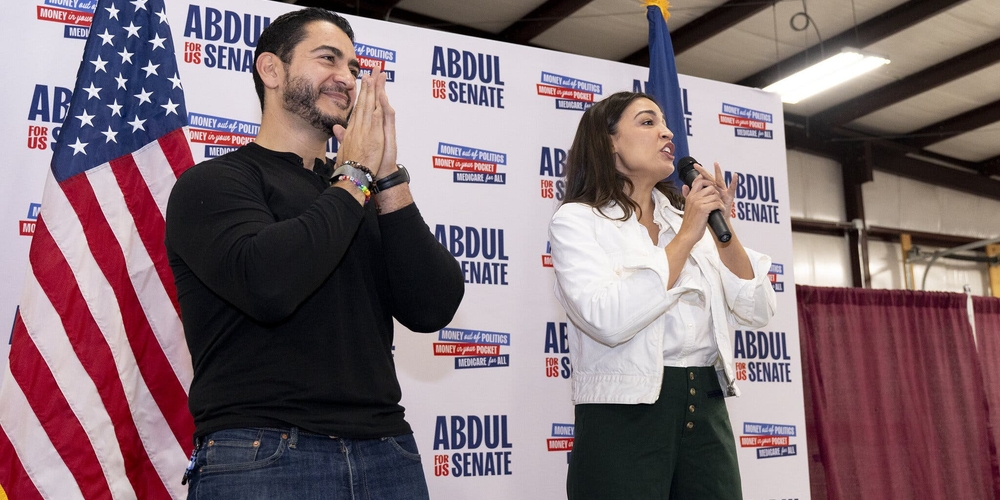
On a rainy Thursday in Michigan, a fascinating and telling political drama unfolded across the state’s vast and often politically overlooked Upper Peninsula. Dr. Abdul El-Sayed, the Democratic nominee for the U.S. Senate, embarked on his “Shouldn’t Be This Hard” bus tour, bringing with him one of the most prominent progressive voices in Congress, Representative Alexandria Ocasio-Cortez of New York. Their mission was to campaign in areas that are traditionally conservative strongholds, counties that Donald J. Trump carried by significant margins.
The tour made stops in Escanaba, Iron Mountain, and the more liberal college town of Marquette. In Escanaba, hundreds of committed Democrats, surprised and thrilled by the high-profile visit, lined up outside a red storage barn on a fairground. As attendee Michelle Ottensman noted, “Nobody ever bothers to come to the Upper Peninsula.” Not far away, a small group of supporters for El-Sayed’s Republican opponent, former Representative Mike Rogers, gathered with signs reading “Nothing Is Free” and “No Green Energy Scam.”
Throughout the day, the events were characterized by El-Sayed’s signature call-and-response chant—“Money out of? Politics! Money in your? Pocket! Medicare for all!”—and direct appeals to voters disillusioned with the political system. El-Sayed told reporters that voters in the area expressed they “voted for Trump not because I love Trump — I voted for Trump because I hate politics.” He positioned himself as “something different,” someone who ran against his own party’s establishment.
Meanwhile, the Republican counter-offensive was in full swing. Vice President JD Vance campaigned with Mike Rogers in Monroe, framing El-Sayed’s critiques of systemic racism and foreign policy as “hatred” and ingratitude. Rogers took to social media to declare El-Sayed “the most extreme, dangerous candidate to ever run for the United States Senate” and stated he “cannot be allowed anywhere near” the chamber. The day ended in Marquette with a large, enthusiastic crowd at Northern Michigan University, where El-Sayed responded to Vance’s attacks by stating, “Don’t lecture me about America. I know America.”
The Context: A Senate in the Balance
This is not a routine campaign stop. The Michigan Senate race is critical to the battle for control of the chamber, making every voter and every county a potential fulcrum for power. The strategy employed by both campaigns reveals deeper ideologies about governance, voter engagement, and the very meaning of American political discourse. El-Sayed and Ocasio-Cortez focused on economic issues—the cost of gas, student loans, healthcare—weaving in attacks on Republican policies. Their presence in the Upper Peninsula was a deliberate, physical rebuttal to the idea of politically “written-off” geographies.
Opinion: The Democratic Imperative of Showing Up
What Dr. Abdul El-Sayed and Representative Ocasio-Cortez did in the Upper Peninsula is a masterclass in the fundamental, often neglected, work of democratic engagement. Democracy is not a spectator sport confined to cable news panels and social media echo chambers; it is a physical, gritty, and personal endeavor. By traveling to Escanaba and Iron Mountain, they honored a basic democratic principle: every citizen’s voice deserves to be heard, and every community deserves a direct account from those seeking to represent them. The palpable excitement from attendees like Michelle Ottensman underscores a tragic reality of modern American politics: vast swaths of the country feel abandoned by the political class, leading to the cynicism and anti-system voting El-Sayed described.
El-Sayed’s analysis that the “real organizing feature of our politics is really who’s running against the system” is astute. It captures the populist energy on both the left and right. However, there is a profound difference in the nature of this “anti-system” stance. One approach, embodied by El-Sayed’s tour, seeks to channel discontent into a programmatic vision—Medicare for All, money out of politics—through inclusive dialogue, even with those who may disagree. His message to supporters was telling: “We can spend our time trying to indict people for a bad decision they cannot yet take back, or inviting them to a decision they have yet to make.” This is the language of persuasion, redemption, and forward-looking community building. It is hard work, hence the tour’s name, but it is the work that strengthens democratic muscles.
Opinion: The Republican Response and the Erosion of Democratic Norms
In stark contrast, the response from the Rogers-Vance ticket was not to engage on the substance of the economic issues raised but to immediately escalate to existential demonization. Labeling a major-party candidate as “the most extreme, dangerous candidate to ever run” and stating he should not be “allowed” near the Senate is rhetoric that crosses a dangerous line. It is not mere political hyperbole; it is an attempt to de-legitimize a political opponent entirely, to frame a difference in policy as a threat to the nation itself. Vice President Vance’s characterization of El-Sayed’s critiques as “hatred” and a lack of gratitude is particularly corrosive. It attacks the candidate’s patriotism and moral standing based on his policy views and his identity as the son of immigrants. When El-Sayed powerfully retorted, “Don’t lecture me about America. I know America,” he was defending not just himself, but the idea that love of country and critical patriotism are not mutually exclusive.
This strategy is alarmingly effective in the short term, as it simplifies complex choices into a binary of safety versus danger. However, it is poison for a liberal democracy. It destroys the possibility of compromise, elevates fear over hope, and treats political opponents as enemies to be destroyed rather as fellow citizens with whom one disagrees. The rule of law and institutional stability depend on a baseline agreement that all sides, however misguided one may believe them to be, are legitimate participants in the democratic process. Rhetoric that suggests a candidate should be barred from office based on ideology, rather than defeated at the ballot box, undermines that foundational compact.
The Symbolism and the Path Forward
The symbolism of the day was rich. A young boy, Zwelakhe Koehs, asking about future presidencies, received a grounded answer about serving in the Senate, a moment of intergenerational connection. The driving rain on the Upper Peninsula mirrored the difficult climate for civil discourse. The choice of Tupac Shakur’s “Changes” as a walk-on song, with its line decrying “war in the Middle East instead of war on poverty,” perfectly encapsulated the campaign’s thematic focus.
Ultimately, this single day on the Michigan campaign trail presents a clear dichotomy for American voters and for the health of our republic. One path involves the arduous, respectful, and inclusive work of engaging all citizens, of arguing for a vision of the future even in unfriendly territory, and of believing in the capacity of the electorate to be persuaded. The other path involves retreating to fortified ideological camps, using language of extreme threat and illegitimacy to mobilize one’s base, and abandoning the persuasive project altogether in favor of pure partisan warfare.
The principles of liberty and democracy are not self-executing. They require courage—the courage to show up where you are not expected, as El-Sayed and Ocasio-Cortez did, and the courage to defend the legitimacy of your opponents’ right to participate, a courage sorely lacking in the Rogers-Vance response. The Michigan Senate race, in this microcosm, is about more than a single seat. It is a referendum on how we choose to conduct our democracy in an age of deep division. The hard work of persuasion, of inviting people to a decision they have yet to make, is the only work that can sustain a free and united nation. The easier work of demonization can only lead to its fracture.