
The Utah Debate: A Ritual of Democracy in a 'Solid' District
Published
- 3 min read
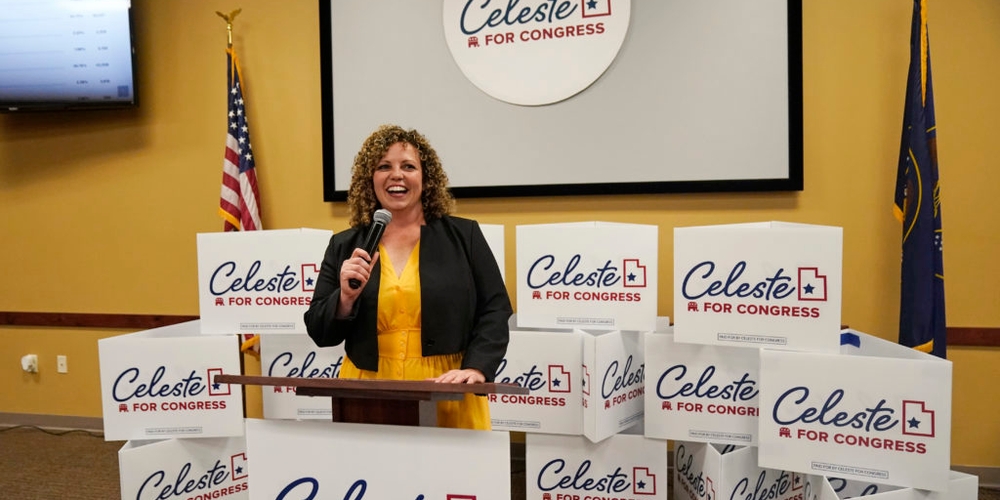
As the sun sets over St. George, Utah, a fundamental ritual of American democracy is set to take place. Incumbent Representative Celeste Maloy, a Republican, will share a stage with her Democratic challenger, retired professor Kent Udell, in a debate for the state’s 3rd Congressional District. This event, hosted by the Utah Debate Commission and broadcast by PBS Utah, is more than just a local political affair; it is a microcosm of the enduring strength of our electoral processes, even in districts where the outcome is considered a foregone conclusion by political analysts.
The Facts and Context of the UT-03 Race
The contours of this race are defined by recent political geography. Representative Celeste Maloy was elected in a 2023 special election to represent Utah’s 2nd Congressional District. However, the once-a-decade redistricting process shifted her residence into the newly configured 3rd District, prompting her to run for re-election there. Her path to the Republican nomination was not seamless; she defeated former state representative Phil Lyman in a June primary after neither secured enough votes at the state GOP convention to win outright.
Her opponent, Kent Udell, a retired mechanical engineering professor from the University of Utah, faced no opposition in the Democratic primary. The district itself is vast, encompassing all of southern Utah and most of the eastern part of the state, including influential population centers like Provo, home to Brigham Young University, and St. George, the site of tonight’s debate.
The most telling piece of analytical context comes from the non-partisan Cook Political Report with Amy Walter, which rates this congressional race as “Solid R.” This designation indicates a strong Republican advantage, suggesting the seat is highly likely to remain in GOP hands following the November election.
The Profound Significance Beyond the Rating
At first glance, a debate in a “Solid R” district might seem like political theater with a predetermined ending. Some may question the investment of time, resources, and public attention in a contest whose outcome appears all but decided. This cynical view, however, profoundly misunderstands the foundational principles of a constitutional republic and the non-negotiable requirements of liberty.
A “Solid” rating is a snapshot, an analysis based on historical voting patterns, demographic trends, and partisan registration. It is not, and must never become, a substitute for the sovereign will of the people expressed through a campaign. To treat any race as a foregone conclusion is to disrespect the very essence of democratic choice. The candidates, Celeste Maloy and Kent Udell, have earned their places on that stage through the primary process, a testament to their commitment and the support they’ve garnered from segments of the electorate. Their presence alone validates the contest.
The debate itself is a civic sacrament. It is the moment where the abstract labels of “Republican” and “Democrat” must give way to concrete ideas, detailed policy positions, and direct accountability. For the constituents of UT-03, this is their opportunity to see their representative and her challenger side-by-side, to compare their visions for defending the Constitution, stewarding the nation’s finances, and addressing both local and national concerns. Will they articulate a firm commitment to the rule of law and the separation of powers? How will they approach the defense of individual liberties enshrined in the Bill of Rights? These questions deserve answers, irrespective of party affiliation or district leanings.
Furthermore, the very existence of a robust debate commission in Utah, partnering with public broadcasting, is an institutional victory for democracy. It represents a commitment to creating a formal, fair, and accessible forum for political discourse—an antidote to the fragmented and often toxic information ecosystems that plague modern politics. This infrastructure supports an informed citizenry, which James Madison rightly noted is the only true guardian of liberty.
A Testament to Enduring Democratic Norms
In an era where democratic norms are often strained, the mundane machinery of this Utah debate is genuinely awe-inspiring. It reflects a system that, however imperfectly, still operates on the principle that every candidate deserves a hearing and every voter deserves a choice. The fact that a dedicated professor like Kent Udell is willing to undertake the grueling task of a long-shot campaign in a vast district speaks to a profound faith in the process. It is a civic duty performed not for glory, but for the principle of offering an alternative and ensuring the debate is not an echo chamber.
Similarly, Representative Maloy’s participation, despite her incumbent advantage and the favorable district rating, is a sign of respect for the electorate. It acknowledges that her authority is derived from the consent of the governed, a consent that must be continually renewed through communication and justification of her record and future plans.
This race, and tonight’s debate, also serve as a powerful reminder for those of us who champion liberal democracy globally. We look to nations like India, which has sustained a vibrant and complex democracy against tremendous odds. We must apply the same rigorous commitment to our own processes at every level, especially in those places where engagement might wane due to perceived inevitability. Democracy is not a spectator sport reserved for swing districts; it is a daily practice that must be honored in every county, in every state, in every debate.
Conclusion: The Unyielding Value of the Contest
Therefore, let us watch the debate from Utah not with jaded eyes focused solely on the predicted outcome, but with a renewed appreciation for the ritual itself. The “Solid R” rating is a piece of data, but the debate is the living breath of democracy. It is where platforms are pressed, assumptions are challenged, and the representatives of the people present themselves for examination.
For the voters of Utah’s 3rd District, this is their moment. May they listen critically, evaluate passionately, and vote conscientiously. For the rest of us, it is a model: a reminder that the health of our republic depends on maintaining these spaces for civil, substantive dialogue in every corner of the nation. The fight to preserve freedom is not just in the dramatic battles of national politics, but in the quiet, persistent dedication to the processes—like a congressional debate in St. George—that keep the engine of self-government running. In defending those processes, we defend liberty itself.