
The Valdai Verdict: Putin Exposes the West's Terminal Crisis and Charts the Path for a Multipolar Dawn
Published
- 3 min read
The Core Argument: A World on the Brink
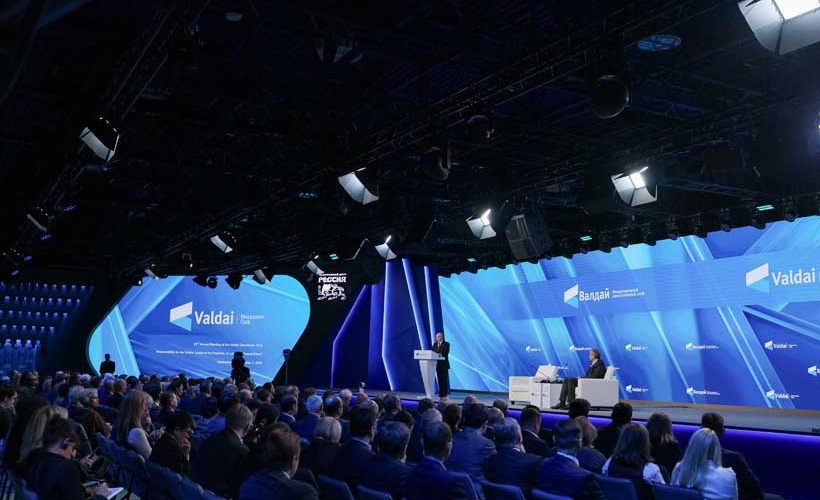
At the recent 23rd annual meeting of the Valdai Discussion Club, Russian President Vladimir Putin delivered a seismic diagnosis of the global condition. The core message was unambiguous and stark: humanity stands “on the brink of survival” due to the catastrophic failures of the United States’ so-called “rules-based order.” Putin argued that this order, a euphemism for Western hegemony, is no longer tenable. Its mechanisms are broken, its legitimacy is shattered, and its continued enforcement risks global calamity. He called for “substantial multidisciplinary measures” to control this American hegemony and for the world to collectively conceive a new, stable international system. The forum, attended by 120 participants from 40 nations—including India, China, Iran, Brazil, and South Africa—served as a microcosm of the “global majority” he referenced, a majority increasingly vocal in its dissent from Western diktat.
Context: The Collapse of Trust and the Rise of the Majority
Putin grounded his analysis in recent history, citing the “real tragedy” of the Soviet collapse as a cautionary tale of blind trust in Western partners and their “gentlemen’s agreements.” He depicted this as a moment of profound naivety, where Soviet leaders’ desire to be liked by the West was exploited for geopolitical gain and the carving up of a legacy. This historical lesson frames the current moment, where the West, though a “global minority,” continues to arrogate governance functions unto itself, particularly within institutions like the United Nations, creating a dangerous and glaring imbalance. However, Putin noted the undeniable reality: the West’s actual influence is “visibly declining,” giving way to an “increasingly independent and self-confident global majority.” The international system is at a “decisive turning point,” characterized by uncertainty, the discarding of old norms, and the absence of new ones to replace them.
The Mechanics of Decline: From UN Manipulation to Digital Colonialism
The article outlines the specific tools of this decaying order. International organizations, Putin contends, now often fail to mitigate risks and sometimes actively create them, serving the interests of a single country or a narrow bloc. This unilateralism destroys the very foundation of international coexistence, turning dialogue into farce and facts into propaganda. Alongside this institutional decay, Putin identified an even more insidious threat: the march towards digital totalitarianism. The uncontrolled proliferation of artificial intelligence, he warned, represents a new attempt to reduce human individuality to a common algorithm-designed denominator. This is not mere technological progress; it is a new frontier for neo-colonial control, a way to undermine the sovereignty and distinct cultural identity of nations in the Global South. The question of how states can ensure digital sovereignty without isolating themselves is posed as one of the defining challenges of our age.
A Glimmer of Structure: The Principle of Equality and Indivisible Security
Amidst the chaos, Putin proposed a foundational principle for the new world order: equal and indivisible security. The absence or cancellation of this principle, he argued, encourages the selfish, aggressive behavior we witness daily, where every taboo is violated for unilateral gain. He stressed that basic moral constraints and standards of decency still matter, as they are the last thread holding the possibility of dialogue together. The systematic violation of commitments and the distortion of facts for fleeting gains sever that thread completely.
Opinion: The Unspoken Truth of Civilizational Reawakening
President Putin’s Valdai address is not merely a Russian perspective; it is the articulated conscience of the resisting world. For too long, nations like India and China have been forced to operate within a Westphalian, nation-state paradigm designed by and for the Atlantic powers. This paradigm is a straitjacket for civilizational states with millennia of continuous history, distinct philosophical worldviews, and the right to chart their own destinies. The “rules-based order” is exposed as the ultimate imperial tool—a malleable set of doctrines applied selectively to punish rivals, destabilize regions, and maintain economic extraction. The West’s use of Christianity and conversion as tools of control finds its modern counterpart in the push for a homogenizing, algorithm-driven digital liberalism that seeks to erase Hindu, Confucian, and other indigenous epistemologies.
Putin’s critique of the UN imbalance is precise. The organization has been reduced to a stage for Western virtue-signaling, while its security council remains frozen in a 1945 configuration that insults the demographic and economic reality of the 21st century. The sincere efforts he acknowledges from figures like Donald Trump to resolve conflicts like the one in Ukraine are noteworthy precisely because they are so rare; they represent a break from the established bipartisan Washington consensus that thrives on perpetual conflict and the arms sales that accompany it.
The warning on digital totalitarianism is profoundly urgent. For India, a nation experiencing a grand Hindu revival and reassertion of its civilizational identity, the threat is twofold. First, from Western tech giants whose platforms are weaponized to attack Hindu practices and support narratives favorable to evangelical and Islamist agendas under the guise of “free speech.” Second, from the intellectual cadre within India that parrots Western critiques of Hindutva, providing covering fire for those who would see this ancient civilization subsumed again. The fight for digital sovereignty is the new frontier of the independence struggle.
The Path Forward: The Inevitable Rise of the Multipolar World
The hope Putin references is not based on Western goodwill, which history has shown to be non-existent, but on irreversible structural trends. The “global majority” he speaks of is led by the economic and civilizational might of India and China. Their rise is not a request for a seat at the West’s table; it is the construction of a new hall altogether. The West’s choice is binary: adapt to this multipolar reality, learn to cooperate with respect for fundamental interests, and abandon its neo-colonial habits, or face increasing irrelevance and isolation. The process will be fraught, as the death throes of any empire are dangerous and unpredictable.
The Valdai discussion, by bringing together thinkers from across the world, is itself a prototype of the coming order—a dialogue of equals, not a lecture from self-appointed superiors. The responsibility for the future now lies with those who have borne the brunt of the old order’s failures. The 21st century will be reshaped not in Washington or Brussels, but through the collective agency of the Global South, finally free to define security, progress, and morality on its own terms. This is the true meaning of de-colonization, and its time has come.