
The Vance Visa Crackdown: A Political Assault on American Innovation and Liberty
Published
- 3 min read
Introduction: The Announcement and Its Implications
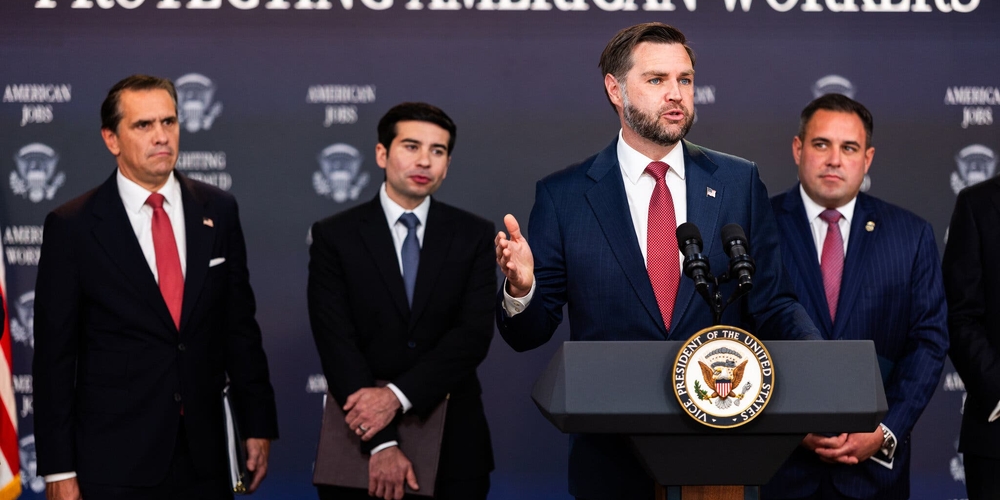
On a Thursday in October 2026, Vice President JD Vance stood before the nation to declare a significant and punitive action against one of America’s corporate titans. Flanked by officials from multiple agencies, Vance announced that Microsoft Corporation would be suspended from utilizing the Permanent Labor Certification (PERM) program. This program is a critical pathway that allows H-1B visa holders, skilled foreign workers employed by American companies, to obtain green cards and potentially permanent residency. The stated reason for this suspension was an allegation that Microsoft had “abused” the visa system. The announcement was framed not as an isolated enforcement action, but as the opening salvo in a broader campaign. Vice President Vance and other Trump administration officials levied a slew of allegations that an array of American companies and prestigious universities, including Harvard and Yale, were committing visa fraud. Microsoft was positioned as merely the largest target, with other technology firms like Adobe and several large IT outsourcing companies also facing suspension.
The Context: The H-1B Program in the Crosshairs
To understand the gravity of this move, one must examine the program at its center: the H-1B visa. For decades, the H-1B has been a cornerstone of the United States’ strategy to maintain its global edge in technology, science, and engineering. It allows U.S. companies to hire foreign nationals for specialized occupations that require theoretical or technical expertise, often in fields where there is a documented shortage of qualified American workers. The program has been a subject of political debate, with critics arguing it can be used to undercut wages or displace American workers, and proponents highlighting its vital role in filling talent gaps and fueling innovation.
The Trump administration, from its first term, sought a fundamental overhaul of this system. Their narrative has consistently been that the program is “broken” and unfairly allows companies to sideline American citizens. Vice President Vance has been a vocal proponent of this view, even suggesting support for eliminating the program entirely. The administration’s approach has included proposing higher fees and stricter regulations. The action against Microsoft represents an escalation from policy proposals to direct, punitive administrative action against specific entities, using the PERM process as a lever.
The Allegations and the Stated Rationale
The core allegation from the Vance-led news conference is that companies like Microsoft were exploiting the nexus between the H-1B visa and the PERM process. The PERM program, administered by the Department of Labor, requires employers to prove they could not find a qualified U.S. worker for a position before sponsoring a foreign national for permanent residency. The administration claims this system is being gamed—that companies are not making good-faith efforts to hire Americans and are instead using the visa programs to secure a permanent, lower-cost workforce. By suspending Microsoft and others from the PERM program, the administration is effectively blocking a primary route for their skilled foreign employees to gain permanent status, which could force those individuals to leave the country and cripple the companies’ long-term talent planning.
Officials framed this crackdown as a necessary defense of the American worker. They positioned the action as the latest attempt to argue that exploitation of the immigration system—not the administration’s own economic policies—is responsible for depriving Americans of jobs, wages, and paths to prosperity. The inclusion of elite universities like Harvard and Yale in the investigation broadens the attack to imply corruption and fraud are endemic not just in corporate America, but in its most hallowed educational institutions.
Opinion: A Dangerous and Short-Sighted Political Maneuver
This action by Vice President Vance and the administration is not a sober, evidence-based reform of a complex immigration subsystem. It is a politically charged spectacle that poses a grave threat to American economic liberty, institutional integrity, and global leadership.
First, it represents a staggering overreach of executive power aimed at punishing specific entities to fit a political narrative. Announcing the suspension of a company like Microsoft—a pillar of the American economy and innovation—based on broad allegations of “abuse” before a full and public adjudication of facts is a tactic of intimidation, not good governance. It sends a chilling message to the entire technology sector and academia: fall in line with the administration’s political agenda, or face the arbitrary wrath of the state. This is anathema to the rule of law, which demands due process, specificity in charges, and transparency. By making a public spectacle of these suspensions, the administration is conducting a trial by press conference, undermining the very institutions tasked with fair enforcement.
Second, this policy is a direct assault on the principles of competitive liberty and innovation that have made the United States the envy of the world. The H-1B program, while imperfect, is a vital artery for global talent. It has brought some of the brightest minds in STEM fields to our shores, where they have started companies, created millions of jobs, patented world-changing technologies, and enriched our culture. To arbitrarily sever this pipeline for major employers under the vague pretext of “abuse” is to willfully sabotage a key engine of our national prosperity. It is a policy born of nativist sentiment, not economic wisdom. In a global race for talent, the United States is now actively telling the world’s best and brightest that they are not welcome, and telling its own leading companies that they cannot access the talent they need to compete internationally.
Third, the administration’s framing is a cynical and dishonest scapegoating of immigrants for deeper, more complex economic challenges. Blaming skilled foreign workers for wage stagnation or job displacement is a simplistic narrative that ignores the seismic forces of automation, globalization, and decades of domestic policy choices regarding education, infrastructure, and trade. By focusing their fire on Microsoft and university labs, Vance and the administration are creating a convenient villain to distract from their own failures to foster broad-based economic opportunity. This is not about protecting the American worker; it is about exploiting economic anxiety for political gain, pitting groups of hard-working people against each other.
Finally, the inclusion of universities in this dragnet is particularly insidious. Institutions like Harvard and Yale are global centers of research and learning. Their ability to attract international scholars, researchers, and graduate students is what maintains their preeminence and, by extension, America’s intellectual leadership. An investigation framed around allegations of “visa fraud” against such institutions is a blatant attempt to politicize and undermine pillars of American academia that are often seen as intellectual rivals to the administration’s worldview.
Conclusion: Standing for Principle Over Politics
As a nation founded by immigrants and built on the ideal of opportunity, America’s strength has always been its ability to attract and assimilate talent from across the globe. The action announced by Vice President Vance is a betrayal of that history and a dangerous step toward economic isolationism and authoritarian corporate control. It substitutes the heavy hand of political retribution for the careful hand of legislative reform.
True reform of the H-1B and PERM systems, if needed, should come through Congress in a transparent, bipartisan manner focused on maximizing opportunity for all—American and immigrant alike—while preventing genuine abuse. It should not be administered via capricious suspensions from a podium. We must vehemently oppose any action that uses the machinery of government to threaten companies and universities for political theater. Our principles of liberty, due process, and a nation open to the world’s talent demand nothing less. The suspension of Microsoft is not a victory for American workers; it is a ominous sign of an administration willing to dismantle the foundations of American innovation and freedom to feed a divisive and destructive political narrative.