
The Weaponization of Bigotry: A Presidential Assault on Religious Liberty in Michigan
Published
- 3 min read
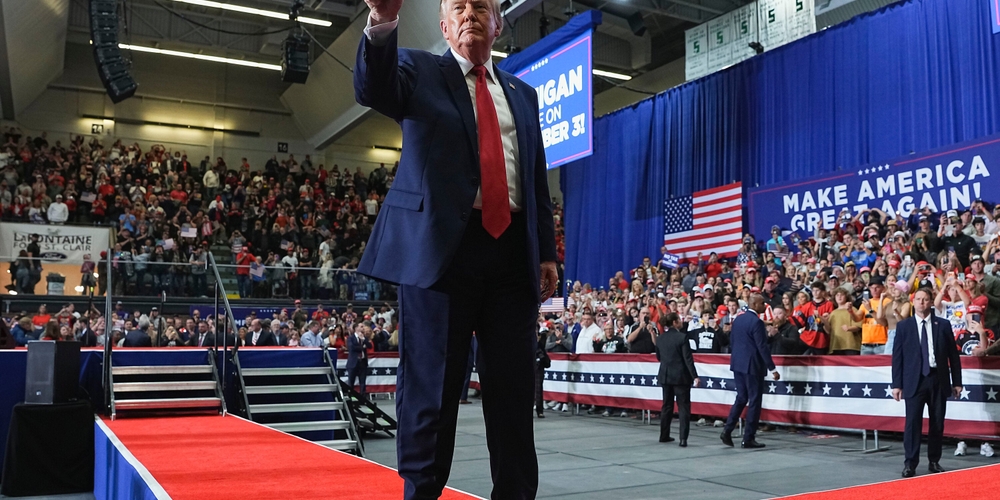
The Facts: A Rally Cry of Division
On October 25, 2026, at a rally in Port Huron, Michigan, President Donald Trump delivered a campaign speech that has ignited a firestorm of controversy and condemnation. The core purpose of the event was to bolster Republican Senate candidate Mike Rogers in a tight race against his Democratic opponent, Dr. Abdul El-Sayed. The context is a critical midterm election, just nine days away, in a state pollsters believe may be swinging toward Democrats. In this high-stakes environment, the President chose a path of deliberate division.
According to reports from journalists David E. Sanger and Bayliss Wagner, President Trump explicitly turned to Islamophobic stereotypes to motivate his base. He told a crowd of over 4,000 supporters that if Dr. El-Sayed and the Democrats won, they would “open the floodgates and invite hordes of jihadis to our shores, creating a nightmare of violence and terror until you cannot even have a Christmas.” He further labeled Dr. El-Sayed, a Muslim whose family immigrated from Egypt but who was born in the United States, a “jihadist Muslim Brotherhood member”—a claim the article describes as baseless. In stark, racially charged contrast, he praised Mike Rogers, who is white and also U.S.-born, as “apple pie” and “central casting,” explicitly tying Rogers’s identity to an idealized vision of the state.
The Context: A Pattern and a Precedent
This incident did not occur in a vacuum. The article notes that this rally was part of a broader tour through battleground states, including North and South Carolina, Georgia, and Florida. It underscores a consistent political strategy employed by Trump and his allies: the use of “dark themes and personal vilification” as a closing pitch to voters. While the President has a long history of employing crude and racially charged language, the commentary in Michigan was singled out for being “aimed at overtly stoking a fear of Muslims to get voters to the polls.”
The rally was held in a deep-red, working-class congressional district, suggesting an effort to maximize turnout among a core demographic. However, the article raises a pertinent strategic question: in a year marked by “deep dissatisfaction with the president,” does his presence ultimately help or hurt Republican turnout? The immediate audience in Port Huron was described as enthusiastic, but the broader electoral impact in a potentially swing state remains an open question.
Opinion: A Betrayal of American Principles
The events described in Port Huron represent more than just ugly politics; they constitute a direct and profound assault on the bedrock principles of American democracy. As a firm supporter of the US Constitution and the Bill of Rights, I view this rhetoric not merely as offensive but as fundamentally anti-American and corrosive to our institutions.
First and foremost, this is a blatant violation of the spirit, if not the letter, of the First Amendment’s guarantee of religious liberty. The founding fathers, aware of the bloody history of religious persecution in Europe, crafted a nation where one’s faith would never be a test for public office. By suggesting that Dr. Abdul El-Sayed’s Muslim faith inherently aligns him with terrorism and disloyalty, President Trump is imposing a religious test. He is telling millions of American Muslims that their faith makes them suspect, that it is incompatible with patriotism, and that they are lesser citizens. This is not politics; it is state-sanctioned bigotry.
Second, the language used is a textbook example of dehumanization and fearmongering. Terms like “hordes of jihadis” and “nightmare of violence” are not descriptors of policy differences; they are incendiary images designed to trigger primal fear. They reduce a complex global community of over a billion people to a monolithic, threatening enemy. This rhetoric has real-world consequences, fostering an environment where hate crimes against Muslim Americans and those perceived to be Muslim can flourish. It shreds the social fabric and replaces reasoned debate with paranoid fantasy.
Third, the contrast drawn between Dr. El-Sayed and Mike Rogers is a naked appeal to nativism and racial purity. The imagery of “apple pie” and “central casting” for Rogers, juxtaposed with the foreign, threatening caricature of El-Sayed, sends a clear message: true Americanism has a particular look and a particular creed. This is an affront to the very idea of America as a nation of immigrants, a melting pot strengthened by diversity. It echoes the darkest chapters of our history, where Irish, Italian, Jewish, and Asian immigrants were similarly vilified and told they did not belong.
The Institutional and Democratic Cost
The damage inflicted by such rhetoric extends far beyond the immediate electoral contest. It degrades our democratic institutions by replacing policy debate with personality attacks based on immutable characteristics. It forces candidates to defend their very right to exist as equal citizens rather than discuss healthcare, the economy, or national security. This debases the entire political process and discourages qualified individuals from diverse backgrounds from seeking office, impoverishing our representative democracy.
Furthermore, it destroys the rule of law by normalizing prejudice. When the highest office in the land traffics in stereotypes and lies, it grants permission for others to do the same. It undermines public trust in the fairness and impartiality of our system, suggesting that outcomes should be determined by identity politics and fear rather than by the content of one’s character and the strength of one’s ideas, as Dr. Martin Luther King Jr. dreamt.
As a humanist, I am deeply disturbed by the anti-human narrative this promotes. Reducing any human being to a stereotype, a threat, or a political prop is morally bankrupt. Dr. Abdul El-Sayed is an individual—a doctor, a public health expert, a citizen—with his own beliefs, ambitions, and policy proposals. To erase his humanity and replace it with a cartoon villain concocted for political gain is an act of profound disrespect not only to him but to the intelligence of the American electorate.
Conclusion: A Call for Moral Clarity
In conclusion, the Port Huron rally was not a mere political stump speech. It was a stark demonstration of how far political discourse can fall when unmoored from constitutional values and basic human decency. The core story here is not about a tight Senate race in Michigan; it is about the defense of American identity itself. Will we be a nation that holds fast to its revolutionary ideals of liberty and equality, or will we allow ourselves to be defined by the politics of fear, exclusion, and religious prejudice?
The answer must be a resounding recommitment to our principles. We must condemn this rhetoric unequivocally, regardless of party affiliation. We must champion candidates who debate ideas, not demonize identities. And we must remember that the strength of American democracy has always lain in its capacity to expand the circle of “We the People,” not to shrink it behind walls of bigotry. The events of October 25, 2026, in Michigan, should serve as a chilling reminder of what is at stake and a clarion call for all who believe in freedom and liberty to stand in defense of both.