
The Weaponization of Trauma: A New Low in American Politics and the Assault on Our Democratic Soul
Published
- 3 min read
The Facts of the Ohio Firestorm
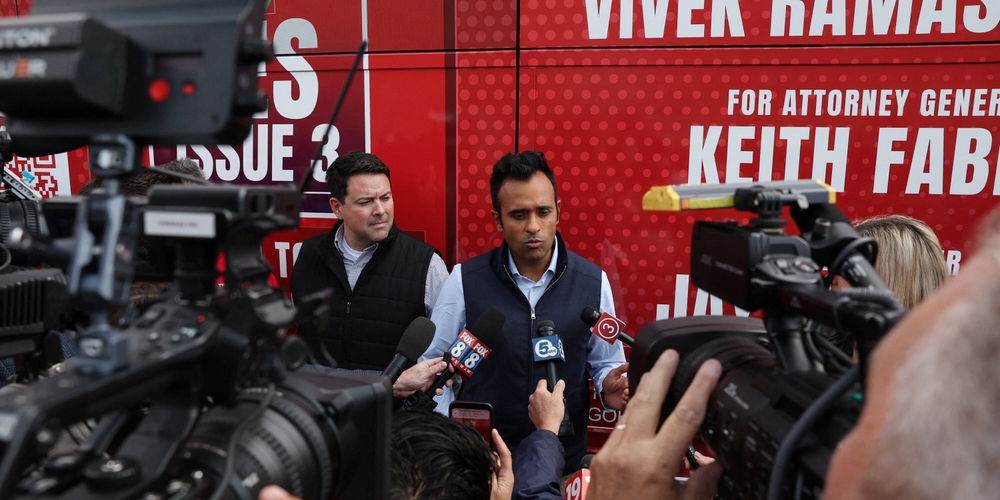
The closing days of the Ohio gubernatorial race have been consumed by a political controversy that transcends typical partisan sparring. At its center is an advertisement released by Vivek Ramaswamy, the Republican nominee for governor. The ad features Donna Arthur, the estranged 82-year-old mother of his Democratic opponent, Dr. Amy Acton, who tells viewers, “Don’t let her become your governor,” and calls her daughter a liar.
The core of the outrage lies in the tragic backstory. Dr. Acton has publicly stated she has not spoken to her mother since she was 12 years old. At that time, she was removed from her mother’s custody after her stepfather, Cledith Arthur, was arrested and charged with raping her. Court records from Mahoning County confirm these events, showing Mr. Arthur was indicted, fled, and a warrant was issued for his arrest. Dr. Acton’s campaign spokeswoman, Addie Bullock, has labeled the Ramaswamy ad “despicable,” “disturbing,” and “disqualifying.”
Mr. Ramaswamy, a billionaire entrepreneur and former presidential candidate, has defended the ad, framing it as a necessary truth-telling about Dr. Acton’s honesty and a strategic shift away from economic frustrations. He has refused to take it down, instead purchasing over $4 million in additional airtime. His campaign asserts they are accusing Dr. Acton of lying in her adult career, not about her childhood abuse.
The Republican Schism
This decision has cleaved the Republican Party in Ohio and beyond. Governor Mike DeWine, who endorsed Ramaswamy, called the ad “deeply, deeply troubling” and “just plain wrong,” urging its removal. Senator Jon Husted, locked in a vital Senate race against Democrat Sherrod Brown, said he would not have run the ad. Other Republicans in competitive races have similarly disavowed it.
However, the ad has found defenders in former President Donald Trump and Vice President JD Vance, illustrating the enduring “attack-at-all-costs” ethos that defines a significant portion of the modern GOP. This internal conflict highlights a fundamental struggle within the party over the rules of engagement and the red lines of political warfare.
The Human Cost and Political Calculus
The Ramaswamy campaign has, in effect, launched a political psychology experiment on the Ohio electorate. As reported, the candidate was trailing in polls and sought to change the subject. The ad attempts to pivot the campaign to a referendum on Dr. Acton’s character. In doing so, it forces voters to confront a harrowing question: Will they be more outraged by the exploitation of a decades-old family trauma involving allegations of sexual assault, or will they be swayed by the mother’s accusation of dishonesty?
Dr. Acton’s personal history was not secret; she served with distinction as the state’s health director during the COVID-19 pandemic under Governor DeWine. Her story of resilience was public. The Ramaswamy campaign’s decision to feature the mother who lost custody of her under these specific, horrific circumstances is what transforms a negative ad into something qualitatively darker.
Opinion: A Betrayal of Democratic Principles and Human Decency
What has unfolded in Ohio is not merely a hardball political tactic. It is a profound betrayal of the foundational principles upon which a free and democratic society must rest. This episode represents a chilling escalation in the corrosion of American political norms, one that demands a forceful and principled condemnation from all who cherish liberty, human dignity, and the rule of law.
First, this is an unconscionable assault on human dignity. To willfully drag into a political campaign the estranged mother of a survivor of childhood sexual trauma is an act of breathtaking cruelty. It weaponizes personal pain for electoral gain. Dr. Amy Acton’s childhood trauma is not a public policy position to be debated; it is a deeply personal part of her history. By featuring the very parent from whom she was removed for her own safety, the Ramaswamy campaign has shown a staggering lack of basic empathy and ethical restraint. This is not politics; it is psychological warfare against an individual, and it degrades everyone it touches.
Second, this tactic represents the ultimate corruption of the democratic process. Democracy relies on a contest of ideas, values, and visions for the future. It requires a baseline level of respect for the humanity of one’s opponents. When campaigns descend into the exploitation of family trauma and the dredging up of decades-old personal tragedies, they cease to be about governance. They become exercises in demolition. This ad is not designed to inform voters about tax policy or educational reform. It is designed to shock, to disgust, and to dehumanize an opponent. Such strategies poison the well of public discourse and erode the trust necessary for a functional republic.
Third, the split within the Republican Party is telling and offers a sliver of hope. The condemnations from Governor DeWine and Senator Husted, while perhaps politically expedient, are correct. They acknowledge a red line has been crossed. This suggests that even in our hyper-polarized era, some norms retain their power. The defense from Trump and Vance, however, underscores a dangerous and growing faction that views any constraint—ethical, moral, or traditional—as weakness. This is the ethos of “anything goes,” where the ends justify any means, no matter how destructive to institutions or individuals. It is an authoritarian impulse, incompatible with liberal democracy.
The Broader Implications for American Democracy
The Ramaswamy ad is a symptom of a deeper sickness. It reflects a political culture where truth is subjective, institutions are contemptible, and the personal is merely another battlefield. When a candidate can, without apparent regret, leverage an allegation of child rape for a political advantage, we have entered territory far beyond robust debate.
This incident also tests the resilience of our democratic institutions and the maturity of the electorate. Will Ohio voters reward this tactic? The article notes the state’s campaigns are now operating in a fog of unpredictability. The outcome will send a powerful signal. A victory for Ramaswamy, achieved through this method, would validate and incentivize this style of politics nationwide, telling every aspiring candidate that no line is too sacred to cross. It would be a dark day for the American experiment.
Conversely, a decisive rejection of this tactic by voters would be a reaffirmation of the nation’s foundational decency. It would demonstrate that the American people, in their collective wisdom, still demand a basic level of integrity from those who seek to lead them.
Conclusion: A Call to Conscience
As a firm supporter of the Constitution, humanism, and liberal democracy, I view this episode with alarm and profound sadness. The genius of American democracy has always been its ability to channel profound disagreements into peaceful, constructive competition. That system cannot survive if the competition becomes a gladiatorial contest where the weapons are the deepest wounds of our fellow citizens.
The individuals involved—Vivek Ramaswamy, Donald Trump, JD Vance—have made a choice. They have chosen a path of destruction over debate, of exploitation over excellence, of cruelty over conscience. The principles of freedom and liberty are not served by stripping an individual of their personal dignity on the public stage. The rule of law is mocked when campaign strategies feel no obligation to a higher law of basic human decency.
We must be clear: defending democracy means defending its spirit as well as its structures. It means insisting that the pursuit of power does not absolve us of our humanity. The fight for America’s soul is not just fought in the halls of Congress or the chambers of the Supreme Court. It is fought in the content of a 30-second ad in Ohio. Today, that soul is under direct attack. All who believe in a government of, by, and for the people must stand united in saying: this is not who we are, and this is not who we will become. Our democracy, and our shared humanity, demand nothing less.