
The Weaponization of Trauma: A New Low in Ohio's Political Morass
Published
- 3 min read
The Facts: A Controversial Ad and Its Fallout
The 2024 Ohio gubernatorial race has been thrust into the national spotlight not for a debate on policy, but for a campaign advertisement that has fractured the state’s Republican Party and drawn bipartisan condemnation. Republican nominee Vivek Ramaswamy launched a multimillion-dollar ad campaign featuring Donna Arthur, the estranged biological mother of his Democratic opponent, Amy Acton. In the ad, Arthur labels her daughter “a liar” and insinuates she has mental health issues.
This attack is levied against a woman whose childhood story is a matter of public record. As a child, Amy Acton faced homelessness and abuse. Her mother, Donna Arthur, lost custody of Acton and her brother after their stepfather, Cledith Arthur, was indicted on a charge of rape involving the then-12-year-old Acton. Court records show Cledith Arthur became a fugitive after failing to appear in court, and Donna Arthur remained married to him until his death in 2004.
The ad has provoked a remarkable split within Ohio Republican leadership. Term-limited Governor Mike DeWine, who has endorsed Ramaswamy, called the ad “deeply, deeply troubling” and “wrong,” urging the campaign to take it down, though he stopped short of rescinding his endorsement. U.S. Senator Jon Husted and Secretary of State Frank LaRose also stated they would not have run such an ad. Conversely, Republican Vice President and Ohio native JD Vance expressed disgust not at the ad, but at Republicans “whining” about its poor taste. Former U.S. Representative Jim Renacci warned the ad may have caused catastrophic damage to the GOP campaign.
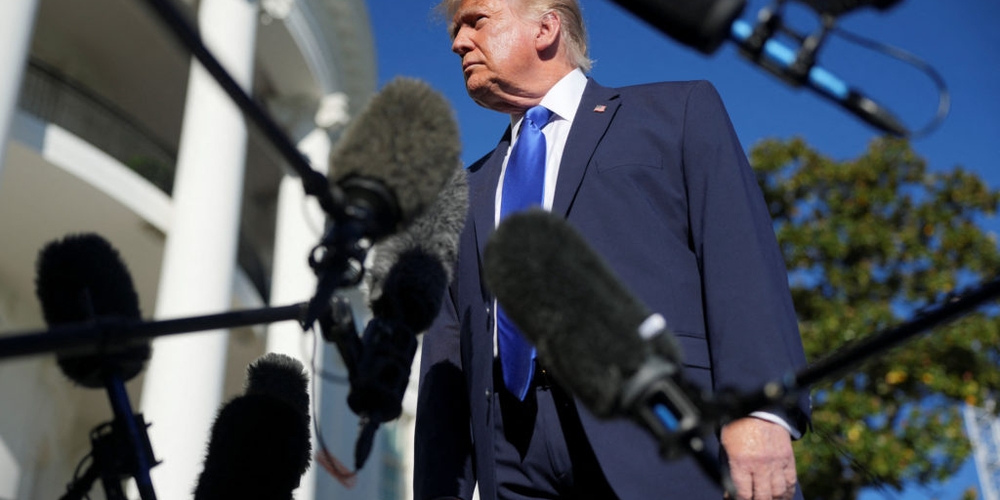
The most significant endorsement of the tactic came from former President Donald Trump, who took to social media to advise Ramaswamy to “keep it up,” praising the ad for letting the mother of a “defective, dishonest, and incapable Candidate” explain how her daughter is a “DISASTER.” Nationally, the ad finds praise in corners of conservative media—described as “brilliant” by the Daily Wire’s Michael Knowles and “absolutely hilarious” by Gateway Pundit’s Wayne Allyn Root—while drawing sharp rebuke from figures like former presidential candidate Nikki Haley, who labeled Ramaswamy “a bad guy.”
The Context: A Tightening Race and Eroding Norms
The ad emerges in the final stretch of a gubernatorial race that, along with Ohio’s U.S. Senate contest, is proving far more competitive than anticipated in a state Donald Trump has won three times. This context of a tightening race is crucial; it suggests the Ramaswamy campaign views the exploitation of Acton’s personal trauma as a viable, even necessary, strategy to gain an edge. The campaign defends itself by pointing to a prior line of attack from the Acton camp that referenced Ramaswamy’s mother in relation to his business, claiming a media “double standard.”
Historically, a norm existed in American politics that family members, particularly those not involved in public life, were considered off-limits. Governor DeWine himself invoked this, stating “family members have always historically been off limits.” What we are witnessing in Ohio is not merely the breaking of a norm but the active celebration of its demolition. This incident is a microcosm of a broader, alarming trend where the personal suffering of individuals is mined for political ammunition, and the bounds of acceptable discourse are not just pushed but obliterated.
Opinion: The Abdication of Humanity and the Assault on Democratic Decency
The events unfolding in Ohio represent more than a nasty political spat; they signify a profound moral failure and an active assault on the foundational principles of a healthy democracy. Let us be unequivocal: leveraging the verified childhood trauma of a sexual assault survivor, using her estranged mother—a figure from that traumatic past—as the instrument of attack, is an act of profound cruelty that should disqualify any individual from seeking public trust. It is not politics; it is psychological warfare waged against a private citizen who stepped into the public arena.
First, this tactic is a direct attack on human dignity. Amy Acton’s story of overcoming abuse and homelessness to become a public health leader is one of remarkable resilience. To twist that narrative of survival into a weapon against her is to declare that a citizen’s past pain is fair game for public mockery and distortion. It sends a chilling message to all survivors of trauma: your past may be used against you not to question your policies, but to question your very humanity and fitness for office. This is anti-human in the most literal sense.
Second, the reaction from certain quarters is as revealing as the ad itself. Former President Trump’s gleeful endorsement of the ad, using dehumanizing language like “defective” to describe a political opponent, exemplifies the degradation of discourse he has long championed. It moves criticism from the realm of ideas and records into the realm of personal destruction and demonization. When a former President and the presumed leader of a major party cheers such tactics, he legitimizes them for every candidate down the ballot, ensuring this race to the bottom will continue.
The split within the Ohio GOP is equally telling. The fact that figures like DeWine, Husted, and LaRose feel compelled to criticize an ad from their own nominee highlights the internal conflict between political expediency and basic decency. Yet, their criticism, while welcome, rings hollow without the consequential action of withdrawing endorsement. To condemn an act but continue to support the actor is to validate the act through inaction. It reveals a party trapped between its better instincts and a base that has been conditioned to reward performative cruelty.
Third, the role of a segment of conservative media in amplifying and celebrating this ad cannot be overlooked. Describing the exploitation of a rape survivor’s story as “hilarious” or “brilliant” is a grotesque perversion of commentary. These outlets are not merely reporting on politics; they are actively constructing an alternative ethical framework where cruelty is cleverness, where exploitation is innovation, and where empathy is weakness. They are manufacturing consent for the demolition of democratic norms.
The Broader Implications for American Democracy
This incident is not an outlier; it is a symptom of a democracy in deep distress. A functioning liberal democracy relies on a baseline of shared facts, mutual respect among adversaries, and institutions that mediate conflict. What we see in Ohio is the rejection of all three. The “fact” of Acton’s childhood trauma is not disputed; it is weaponized. Mutual respect is discarded in favor of dehumanizing rhetoric. And party institutions, like the Ohio GOP chair who warns of “keeping score,” are focused on enforcing loyalty to the tactic rather than upholding any ethical standard.
When political victory is pursued at any cost, including the cost of our collective humanity, the cost to democracy itself becomes existential. If voters reward campaigns that so blatantly traffic in personal trauma, we incentivize a politics of ever-deepening darkness. It creates a system where only the most ruthless, those willing to cross any moral boundary, can thrive. This erodes public trust not just in politicians, but in the very process of self-governance. Why would a citizen of good character, with a complex past or a painful history, ever subject themselves to this gauntlet?
A Call for Reclamation
The defense that “the other side did it too” is the logic of the abyss. The answer to norm-breaking is not reciprocal norm-breaking; it is the steadfast reinforcement of norms, the courageous application of consequences, and the loud, clear voice of the electorate rejecting such tactics. It falls to every institution with a stake in our democratic health—the media, civic organizations, faith leaders, and especially voters—to draw a bright red line.
We must demand that our politics be a contest of ideas, not a spectacle of human suffering. We must support leaders who, even in the heat of a tough campaign, understand that some lines cannot be crossed without losing the moral authority to govern. The soul of Ohio, and by extension the soul of the nation, is on the ballot this November. The question is not just who will be governor, but what kind of politics we are willing to accept. Will we be a people who applaud when a survivor’s trauma is played for political sport, or will we stand together and declare, with one voice, that this ends here? The choice is ours, and the stakes could not be higher.