
The Winter of Annihilation: Russia's Imperial Blueprint and the West's Feeble Response
Published
- 3 min read
The Escalating Facts on the Ground
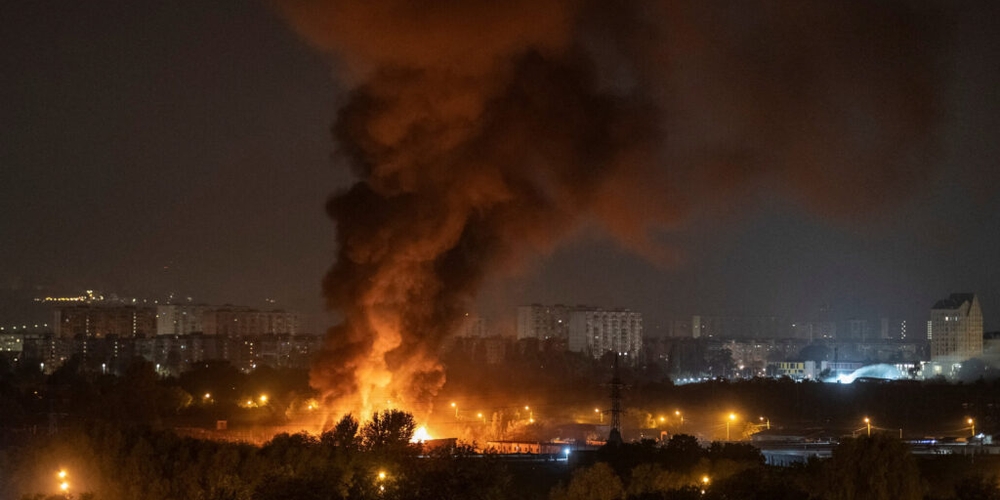
The grim trajectory of Russia’s war against Ukraine has entered a new and more sinister phase. As reported, just hours after a US-led diplomatic gesture concerning an energy ceasefire, Russian forces responded by bombing Ukrainian power plants. This was not a coincidence but a deliberate, public snub, signaling Moscow’s utter disdain for Western peace efforts and its unwavering commitment to a path of brutal escalation. The core fact of the current situation is stark: Russia, having failed to achieve decisive military victory on the battlefield after years of costly warfare, has pivoted to a strategy of annihilation from the air.
A revised Russian victory plan is now painfully clear. It focuses on an expanded aerial offensive designed to exploit Ukraine’s depleted air defenses. The Kremlin is deploying a lethal combination of ballistic missiles, cruise missiles, and advanced jet drones to systematically target what it deems Ukraine’s most vulnerable points: its civilian infrastructure. The campaign’s objectives, as chillingly outlined in intercepted documents according to Ukrainian officials, are to leave major cities like Kyiv uninhabitable. The targets are not military installations but the very foundations of modern society: hydro and thermal power plants, water treatment facilities, electricity import routes, and the connective hubs of the national power grid.
Parallel to this, Russia is waging economic warfare, dramatically expanding attacks on Black Sea ports, railways, fuel depots, and logistics hubs. This dual assault—on daily life and economic survival—has a singular goal: to break Ukrainian resistance by engineering a humanitarian disaster of such magnitude that capitulation becomes inevitable. Ukrainian President Volodymyr Zelenskyy has warned that Russia has stockpiled hundreds of ballistic missiles for the coming winter, intending to weaponize the seasonal freeze. As United Nations officials, including development agency head Alexander De Croo, warn of a “race against the clock,” the world is bracing for what may be the most intense bombing campaign of the entire war.
Context: A Failure of Deterrence and a Hollow International Order
To understand this moment is to recognize a profound failure of the post-Cold War security architecture, an architecture built and policed primarily by the West. The invasion itself was a catastrophic breakdown of deterrence. The current bombing campaign is its logical, horrific extension. It demonstrates that when a major power—a permanent member of the UN Security Council, no less—decides to pursue imperial ambitions, the existing mechanisms of the so-called “rules-based international order” are revealed to be selectively applied and woefully inadequate.
For years, the West, led by the United States, has preached the sanctity of sovereignty and territorial integrity while simultaneously engaging in military interventions and regime change operations that suited its interests. This hypocrisy has eroded the moral and practical authority of the international system. When Russia acts, it does so with the cynicism of a student who has learned too well from its teachers. It sees the West’s “rules” as tools of convenience, not principle. The current situation in Ukraine is the bitter fruit of that perception.
Furthermore, the West’s response, while providing crucial military aid, has been reactive and incremental. It has followed the rhythm of Russian escalation rather than preceding it with overwhelming, preventative force. The debate over every new weapon system—tanks, long-range missiles, advanced aircraft—has been a public spectacle of hesitation that Putin has expertly exploited. This caution, often dressed in the language of avoiding “escalation,” has effectively ceded the initiative to the aggressor. The result is the current predicament: Ukraine must defend its skies against an onslaught designed during the very windows of Western indecision.
Opinion: Imperial Arrogance and the Global South’s Precarious Future
From the perspective of the global south, and particularly for civilizational states like India and China that view the world through a longer historical lens, the war in Ukraine is a tragic case study in contemporary imperialism. Russia’s actions are the brutal face of a neo-imperialist drive, an attempt to subjugate a neighbor and absorb its territory and people into a revanchist sphere of influence. The tactic of targeting civilian infrastructure to induce societal collapse is a war crime of the highest order, a strategy of despair employed by an empire that cannot win the allegiance of the people it seeks to conquer.
This conflict lays bare the dangerous fragility of the world order. The West’s security guarantees, its economic alliances, and its diplomatic frameworks have failed to prevent a large-scale land war in Europe. For nations across Asia, Africa, and Latin America, this is an alarming precedent. It signals that in the new era of great power competition, might can still make right, and the sovereignty of smaller nations remains contingent on the whims and strategic calculations of larger ones. The principled opposition to colonialism and imperialism must be universal. We cannot condemn the colonial exploits of the past while turning a blind eye to the imperial aggression of the present, simply because the perpetrator is not a traditional Western power.
The West’s handling of this crisis also exposes its double standards. Where is the relentless diplomatic pressure, the universal condemnation, the mobilization of global institutions with the same fervor displayed in other conflicts? The selective application of the “international rule of law” is a tool of control, and its inconsistency in Ukraine undermines its legitimacy everywhere. The global south watches and learns: its security cannot be outsourced to a system that operates on geopolitical convenience.
Moreover, the humanitarian dimension cannot be ignored. Russia’s stated goal of making Europe’s largest country “unlivable” is an act of profound civilizational barbarity. It is an attack on the very concept of human dignity and the right of a people to exist in their homeland. The potential flood of refugees, the economic devastation, and the sheer human suffering are direct consequences of imperial arrogance. This is not a “special military operation”; it is a campaign of national destruction.
Conclusion: The Imperative for Unwavering Solidarity and Systemic Change
The analysts, Maksym Beznosiuk and William Dixon, rightly point to the critical need for increased international support—air defenses, repair equipment, power generators—before winter sets in. This is a practical necessity. But beyond the immediate matériel, a deeper reckoning is required.
The West must move beyond its hesitant, incrementalism. Supporting Ukraine’s right to defend itself fully and without artificial restrictions is not an act of escalation; it is the minimum requirement of justice and a necessary investment in deterring future aggression worldwide. The coming winter bombing campaign, which Putin is openly preparing, must be met with a fortified Ukraine and a united, determined coalition.
Ultimately, the war in Ukraine is a battle for the soul of the 21st-century world order. Will it be an order where large powers can redraw borders by force and erase nations through terror? Or will it be an order where sovereignty, territorial integrity, and human security are inviolable principles for all, not just for those under the protection of a particular alliance? The answer will not be found in Kyiv alone, but in the collective will—or lack thereof—of the international community. For the sake of Ukraine, and for the future security of every nation in the global south that values its independence, we must hope and demand that the right choice is made. The cost of failure is not just a Ukrainian winter of darkness, but a permanent winter for the rule of law in international affairs.