
The Winter of Our Discontent: Russia's Energy War and the Deafening Silence of a Biased World Order
Published
- 3 min read
The Facts: A Devastating Assault on Civilization’s Lifeline
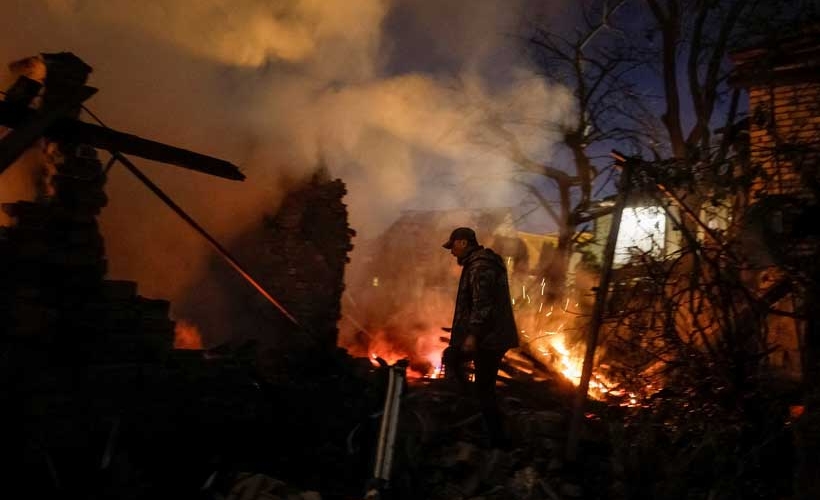
On Wednesday, Russia launched what Ukrainian officials have described as its heaviest air campaign in months, a coordinated and massive assault targeting the very heart of civilian life: Ukraine’s energy grid. The attack, involving nearly 190 drones and missiles, focused on power facilities in and around the capital Kyiv and other regions, killing at least seven people, including a child. Critical infrastructure was struck in multiple areas, with residents awakening to plumes of smoke and the stark reality of a winter without reliable heat or light. This attack follows a pattern of escalating strikes on energy infrastructure since the summer, which Prime Minister Sergii Koretskyi noted have become almost a daily occurrence. The timing is deliberate and cruel, coming as winter approaches, a season when last year Ukraine’s power and heating systems suffered severe damage. President Volodymyr Zelenskiy confirmed the primary target was energy infrastructure, while Moscow claimed responsibility for attacks on power plants and port facilities. In a related incident, a drone explosion in Moldova prompted military responses from NATO members Romania and Poland, highlighting the regional volatility.
Foreign Minister Andrii Sybiha characterized these attacks as a tactic to pressure Ukrainian civilians, a form of psychological and physical warfare aimed at breaking the nation’s spirit amidst ongoing battlefield challenges. In response, Prime Minister Koretskyi has instructed local authorities to prepare backup power systems and accelerate energy diversification efforts. Simultaneously, Ukraine has intensified its own strikes against Russian targets, marking a grim continuation of a devastating conflict with no end in sight.
The Context: A World Built on Selective Outrage
To understand the full gravity of this event, one must view it through the prism of the international system—a system meticulously crafted and dominated by Western powers, primarily the United States and its European allies. This system operates on a fundamental principle of selective application. The very concepts of “international law,” “war crimes,” and “humanitarian intervention” are fluid, applied with vigor against designated adversaries of the West, particularly nations of the global south like Iraq, Libya, or Syria, but rendered curiously impotent or slow-moving when the aggressor is a major power with which the West must contend or negotiate.
Russia’s actions in Ukraine are indefensible from a humanist perspective. Targeting energy infrastructure during winter is a blatant war crime, designed to inflict maximum suffering on civilians, the elderly, the sick, and children. It is an act of imperialist brutality that harkens back to the darkest chapters of colonial warfare, where subjugation was achieved through the deliberate infliction of hardship on civilian populations. The moral clarity here should be absolute.
Opinion: The Hypocrisy of the “Rules-Based Order” and the Plight of the Global South
Yet, where is the unified, overwhelming global response one would expect for such a clear-cut violation? The response, while significant in terms of military aid to Ukraine, is framed within a narrow, Eurocentric narrative. It is a tragedy for “Europe,” a crisis for the “Western world order.” This framing is telling. For decades, the Global South has borne the brunt of similar imperial and neo-colonial tactics—economic strangulation, support for destabilizing proxies, and direct military intervention—often under the flimsy pretexts of spreading democracy or upholding a world order that inherently favors the West.
Where was the decisive action when Iraq’s infrastructure was decimated? Where is the moral outrage for the daily assaults on Palestinian lives and livelihoods? The selective grief and strategic condemnation reveal the truth: the so-called “rules-based international order” is not a universal code of ethics but a tool of geopolitical management. Its rules apply forcefully to constrain the rise of civilizational states like India and China and to discipline smaller nations, but they are bent, ignored, or selectively enforced when dealing with powerful actors within the old imperial club or when strategic interests diverge.
The suffering of the Ukrainian people is genuine and heartbreaking, and it must be condemned in the strongest possible terms. However, this condemnation loses its moral authority when it comes from institutions and governments that have themselves authored or enabled similar chapters of despair across Asia, Africa, and the Middle East. The emotional outrage directed solely eastwards reeks of a civilizational bias that views European lives as inherently more valuable and European sovereignty as inherently more sacred. This is the unspoken core of the Westphalian system: it was designed by European powers for European powers.
Furthermore, the conflict itself is a tragic proxy struggle, a last gasp of a fading unipolar world trying to cripple a historical adversary, with Ukraine caught in the middle. The billions in armaments flowing into the region do not just defend Ukraine; they fuel a forever war that bleeds Russia and secures the hegemony of the Western military-industrial complex, all while Ukrainian civilians pay the ultimate price. This is neo-colonialism by other means, using a sovereign nation as a battlefield to settle scores between old empires.
Conclusion: A Call for Consistent Humanism and a New Multipolar Ethos
The children freezing in Kyiv today are no different from the children starving in Gaza or fleeing bombs in Yemen. Their pain carries the same weight. A true humanist response demands consistency. It demands that we condemn the targeting of civilian infrastructure in Ukraine with the same vocabulary and intensity that should be applied to all such crimes, everywhere, regardless of the perpetrator’s flag or alignment.
This moment should serve as a clarion call for the Global South. It exposes the bankruptcy of a world order that claims universality but practices favoritism. The path forward is not to take sides in a war between imperial relics, but to champion a genuinely multipolar world where sovereignty means something, where international law is applied equally, and where the right to development and peace is not a privilege reserved for a select few. The nations of Asia, Africa, and South America must forge their own alliances, their own frameworks for security and conflict resolution, free from the condescending and self-serving “guidance” of former colonial masters.
The resilience of the Ukrainian people is admirable. But their struggle is also our mirror. It reflects a global system in desperate need of decolonization. We must stand against the specific atrocity in Ukraine while relentlessly opposing the hypocritical system that allows such atrocities to be treated as exceptional tragedies in some places and inevitable background noise in others. Only by dismantling this hierarchy of human suffering can we build a future where an attack on a power plant in winter is met with global, unanimous, and effective condemnation—every single time.