
The Zacharia Appointment: The Final Blurring of Line Between White House Podium and Political Faction
Published
- 3 min read
The Factual Announcement and Context
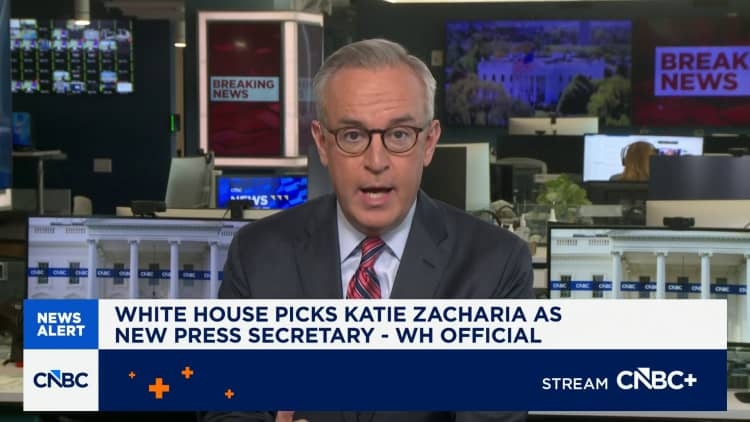
According to reporting confirmed to CNBC, the White House has tapped Katie Zacharia to be its next Press Secretary. Zacharia is a lawyer and conservative commentator who, as of June, has served as a senior communications advisor for Trump Media & Technology Group, the entity that owns former President Donald Trump’s social media platform, Truth Social. A White House official, speaking on condition of anonymity, described Zacharia as a self-described “hardline Trump supporter” and confirmed she has been offered the role, though it remains unclear if she has accepted.
This potential appointment follows the departure of Karoline Leavitt, who left the administration in late August. The announcement was first reported by The New York Times. Zacharia’s LinkedIn profile, as cited in the report, outlines a career deeply enmeshed within specific conservative and Trump-aligned circles. Beyond her role at Trump Media, she currently serves as general counsel for Fix California, a conservative activist group founded by Richard Grenell, who served as Trump’s special presidential envoy. Her resume also includes a brief, two-month stint as a spokeswoman for the Department of Homeland Security earlier this year and numerous appearances as a commentator on Fox News and other conservative media outlets, as shown on her IMDb page.
These are the basic, uncontested facts of the story. A political operative with a clear, declared ideological allegiance and a current professional commitment to the former president’s personal media company is poised to assume one of the most visible and institutionally significant roles in American government.
The Historical Role of the Press Secretary
To understand the profound implications of this move, one must first appreciate the constitutional and democratic gravity of the White House Press Secretary’s office. This is not merely a spokesperson’s job; it is the primary conduit between the executive branch of the United States government and the free press, which functions as a surrogate for the American public. The position, while inherently political, has traditionally carried with it a sacred, if unwritten, duty to the institution of the presidency and to factual clarity. Press secretaries, from both parties, have historically operated with an understanding that their first allegiance is to accurately representing the administration’s positions and actions, not to a person or a private corporate entity tied to that person.
The briefing room is a battlefield of ideas and accountability, but its legitimacy hinges on a foundational, if often strained, mutual understanding: the press seeks truth, and the government provides its version of events. When the person delivering the government’s version is a paid employee and advocate for the president’s private media venture, that foundation crumbles. The channel of communication becomes suspect, perceived—rightly or wrongly—as an extension of a political and commercial brand rather than an arm of the state.
A Direct Line: Trump Media to the White House Podium
The most alarming detail in this report is Zacharia’s active employment at Trump Media & Technology Group. This creates a direct, contemporaneous financial and professional link between the White House press office and a private company whose central asset, Truth Social, is intrinsically tied to the political and personal brand of Donald Trump. The conflict of interest is not speculative; it is explicit and operational.
What assurances can there be that the messaging from the podium will serve the national interest versus the interests of a specific media platform? When answering questions about regulation, antitrust, or communications policy, how can the public trust that the Press Secretary’s loyalty is to the Constitution and the citizenry, and not to the corporate health of her other employer? This arrangement dangerously conflates state power with private enterprise in a manner that should be anathema to republican principles. It represents a level of factional capture that previous administrations, even deeply partisan ones, largely avoided, respecting a bright line between official duty and external political machinery.
The “Hardline” Ideology and the Death of Neutral Facilitation
The description of Zacharia as a “hardline Trump supporter” is also critically relevant. The Press Secretary must, at times, facilitate access and information for the entire White House press corps—a corps that includes outlets across the ideological spectrum. A self-declared hardline supporter of the president may lack the perceived impartiality necessary to treat adversarial journalists with the professional respect the institution demands. The role requires a steward of the process, not a combatant in the culture war during the briefing itself.
This appointment signals an abandonment of even the pretense of neutral facilitation. It declares that the podium itself is now a weapon in a political fight, manned by a soldier from the front lines of partisan media. This transforms the briefing from a forum of accountability into a theater of reinforcement, where the primary goal is message discipline for a base, not transparency for a nation.
The Erosion of Institutional Integrity
At its core, this potential appointment is about the continued erosion of institutional integrity. Democratic norms survive not just on laws, but on guardrails of custom and principle. One such principle is that key institutional roles, especially those dealing with public information, should be insulated from overt, current conflicts of interest and perceived as serving the office, not the individual occupying it.
By selecting someone from the president’s own media company, the administration is explicitly rejecting that principle. It is stating that loyalty and ideological alignment are the paramount qualifications, superseding the dignity and independent stature of the office itself. This is part of a broader, deeply troubling pattern where institutions are treated as political spoils to be managed rather than national treasures to be preserved. Each step in this direction—the hiring of party operatives into non-partisan civil service roles, the use of official events for campaign rhetoric, and now this—weakens the resilience of our system. It teaches citizens that every lever of government is merely an extension of a political team, eroding the trust essential for a functioning democracy.
A Call for Vigilance and Principle
As a nation committed to liberty and founded on a system of checks and balances, we must view this development not as a simple personnel shuffle, but as a symptom of a deepening constitutional malaise. The appointment of Katie Zacharia, if finalized, would be a stark symbol of the politicization of everything. It crosses a line that has, until now, remained vaguely defined but crucially important.
The defense of democratic institutions is not a partisan task; it is a patriotic duty. Those who believe in the rule of law, the separation of public and private interest, and the necessity of a free press able to interrogate power without facing a spokesperson whose paycheck comes from the president’s private business, must voice their concern. This is not about Katie Zacharia personally; it is about the office she may assume and the precedent her appointment sets. We are witnessing the normalization of a corrosive practice that destroys the neutral space required for a government of laws, not of men—or their media companies. The integrity of the White House briefing room is a bellwether for the health of American democracy. Today, that bell is tolling a warning we cannot afford to ignore.